

Topic of the Week: Pelikan
One of an occasional series that spotlights one part of the Pentrace archive for readers who haven't explored the whole site yet.
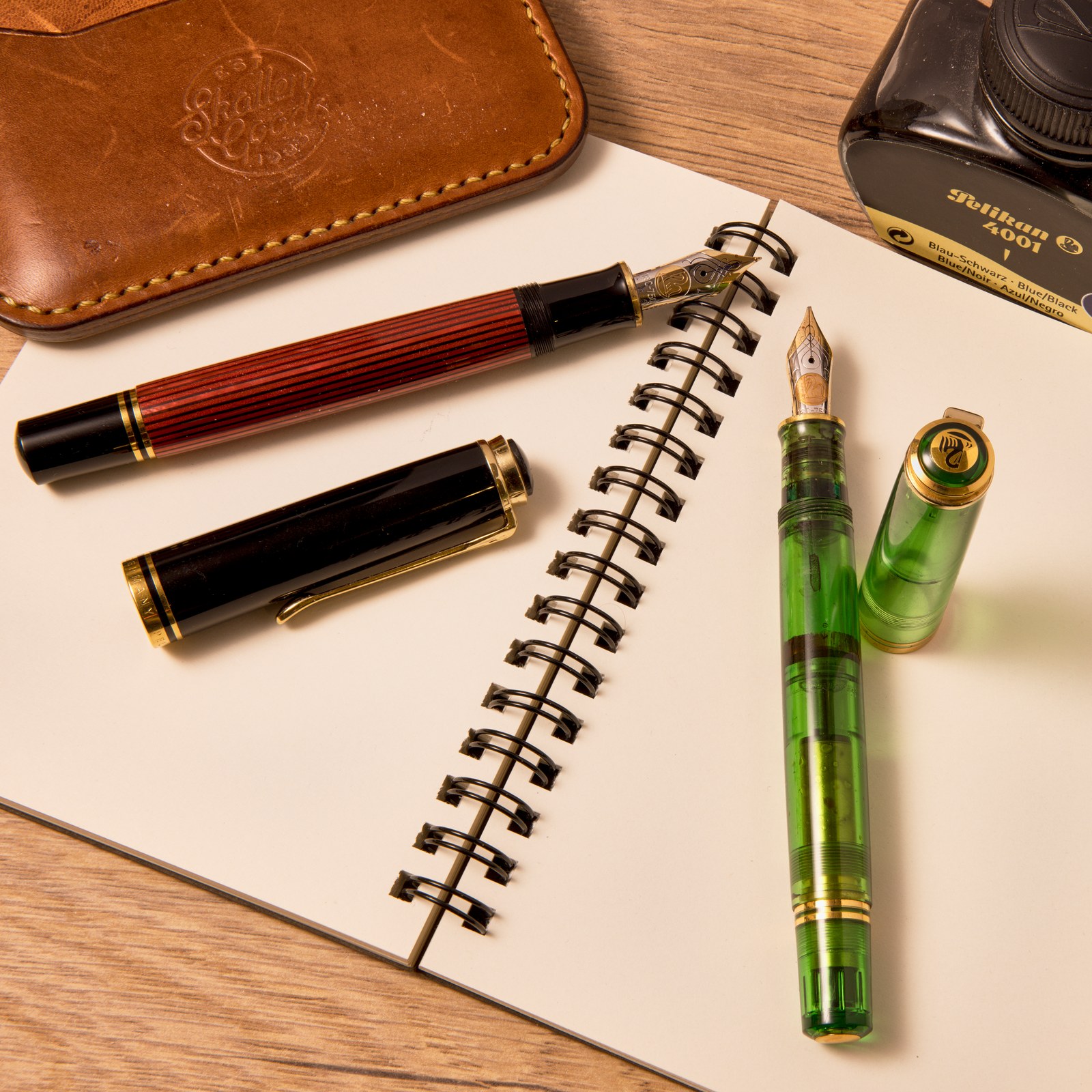
Two Souverän M800s: a Transparent Green demonstrator of 1992 (right), and a Red-Striped pen, the finish Pelikan added in 2001, bought from the nib-maker John Mottishaw at the 2002 Chicago Pen Show; he ground its medium nib to a flexible oblique and tuned it to its new owner’s hand, as Donal Higgins told in his show report. (Photo: Donal Higgins, private collection)
Pelikan made inks and artists’ colours for almost a century before it made a pen, and when the pen came, in 1929, it was a piston filler: turn the knob and the whole barrel fills with ink. The same idea runs through every Pelikan since, from the marbled 100 of the 1930s and the striped 400 of the 1950s to the Souverän M800 on many a desk today. Pentrace’s writers covered the company in depth in 2003 and 2004, led by Rick Propas’s four-part history. This week gathers that writing in one place, with a short history brought up to date and a guide to telling the eras apart.
From a colour works to a pen maker
The company began in Hanover in 1832, when the chemist Carl Hornemann opened a works making colours and ink; Pelikan itself counts from April 28, 1838, the date of its oldest surviving document. Günther Wagner arrived in 1863 as chemist and works manager and took the business over in 1871. Two years later he drew a pelican, taken from his family’s coat of arms, for a range of watercolours, and he registered it as a trademark in 1878: the bird with four chicks that still marks the oldest pens. Fritz Beindorff, who bought the firm in 1895, built it into a household name in ink, with 4001 and a long line of artists’ posters (Pelikan, Our history; Pelikan Holding, German Wikipedia).
The pen came from outside the company. The engineer Theodor Kovács had patented a piston-filling pen in the mid-1920s, and in August 1927 he gave Günther Wagner an option on it; the German patent was granted in 1928 and the American one in March 1929, the year the first Pelikan went on sale. Joshua Danley’s account of the patent on The Pelikan’s Perch, drawn from Jürgen Dittmer and Martin Lehmann’s histories, corrects the older story of an outright purchase in about 1925. The pen took the number 100 in 1931.
The history has a darker chapter that Pentrace’s earlier articles don’t touch. Fritz Beindorff was among the industrialists who signed the 1932 petition urging President Hindenburg to make Hitler chancellor; the company took over a Hanover site from the Jewish industrialist Sally Wolf under “Aryanization”; and during the war more than 2,000 forced labourers, most of them from Poland and the Soviet Union, worked at its Hanover plants. The city now marks this with an information board at Pelikanplatz (City of Hanover), and Pelikan commissioned a study of the period, Annemone Christians’s Tinte und Blech (2018).
After the war came the 400 in 1950, the Pelikano school pen in 1960, a new company name, Pelikan, in 1968, and a move of pen making to Peine-Vöhrum in 1973. Pelikan went through a court settlement with its creditors in 1982, the same year the Souverän line began with the M400; the M600 followed in 1985, the M800 in 1987 and the M1000 in 1997. The company changed hands several times after that, and since December 2023 it has belonged to the French stationery group Hamelin (Pelikan; The Pelikan’s Perch, Timeline).
Telling the eras apart
A Pelikan carries no date code, so it is dated from a handful of features, and most of them are on the cap. Nib units screw out and move freely between pens, and caps are swapped too, so read the body first and treat the cap and nib as clues to check against it.
- The cap top. The pelican with four chicks belongs to the pens of 1929 to about 1937–38. Then came a new logo with two chicks, which lasted until 2003. One chick means 2003 or later, never a vintage pen; a raised all-metal logo means 2010 or later.
- The barrel. A marbled sleeve with an ink window is a 100 or 100N, made from 1929 to 1954. Alternating clear and coloured stripes with a beak-shaped clip is the 400 family, made from 1950 to 1965: the 400, then the 400N with a rounder knob, then the longer, pointed 400NN.
- The model number. On a Souverän the first digits give the size, and the last digit gives the trim: 0 for gold (M800), 5 for silver-coloured (M805), which began in 2002.
- The cap band of a Souverän. “W.-Germany” dates it before about 1991–92, “Germany” alone from then until 1997, and “Souverän Germany” from 1997.
- The M800’s cap top. A brass medallion with the bird stamped through it means 1987 to 1997 (filled with enamel on the first pens of 1987–88); a gold two-chick logo printed on black, 1997 to 2003.
These clues come from Dating a Pelikan and the M800’s history on The Pelikan’s Perch, Dominic Rothemel’s model pages at pelikan-collectibles.com, and Rick Propas’s Decoding the Pelikan M800, which splits the M800s into three eras by their markings. The sources differ by a year here and there, so treat each date as a range.
Date your own
When Was My Pelikan Made? explains these clues in full, and ends with the Pelikan Dater: say which kind of Pelikan you have, pick what you can see on its body, cap and nib, and it gives a range of dates and checks each part against the rest. For the Red-Striped M800 above, bought in 2002, the finish alone says 2001 or later, and its cap top, the gold two-chick logo printed on black, narrows it to 2001 to 2003. Every result has a link of its own, so you can share it on the Message Board.
Looking after a Pelikan
Most Pelikans need only a little silicone grease on the piston every few years. The Pelikan’s Perch explains how to grease one without taking the piston out. That matters, because the pistons in the M200 to M600 are pressed into the barrel and can crack it if forced out, while the M800 and M1000 have a brass mechanism that unscrews (The Pelikan’s Perch, FAQ). For changing a nib safely, see the Pen Doctor below.
Start here
If you only read a few of these, start with the following:
- Pelikan History Part I
- Rick Propas on where the piston filler came from and on Pelikan’s first pens, the 1929 pen and the 100.
- Pelikan History Part IV
- The last part of Propas’s history: the lean years after 1965, the M400’s return in 1982 and the coming of the M800.
- Pelikan 100/100LE – a comparison
- Felipe Jordão sets a 1930s Pelikan 100 beside the modern reissue and explains how the piston, its cork seal and the rest of the pen are made.
- Pen Doctor: Changing Pelikan Nibs
- Richard Binder shows the safe way to unscrew a Pelikan nib, and why some M800 and M1000 nibs of the early 2000s wrote badly.
- The Pelikan 500NN Fountain Pen
- The 1950s pens up close, and which of their nibs will fit a modern Pelikan.
- Pen Doctor: Vintage Aurora Flow Trouble, Fixing a Pelikan Piston? and Nib Tines That Won’t Stay Aligned
- Why the Pen Doctor won’t take apart a modern Pelikan’s piston at home.
Every article on Pelikan
Everything in the archive on this topic, grouped by section:
History
- Pelikan History Part I
- Pelikan History Part II
- Pelikan History Part III
- Pelikan History Part IV
- Pelikan Advertising in the Air and on the Wall
Reference Pages
Pen Identification
Videos
Fiction
Review
- Pelikan 100/100LE – a comparison
- The Pelikan 500NN Fountain Pen
- The Pelikan Toledo
- Pelikan City Series: Chicago
Message Board Archive
Report
Collector Profile
Pen Doctor
- Pen Doctor: Changing Pelikan Nibs
- Pen Doctor: Vintage Aurora Flow Trouble, Fixing a Pelikan Piston? and Nib Tines That Won’t Stay Aligned
- Pen Doctor: Rattling Lever in Sheaffer Pen, Converter Interchangeability?, Pelikan Nib Skips — Easy to Fix? and Tightening a “51” Clip
Further reading
- The Pelikan’s Perch, Joshua Danley’s site, with its timeline of models and editions.
- The PENguin, Rick Propas’s site.
- Jürgen Dittmer and Martin Lehmann, Pelikan Schreibgeräte 1929–1997 and its successor, Pelikan Schreibgeräte 1929–2004, the standard histories of the pens.
- Sam Fiorella, “Pelikan 1832–1997 Pen Introduction Dates,” The PENnant, Summer 2001, Vol. XV, No. 2, p. 7.
- Andreas Lambrou, Fountain Pens of the World (Philip Wilson).
- Giorgio Dragoni and Giuseppe Fichera, Fountain Pens: History and Design (Antique Collectors’ Club, 1998).
Looking for something this list doesn't cover? Browse all pages.