

When Was My Pelikan Made?
Pelikan never stamped a date code on its pens, but almost a century of small changes can still place one within a few years. On a vintage pen the body tells you the most; on a modern Souverän, the top of the cap does. Here is what to look at, and why the nib is the last thing to trust.
 to 1937–38 four chicks
 1937–38 to 2003 two chicks
 2003 onwards one chick, never original on a vintage pen
This guide in 42 seconds: the three families, the cap top, the nib and the Souverän’s cap band. The Pelikan name and logo are trademarks of Pelikan.
A Parker of the 1940s tells you its own age: a digit and a few dots in the barrel imprint give the year and the quarter. A Pelikan doesn’t. The company used no date codes, on vintage pens or modern ones, and its production records are believed lost, since German law asks a firm to keep them for only fifteen years. What a Pelikan does have is a long run of small, dated changes: the pelican on the cap top lost two chicks in the late 1930s and another in 2003, the nib changed metal three times around the war, and the lettering on a Souverän’s cap band changed after German reunification and again in 1997. Read enough of them together and they close in on a range of a few years.
The method is the one collectors use on the Vacumatic and the Parker 51: date the body first, then check every other part against it. With a Pelikan the second step matters more than usual, because two of the most informative parts, the nib and the cap, are also the easiest to swap.
Three families
Before dating a Pelikan, decide which of three families it belongs to. Each has its own clues.
- The marbled pens, 1929 to 1954. The first Pelikan of 1929, numbered the 100 from 1931, and the larger 100N, which appeared for export in March 1937 and in Germany a year later. Both have a see-through barrel wrapped in a marbled celluloid sleeve, with a clear stretch near the nib to show the ink. The 100 stopped in 1944; the 100N ran until January 1954.
- The striped pens, 1950 to 1965. The 400, presented on May 25, 1950, with its barrel of fine alternating stripes, clear and coloured, and a clip shaped like a pelican’s beak; then the 400N of late 1955 and the longer, pointed 400NN of April 1956, made until July 1965. The cheaper 140 (1952–65) belongs here too, in plain colours as well as stripes. In 1973–78 the firm Merz & Krell made 400NNs again for Japanese shops, with the knob and section flush with the barrel.
- The Souveräns, from 1982. The M400 brought the striped piston pen back in March 1982, joined by the M600 (1985), the M800 (February 1987), the M1000 (1997) and smaller sizes. The model number is a code: the first digits give the size, and a final 5 instead of 0 means silver-coloured trim, which began in 2002.
Between 1965 and 1982 Pelikan made no striped piston pen of the 400 family, apart from the 400NNs made for Japan in 1973–78, which makes the families easy to tell apart: a pen with “Germany” on its cap band is a Souverän, and a striped pen whose band is plain or says “Pelikan 400” is from the 1950s or 1960s.
Dating a vintage Pelikan
The body
On a marbled pen, the body’s small changes are well recorded, mostly by Dominic Rothemel from Pelikan’s own circulars. The one-piece body of 1929 gave way in June 1931 to a celluloid barrel with a separate section; a metal ring appeared at the barrel’s thread in mid-1931; and the straight hard-rubber section became a waisted one in mid-1933. The see-through barrel under the sleeve was yellow until about 1937, then green. The piston knob was knurled hard rubber stamped with a turning arrow until the late 1930s, then milled and finally smooth celluloid. Red, yellow, blue and brown marbled sleeves belong to the 100 only; the 100N kept green, black, grey and tortoise.
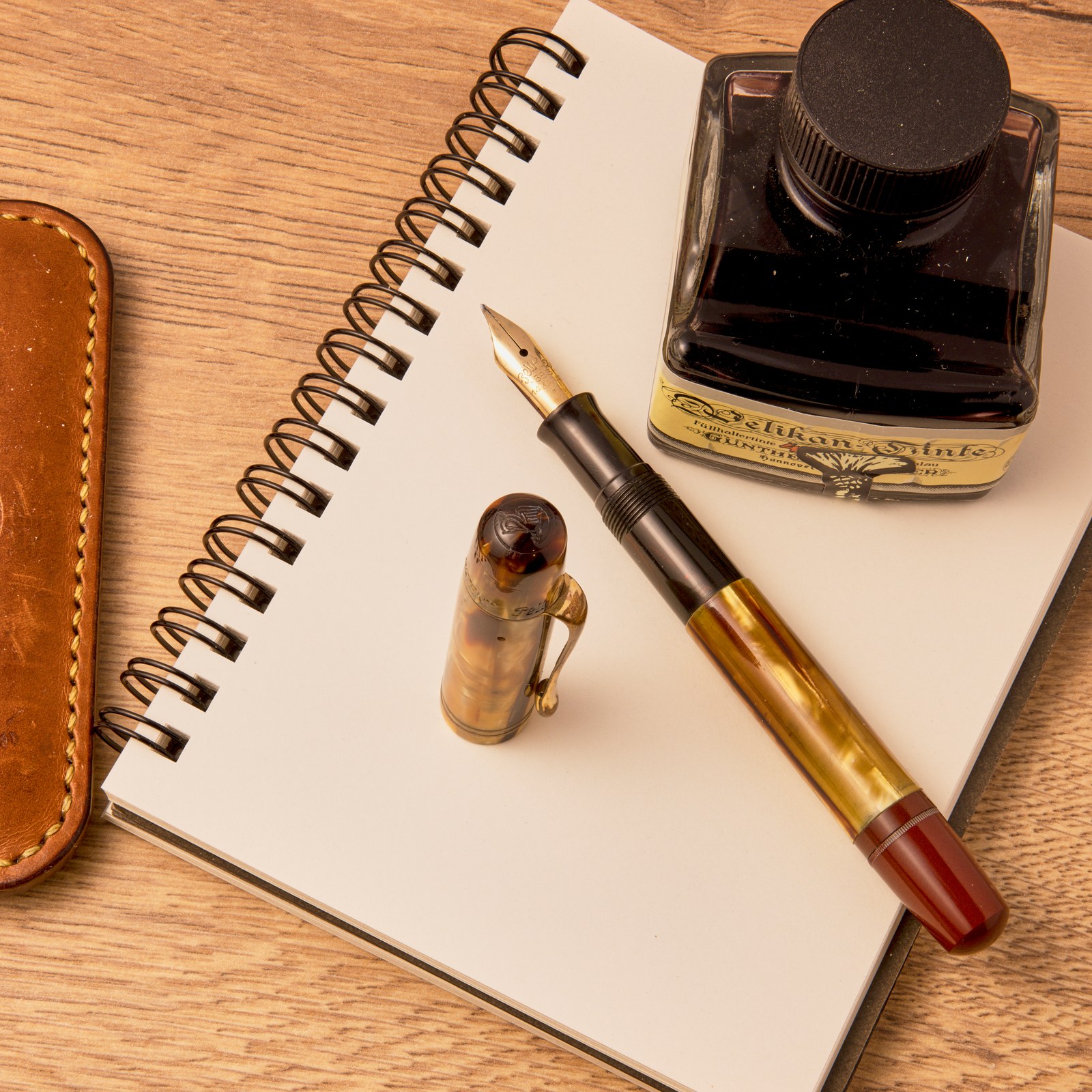
A Pelikan 100 of 1936 in tortoise marbling, with the waisted black section used from mid-1933 and a gold nib stamped “Pelikan 585 14 KARAT”, beside Pelikan’s reissue of its 1897 ink bottle. (Photo: Donal Higgins, private collection)
On a striped pen, the shape tells the model. The 400 has a flat cap top held by a nut and the shortest, squarish knob; the 400N’s domed top stands proud and its knob is rounder; the 400NN is longer, with a pointed top and knob. “Günther Wagner”, the company’s old name, on the barrel of a 400 or 140 points to 1950–54, as does a nib-width letter on the knob.
The piston seal, seen through the window, is a good clock when it is original: cork until October 1942, black from then until late 1953, clear after. But restorers replace seals as a matter of course, so a clear seal in a 1930s pen means a repair, not a date.
The cap
The cap top carries Pelikan’s trademark, and it changed once in the vintage years. Until about 1937–38 the pelican has four chicks; then came O.H.W. Hadank’s redrawn logo with two. (The sources split on the year, so the Dater treats 1937 and 1938 as overlap.) A pelican with one chick is from 2003 or later and is never original on a vintage pen. Coloured cap tops, matching the ink a pen was sold for, came in on the 400 in June 1951.
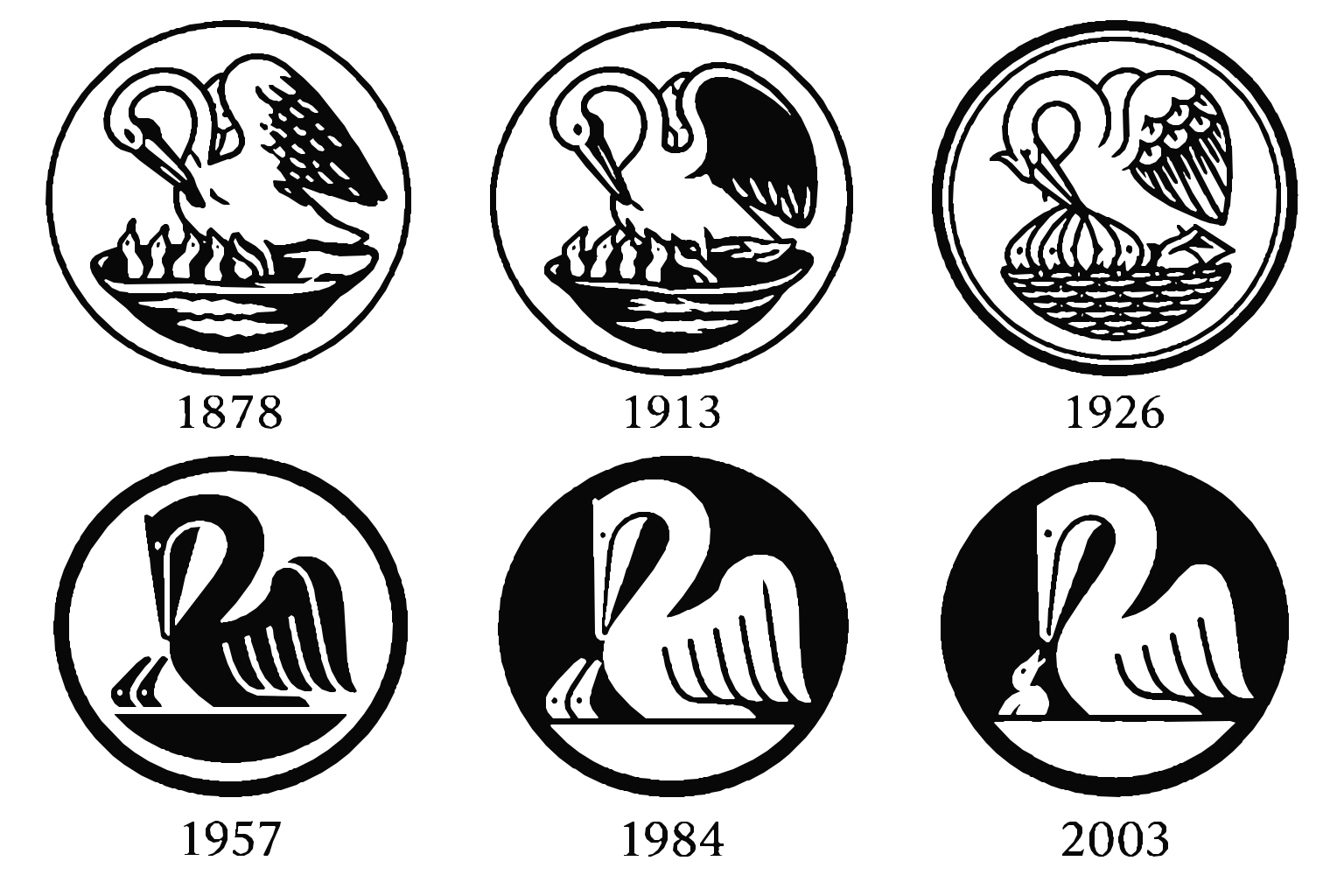
The Pelikan logo, 1878 to 2003. Pelikan logo drawings: simplified vector versions by Donal Higgins. The Pelikan name and logo are trademarks of Pelikan.
On the marbled pens, the cap’s own changes help: two air holes in 1929, four from mid-1931 to mid-1933, then two again; two narrow gold rings from 1930; hard rubber until 1937–38, then celluloid, with the tube changing first, so a celluloid cap under a hard-rubber top is often original. On the 400 the cap band was plain until mid-1954 and engraved after.
The nib
The nib gives the sharpest dates of all, because the war changed its metal. Gold nibs were stamped “14 KARAT” in 1929, “Pelikan – 14 – KARAT” in 1930–31, then “· 14 ·”, with “585” added about 1937. With gold barred for home sales, Pelikan made palladium nibs marked PD from May 1938 to February 1940, then chrome-nickel steel nibs marked CN from late 1939. Gold came back in July 1949 with a script “Pelikan 585”, and from December 1954 the nib carried the Pelikan logo, whose chevrons met at the slit until 1964.
But the nib is also the least trustworthy part. Pelikan nibs sit in a unit that screws out of the section, and the units fit across the 100N, the 400 family and even the modern M400. After the war many owners had their PD and CN nibs replaced with gold ones. So the Dater dates the nib on its own and says whether it fits the body, rather than letting it decide.
Dating a Souverän
On a modern Pelikan, the order reverses. The body says little beyond the model’s first year, and the cap says most.
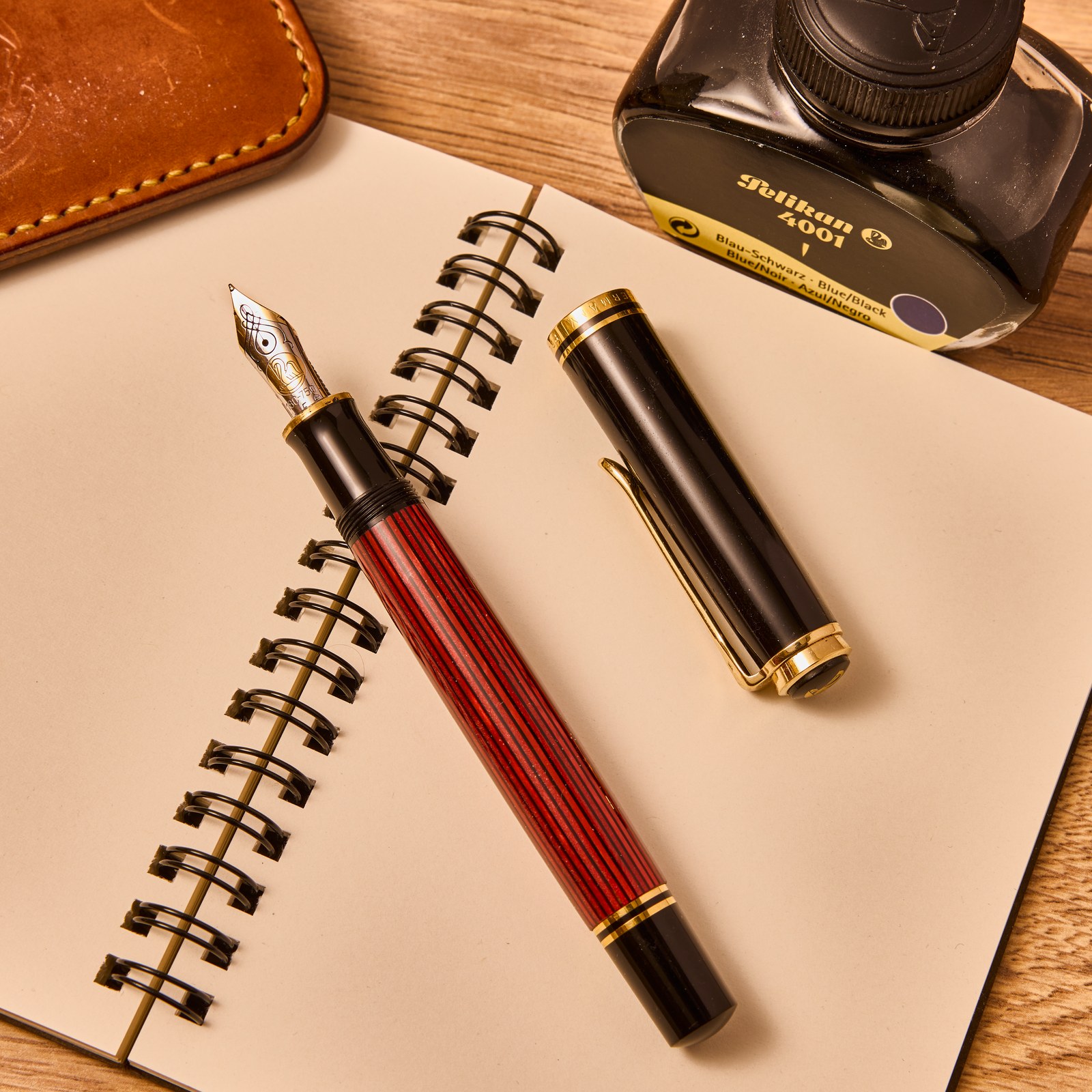
A Red-Striped M800. The finish says 2001 or later, and the gold two-chick logo printed on black on its cap top narrows it to 2001 to 2003. (Photo: Donal Higgins, private collection)
The cap band
The band at the cap’s open end reads “Pelikan W.-Germany” on pens until 1991 or 1992, “Pelikan Germany” from then until 1997, and “Pelikan Souverän Germany” since.
The cap top
Rick Propas’s Decoding the Pelikan M800 divides the M800 into eras by its markings, and Joshua Danley’s history of the pen at The Pelikan’s Perch gives the dates. The first M800s, of 1987 and 1988, have a brass disc on the cap top with the crest filled with enamel; from 1989 to 1997 the crest is punched right through the disc. In 1997 the disc gave way to a gold two-chick logo printed on black; in 2003 the logo was redrawn with one chick; and in 2010 it became all metal. The Perch’s rule for every Souverän is that an engraved or stamped logo is before 1997 and a printed one is 1997 or later.
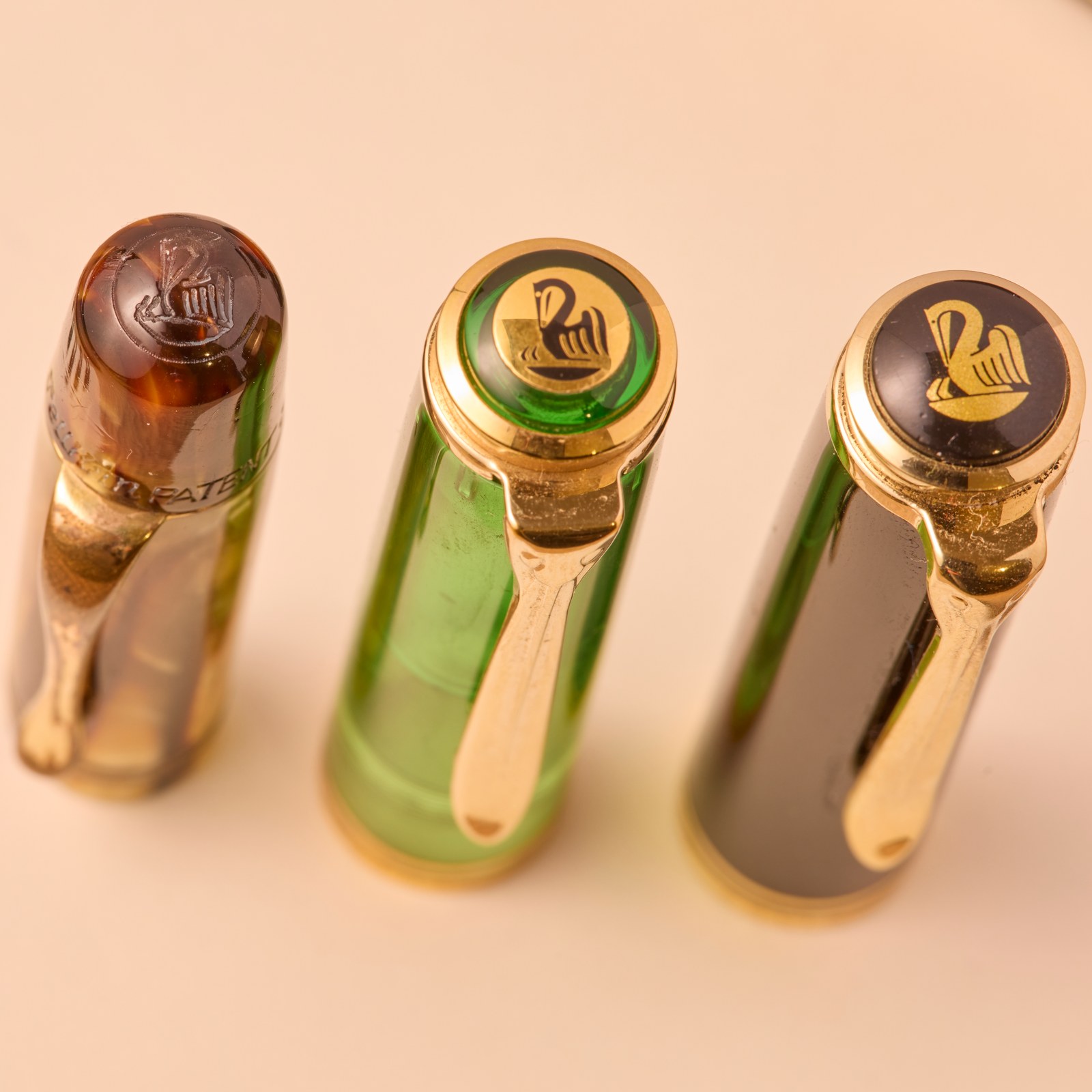
Three cap tops, left to right: the pelican engraved in the celluloid of the 1936 Pelikan 100; the crest punched through the brass disc of a 1992 M800 Transparent Green, the style of 1989 to 1997; and the gold two-chick logo printed on black of a Red-Striped M800, 1997 to 2003. (Photo: Donal Higgins, private collection)
The 1997 restyle
The year 1997 changed more than the cap top. The M400 gained a second cap band and two rings on its knob, where it had none; the M600 grew longer and wider and also took two knob rings; and the M800 lost the gold disc on the end of its knob. Pens that mix old and new parts are usually leftover stock rather than repairs.
The nib and the finish
The M800’s nib was 14-carat (14C-585) until March 1990 and 18-carat (18C-750) since. The pelican on Souverän nibs lost one of its two chicks about 2010. Pelikan stopped making oblique nibs about 2012–13 and added an italic broad, the IB, in 2019; a modern oblique has usually been ground by a nibmeister.
Finishes rule out early dates: blue stripes from 1996, red stripes (sold as Red-Striped and Black-Red) from 2001 until 2010–12 and again from March 2022. In 2022 Pelikan moved the striped pens to a material that no longer shows the ink, so stripes that stay solid against a light mean 2022 or later. Of the two green M800 demonstrators, the 1992 Transparent Green has two separate cap rings and the 2023 Green Demonstrator a single wide ring with a satin band through it.
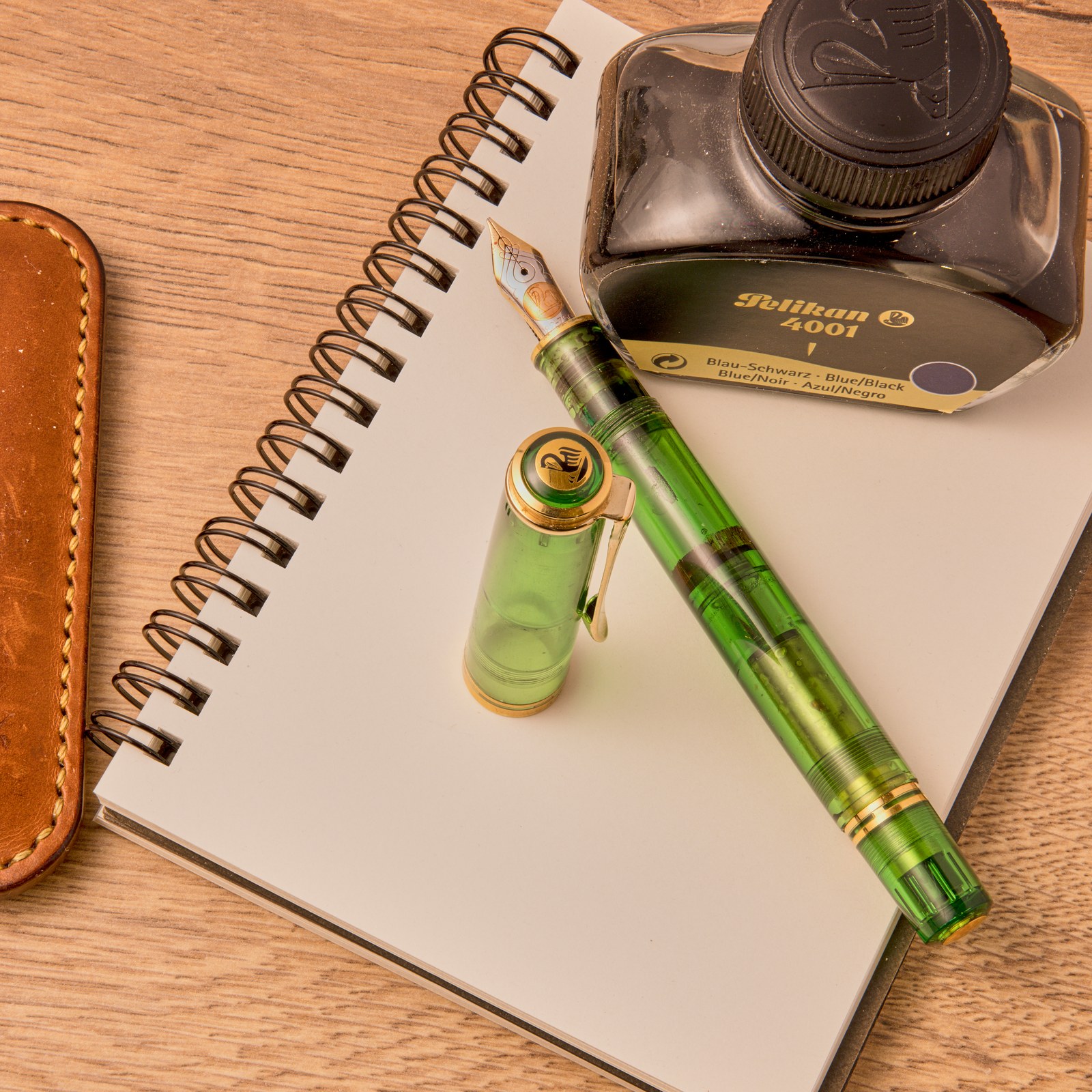
The 1992 M800 Transparent Green, its piston mechanism on show through the barrel. Its cap band still reads “W.-Germany”. (Photo: Donal Higgins, private collection)
Pelikan’s Souveräns are rarely faked; The Pelikan’s Perch has never met a counterfeit. The risk is the mixed pen: an M400 cap on an old M600, or a W.-Germany band on a pen with a one-chick cap top. Parts that disagree by years are the sign.
When the clues disagree
Most Pelikans show a few clues that don’t quite agree, and there are two reasons. The first is the factory: Pelikan used up old parts as it went, so transitional pens, such as a two-chick top on a hard-rubber cap of 1937–38, are original. The second is the pen’s later life: nibs were changed for a different width, caps were lost, and seals were replaced. Date the body, see which parts agree with it, and treat a cap or nib that is years away as probably from another pen.

Date your Pelikan
Put it all together with the Pentrace Pelikan Dater. Say which kind of Pelikan you have, then pick what you can see on its body, cap and nib. It gives a range of dates, says which parts fit and which have probably come from another pen, and names the model. You can link straight to it at pentrace.ink/pelikan-dater, and every result has a link of its own to share.
Where the sources disagree
The dates above come mostly from two collectors’ databases, The Pelikan’s Perch and pelikan-collectibles.com, both drawn from Pelikan’s own catalogues and circulars. Where they differ, the Dater takes the range that covers both.
| Question | What the sources say |
|---|---|
| The two-chick logo | 1937 (Dominic Rothemel); late 1937 (Vintage Pelikan Pens); 1938 (The Pelikan’s Perch, Rick Propas) |
| The 100N | March 1937 for export and 1938 at home (Rothemel); 1938 (the Perch) |
| The 400N and 400NN | 400N from December 1955 (the Perch), 1955 (Propas) or 1956 (Rothemel); 400NN to July 1965 (the Perch, Rothemel) or about 1963 (Propas) |
| Steel CN nibs | Oct. 11 or Nov. 11, 1939, on two of Rothemel’s pages |
| W.-Germany to Germany | 1991 (Rothemel, Propas); 1992 (the Perch) |
| Souverän on the band | 1997 (the Perch); 1997–98 (Rothemel) |
| The all-metal logo | 2010 (the Perch); a metal look from 2003 (Rothemel) |
| Red-Striped’s first run | Ended 2010 (Rothemel) or 2012 (the Perch) |
| The black and tortoise M800s | Black from 1987, 1988 or 1989; the first tortoise of about 1987, 1988–89 or 1991, depending on the source |
Further reading
- Topic of the Week: Pelikan, with every Pelikan article in the Pentrace archive.
- Pelikan History, Rick Propas’s four-part history of the pens for Pentrace, 2003.
- Pelikan 100/100LE – a comparison, Felipe Jordão on the 1930s 100 and its reissue.
- Pen Doctor: Changing Pelikan Nibs, on taking a nib unit out safely to read it.
- Dating a Pelikan, the M800’s history, the 400 and the timeline at Joshua Danley’s The Pelikan’s Perch.
- pelikan-collectibles.com, Dominic Rothemel’s model-by-model reference, including the Model 100’s details and the nibs.
- Decoding the Pelikan M800, Rick Propas at The PENguin.
- Jürgen Dittmer and Martin Lehmann, Pelikan Schreibgeräte 1929–1997 and 1929–2004, the standard histories of the pens.