Why Pelikan?
|
I collect Pelikan fountain pens mostly because I enjoy writing with Pelikan fountain pens. Therefore this article explores why I collect Pelikan pens and why I like to use them. In the interest of full disclosure I should note that my collecting leans toward post-World War II Pelikans including current models, so this article is biased in that direction. A Rocky Start Lacking a clear focus, I relied on the knowledgeable staff at Joon, who suggested a Pelikan M800 with a medium nib. I dipped the pen and it wrote well, so I purchased it, some Waterman blue-black ink (my first ink in a bottle and to this day my favorite ink) and hurried back to my hotel room. There I tried to remember how to fill the pen without spilling ink all over, eventually got it filled, and excitedly started to doodle. After the first few lines…nothing, nada, zip. The pen would not write. Thoroughly disgusted, I concluded, based on a grand sample of one, that all Pelikan pens stank. I moved on to exploring other brands of pens in my quest for Fountain Pen Nirvana, the One True Pen.
My first Pelikan, an M800 Eventually I stumbled on John Mottishaw’s site, called and ordered a new, fine M800 nib from his delightful assistant Pat (I had not yet heard about free nib exchanges). Pat had promised me that they could make a nib “glassy smooth” and personally adjusted to my writing style. She lived up to her promise. That M800 became my favorite pen. The Flock Breeds
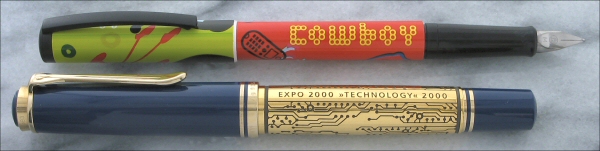
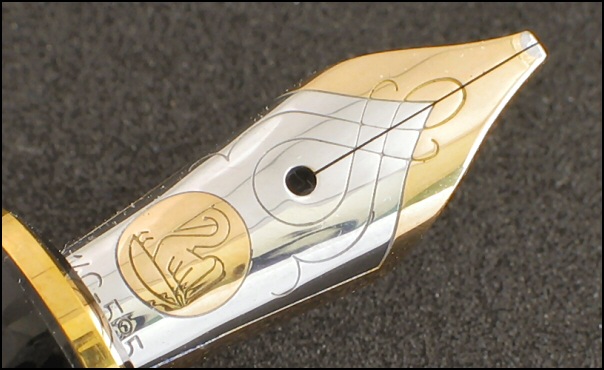
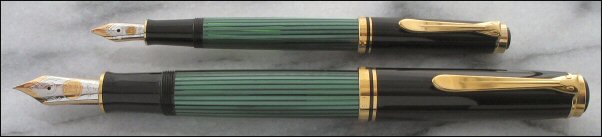
Top, Culture; bottom, Expo 2000 “Technology” What impresses me about the Pelikan line is their design, quality/writing experience, and depth and breadth of models. Design Interchangeable nibs. The feed/nib assemblies on all these Pelikans screw out, which makes them interchangeable between pens of the same series. This is a great advantage since you can have multiple nibs with a single body, or swap nibs between and among pen holders. This is a great way to try out custom ground “exotic” nibs such as stub or cursive italics. Warning: Some care is required to remove the feed/nib assembly so as not to damage it. Specific instructions on how to do that are beyond the scope of this article, however this Pen Doctor column tells you how.
Double broad cursive italic nib Visible ink supply. All of the Pelikan pens have some way to tell how much ink is in the pen, whether by removing the barrel to see the cartridge/convertor, by looking at an ink-window, or, with a wee bit of practice, by looking between the solid and translucent parts of a striped barrel. For me, that’s an important consideration. I really do not like running out of ink in the middle of a meeting. One turn—and ready for writing. To quote an early Pelikan pen ad: “No turning, turning and still more turning—just one turn of the cap suffices. Nevertheless, the Pelikan pen closes firmly, for the screw has a quadruple thread, which acts in four different places. Can you imagine a quicker manipulation of a fountain pen?” Caps which unscrew quickly are a godsend for taking sporadic notes. Some people complain that the caps come off a little too easily in the pocket. As long as the cap is snugged on with a just a slight bit of torque you will never have a problem Easy to clean. Most Pelikans are piston-fillers. Overall, I’ve found piston-fillers to be the quickest, least messy pens to clean. Just fill the ink-chamber with water and empty a few times. The Goldilock’s Effect. You know the story. Goldilocks gets lost in the woods, visits the bear’s house when they are out and plays with their fountain pens. Daddy’s M800 is too big, baby’s M400 is too small, and Mommy’s M600 is just right.
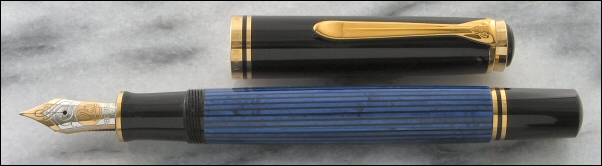
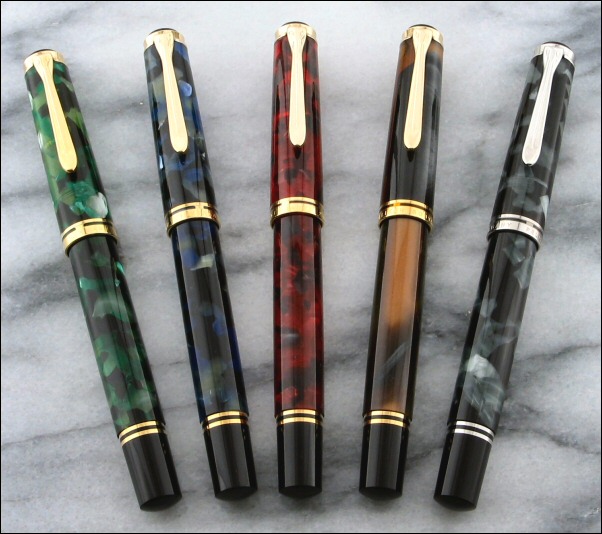
Top, M300; bottom, M1000 Appearance. Pelikan designs its pens conservatively, with most of them aimed at the professional, business set. Some view that design choice as boring. Personally, I view it as classic, understated and timeless. Quality/Writing Happily, Pelikan has been making quality pens from the start, so a vintage 400 or 400NN is likely to write as well now as it did when new. Generally, Pelikan nibs are firm (or pleasantly “springy” in the larger sizes) and write a consistent, wet line. The nibs tend to run wide and have a slight “tooth” (a positive I think for better overall performance across a variety of papers). Many of the vintage Pelikans are equipped with semi-flexible or oblique nibs. Depth and Breadth Therefore, once you’ve figured out how the Goldilocks Effect applies to you, you can start delving into the many variations available for each of the basic models of pens. For me, the M600 fits my hand best. Happily, Pelikan has been issuing at least two new variations per year based on the M600 as part of the “Cities Special Edition Series.” As I write, Pelikan has issued five in the series, the Berlin, Stockholm, Madrid, San Francisco and Chicago. Including the Cities Series, Pelikan has issued fifteen different variations of the M600.
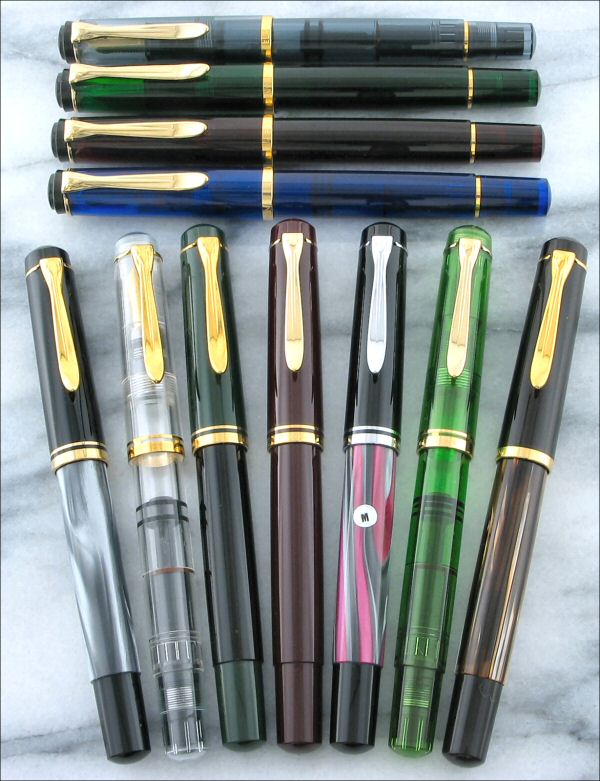
Pelikan Cities Series If you like a slightly smaller pen, consider the M400, the 200 (which are the same size as the M400 only injection molded and with less gold trim and a gold-plated nib), the 250 (same as the 200 except with a gold-nib), or the M700 series (high end variations of the M400). If you look around there are some unusual variations for each of these lines. For example, I’ve managed to add 20 variations of the 200/250 models, and I know there are others around. |