Pelikan 100/100LE - a comparison
|
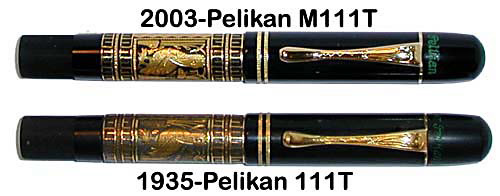
Introduction The Pelikan 100 model was first introduced in 1929 and went through a series of changes until the middle of 1931 when it settled down to the model that was produced until 1944. Interestingly, none of the re-issues are of the model 100 per se, but of slightly different versions. The first of the series, model 111 has a gold barrel and black cap. The 110 has a white gold barrel and cap. The 101 came in marbled green, red, blue, tortoise shell, and lizard (only the blue and green were re-created as limited editions). The last of the series was the Toledo, model T111, released in March of 2003. In this article I will go over each major component of the pens, starting with a general overview. The pens will be referred to as follows: 100 – the original and 100LE – the limited edition.
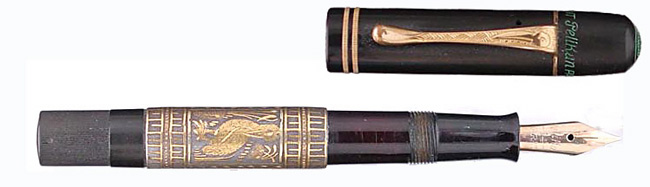
Pelikan Toledos from the collection of Rick Propas, photography by Rick Propas. Pen Nib/Feed The ink flow is adequate, not too wet and not too dry. The nib has a modern feed seen on other Pelikan models, with many thin vanes perpendicular to the nib itself. The collar has a metal ring around it to prevent cracks when removing and resetting the nib and feed. 100: The vintage nibs on all my 100 models are 14kt gold and have a little more tooth than the modern nibs. One explanation is the tip: on the modern nibs the tip is round when looked at sideways, while the vintage tip is a little flatter. This may be due to age and the wear of the tip over the years. The nib is nice and flexible, leaving a nice line on paper with variation and shading. The ink flow on my vintage pens is generous, leaving a nice wet line with plenty of variation and shading. The three large vanes on the feed run parallel to the nib itself, with the entire nib unit made from ebonite. The collar is about twice as long as the re-edition. Barrel 100LE: The section on the re-editions is made of black celluloid and has a distinct seam where it attaches to the barrel. The threads are on the section itself and not on the barrel as in the vintage version. The section continues for about 1mm after the threads end before attaching to the barrel, which is why the seam is so prominent on some of my “originals” pens. 100: The section on the vintage pens is made of hard rubber and was later changed to celluloid. The threads are on the barrel, not on the section. The section attaches to the barrel exactly where the threads end, which is why there appears to be no seam. Careful observation with a 10x loupe reveals the almost invisible seam, however. The vintage pen appears to have better quality construction because of this, despite the modern manufacturing methods used in the re-issue.
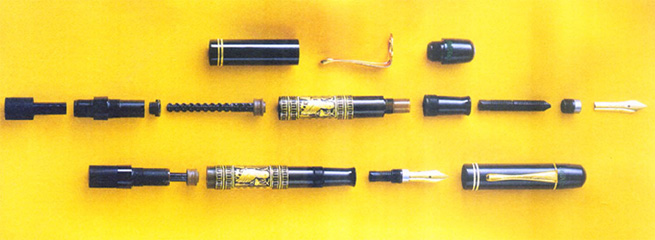
Pelikan Toledo from the collection of Rick Propas. Photography by David Isaacson. Piston 100: Besides the differences mentioned above, the vintage 100 has a cork seal. While functional, this means it requires more maintenance. If the seal dries up it loses some of its sealing properties and might cause the pen to leak or not fill at all. This problem is not as prominent if the pen is kept filled with water when not inked. Cork is also more biodegradable than plastic, which means it will wear out faster and need to be replaced. This is a minor issue with the many experienced pen repairers available out there.
Exploded view of modern Toledo - image courtesy of Pelikan Cap 100: The cap on the vintage pens is made of hard rubber on the early models and celluloid on the later ones. The design is the same as above but there are variations in the number of holes in the cap as well as the internal construction where the section reaches when capped. They were made with two or four holes at various points in time. The vintage caps also had different engravings on the cap top. My vintage pens have “Pelikan PATENT” repeated around the cap top.
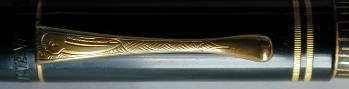
Clip and ring - image courtesy of Pelikan Clip Vintage Nib Unit – The best of both worlds* Thanks to Pelikan’s conservative and consistent pen designs over the years there is a solution. The nibs on Pelikan pens screw out and can easily be replaced. As it turns out, the nibs of both modern and vintage Pelikan 400s have the same thread pattern as the “originals” series limited editions. This means you can take that wonderful vintage nib off your Pelikan 400 and put it directly on the limited edition. This completely transforms the pen from a sterile writing instrument to one full of character, painting the words on the page rather than just writing them. After the initial glee from the discovery comes the sad realization: you have to share that nib with your 400 and your limited edition. Luckily, Rick Propas was able to masterfully craft a nib unit specifically for the limited edition pens. The nib unit is a mix of parts from different years, usually a 100N or early 400 nib and a 100N or 400 feed, married and reset with a 140 or modern 200-400 collar. Regardless of origins, it writes beautifully. He even goes as far as trying to match the engraving on the nib to the correct year for the pen – a 1935 nib for the 1935 limited edition. The only tell-tale sign that this nib unit is a modern contraption is the four vane feed under the nib. The older three vane feeds of the original 100 are not the right size for the collar that fits in the modern pens, so a compromise was made. It is not at all a bad compromise, because the whole idea behind the custom nib unit is to get the modern pen to write like its vintage cousin, which it does admirably. Conclusion Editor’s Note: The discussion of the custom vintage nib units created by Rick Propas is unsolicited by me, nor is it endorsed by Pentrace. The author is in no form being compensated for his discussion or endorsement of that conversion. Bibliography Text © 2003 Felipe Jordão. Photos © 2003 as indicated in captions. Editor: Rick Propas |