

Review: Surrender! by Richard Binder
The End of World War II, and the Pens That Signed the Axis Death Warrants
Richard Binder follows the pens — and the people — through twelve surrender ceremonies, from a tent in Sicily in 1943 to a Hong Kong ballroom in 1945. The result is a careful, readable history that also works as a detective story for collectors.
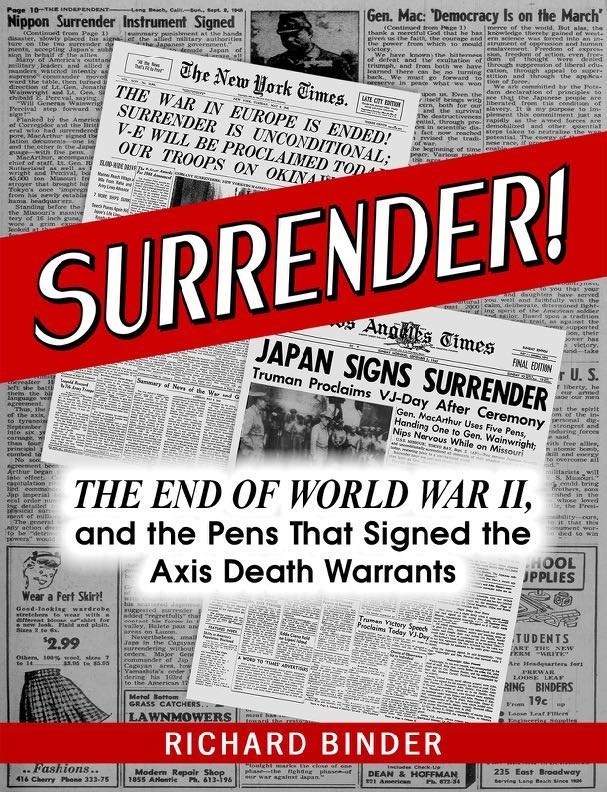
The cover of Surrender!, set against the front pages that announced the end of the war. (© 2025 Richard F. Binder)
Few people in the fountain pen world need an introduction to Richard Binder. He is the Pen Doctor here on Pentrace, his repair and restoration work set the standard for a generation of collectors, and his reference pages at richardspens.com are where many learned what a sac, a breather tube or a Vacumatic filler actually is. You can watch him at his workbench in National Geographic’s short film Fountain Pens Are Actually Fascinating, in our Videos section. Readers of his 366 Days of World War II and War and the Fountain Pen also know his second passion: the Second World War. Surrender! is the book in which those two interests meet head on.
The premise is simple. When the war ended, men sat down at tables and signed documents, and every signature needed a pen. Which pens were they, who held them, and where are they now? Binder asks those questions of twelve surrenders, some famous and some almost forgotten, and answers them with the patience of a restorer working on a stubborn pen.
What’s in the book
The book grew out of a series of articles, one per ceremony, and it keeps that shape. Each chapter follows the same four parts: a prologue that sets the military and political scene, the preliminaries that brought the two sides to the table, the signing itself, and the aftermath. The twelve chapters run in date order:
- the Italian armistice at Cassibile, Sicily (Sept. 3, 1943);
- Montgomery’s tent on Lüneburg Heath (May 4, 1945);
- the “little red schoolhouse” at Rheims (May 7);
- the Dodecanese, signed in a small courtroom on the Greek island of Simi (May 8);
- the restaged German surrender the Soviets demanded at Karlshorst, Berlin (May 9);
- the Allies’ Berlin Declaration, which divided Germany into zones (June 5);
- Tokyo Bay, aboard USS Missouri (Sept. 2);
- General Yamashita at Baguio in the Philippines (Sept. 3);
- Wake Island, aboard the destroyer escort USS Levy (Sept. 4);
- the Ryukyu Islands, on a lawn on Okinawa (Sept. 7);
- Korea, in the Japanese Governor-General’s throne room in Seoul (Sept. 9);
- Hong Kong, in the hotel where the British had surrendered in 1941 (Sept. 16).
The appendices print the documents behind the ceremonies, including General Order No. 1, Eisenhower’s Victory Order of the Day, Roosevelt’s “Day of Infamy” speech, Hirohito’s Imperial Rescript, the Potsdam Declaration and Truman’s announcements of the war’s end. There are two forewords, plus about a hundred endnotes. The first is by Nicky Pessaroff, editor-in-chief of Pen World. The second is by Frederic L. Propas, a historian at San José State University, whom Pentrace readers know better as Rick Propas. He wrote the four-part Pelikan History series for Pentrace, appears in The Penguin: A Life in Pens and Pelikans in the Videos section, and stands beside Binder in the photo on our Pen Shows Topic of the Week. Like Binder, he is devoted to both pens and the Second World War, and he also read the manuscript for historical accuracy. The book is heavily illustrated with period photographs, the signed documents themselves, and modern photos of pens matching the ones in the signers’ hands.
The pens
For collectors, the pleasure is in the detail, and there is plenty of it. At Rheims, Eisenhower handed his naval aide, Capt. Harry Butcher, the job of looking after the pens, in Bedell Smith’s words to “make you superintendent of the fountain pens.” Jodl signed the first copy with a Dove Gray Parker “51”, and Butcher then whisked it away and gave him his own Carmine Red Sheaffer Valiant for the other three, a pen that the CBS broadcaster John Daly later said he had only lent to Butcher. Binder also shows that the “51” in the Parker archives long claimed as Jodl’s can’t be the one: film of the ceremony shows a single-jewel model.
The other chapters are just as rich. Montgomery, a man known for his vanity, signed at Lüneburg Heath with the same plain dip pen he had handed to each German in turn. At Karlshorst, Field Marshal Keitel refused the dip pens on the table and signed with his own Soennecken “Medicus”; Air Marshal Tedder used a Yellowstone “51” from Eisenhower’s seemingly endless supply, its clip sprung by the thick cloth of a British uniform pocket; and General Spaatz pocketed the pen he had borrowed from the French until he was asked to give it back.
The Tokyo chapter is the longest and the best. Using the memoir of Col. Hervey Whipple, who staged the ceremony, and Gen. Jonathan Wainwright’s own account, Binder untangles MacArthur’s six pens: the four Waterman desk pens, the borrowed Sheaffer, and the small red Parker Duofold that belonged to Jean MacArthur. He makes a good case that it was a Duofold Junior rather than the “Big Red” that is usually pictured. He follows Admiral Nimitz’s two pens, his “old green Parker” Jade Duofold and the “51” given to him by the San Francisco banker Y. C. Woo, which turned up decades later in the Nanjing Museum. And he explains how a humble Navy-issue Swivodex desk pen ended up saving the day after Canada’s representative signed the Japanese copy on the wrong line.
Some of the best moments are pure pen detective work. At Wake Island, Binder spots the faint stripes of a Parker Vacumatic Major in an enlarged photo of Admiral Sakaibara’s hand, and works out that the pen must have been an Azure Blue Pearl prewar double-jewel model. In Korea, he identifies Admiral Kinkaid’s pen as a wartime Sheaffer Triumph from the reflection of its metal threads and the shape of its conical nib. On Okinawa, he notes that all four signers used the same Morriset desk pen.
How it’s done
What makes the book trustworthy is that Binder says where his evidence stops. Phrases like “tentative identification” and “I cannot be certain” appear often, and when a pen can’t be identified (Brigadier Moffatt’s on Simi, de Lattre’s borrowed pen at Karlshorst) he says so instead of guessing. When he disagrees with a museum or a website, as with a popular history site’s solid-gold “51”, a model Parker didn’t make until 1949, he explains why and cites his source.
He has also gone to real trouble for his primary sources. His most remarkable find is the signed Dodecanese surrender. It had never been photographed or put on public display; it sat unnoticed in a box of Brigadier Moffatt’s personal papers at the Imperial War Museums, and the archivists didn’t know they had it until Binder gave them the box number. That obscurity is what saved it. The document was run off on a spirit duplicator, whose copies fade in light, and years in a display case could have made it vanish altogether. Kept in the dark, it was still legible enough for Binder to decipher, and the museum photographed it for this book. He prints it beside a facsimile showing how it would have looked when new.
More than pens
This is not just a book for pen people. As Pessaroff writes in his foreword, the pens are a way into the story, not the story itself, and Binder gives the people and places as much care as the hardware. There are fine human moments: the Soviets having a French flag made on the spot at Karlshorst and getting the Dutch flag by mistake; Foreign Minister Shigemitsu climbing Missouri’s ladders on an artificial leg; Marshal Zhukov dancing at the banquet afterwards. Binder also doesn’t look away from the atrocities that led to these tables, among them the deportation of the Jews of Rhodes, the massacre of 98 American civilians on Wake Island, and the treatment of Korea and Hong Kong under occupation. He is willing to judge, too: his account of Yamashita’s trial concludes that it was victor’s justice rather than a fair hearing.
In conclusion
Binder expects most readers to take the book a chapter at a time, so he repeats key background where it is relevant, and each chapter stands on its own. Binder’s opinions of the commanders are strong and freely given (Montgomery and MacArthur come off poorly), which some readers will enjoy more than others. And since many of the photos are wartime press and newsreel images, some of the pen identifications rest on blurry details; Binder is honest about that, but readers looking for a definitive answer on every pen won’t always get one. None of this takes much away from the book.
The verdict
Surrender! does something few pen books try: it puts the pens back in the hands of the people who used them, at the moments that mattered most. Collectors will come away knowing why a Buckskin Beige “51” is in the Truman Library and how to tell a Duofold Junior from a Big Red in a 1945 photograph. History readers will come away with a clear, human account of how the war actually ended, one table at a time. It is highly recommended for both.
Surrender! The End of World War II, and the Pens That Signed the Axis Death Warrants, by Richard Binder. © 2025. Available as a Kindle ebook and in print. See Richard Binder’s books page for details.