

History of the Parker Aztec fountain pen
The pen commonly called “the Aztec” would never have been created were it not for the youthful ambition of a young man to visit the Wild West of America in the twilight days of western America discovery and settlement.
George Parker was a man born to travel and seek exotic and wonderful destinations. From the day he packed his bags and left Fayetteville, Iowa for Janesville, WI to attend the Valentine School of Telegraphy, his real desire was to travel the open West of America. This passion was fired by his imagination as he read the exciting stories of Wild West adventure in the Youth’s Companion newspaper. It is almost certain some of these stories contained articles about Santa Fe, NM and pioneer frontiersmen such as Buffalo Bill and Kit Carson who blazed the pioneer trails to this final outpost trail leading from St. Louis, MO.
When Santa Fe was founded in 1607, official records show an inn or fonda was among the first businesses established. More than two hundred years later, in 1821, when Captain William Becknell completed the first successful trading expedition from Missouri to Santa Fe - a route that came to be known as the Santa Fe Trail - he enjoyed the hospitality at the inn (la fonda), where the Santa Fe Trail terminated at the town's central Plaza.
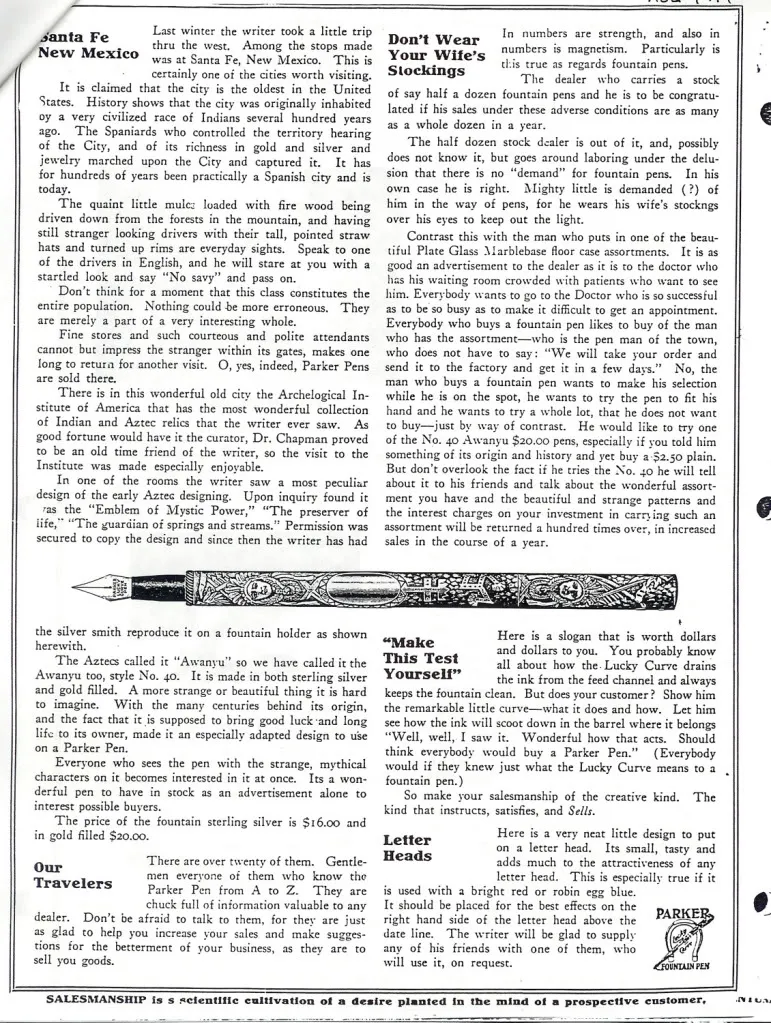
1912 Parker No: 60 gold filled "Awanyu" Aztec Indian design pen.
This catalogued model is one of the most sought after of the Parker eye droppers and very few are known to exist. Size 5.25 inches. It was made in 1911 and originally cost $20. Nearly 100 years later the selling price at a recent auction was £48,000 ($77,000).
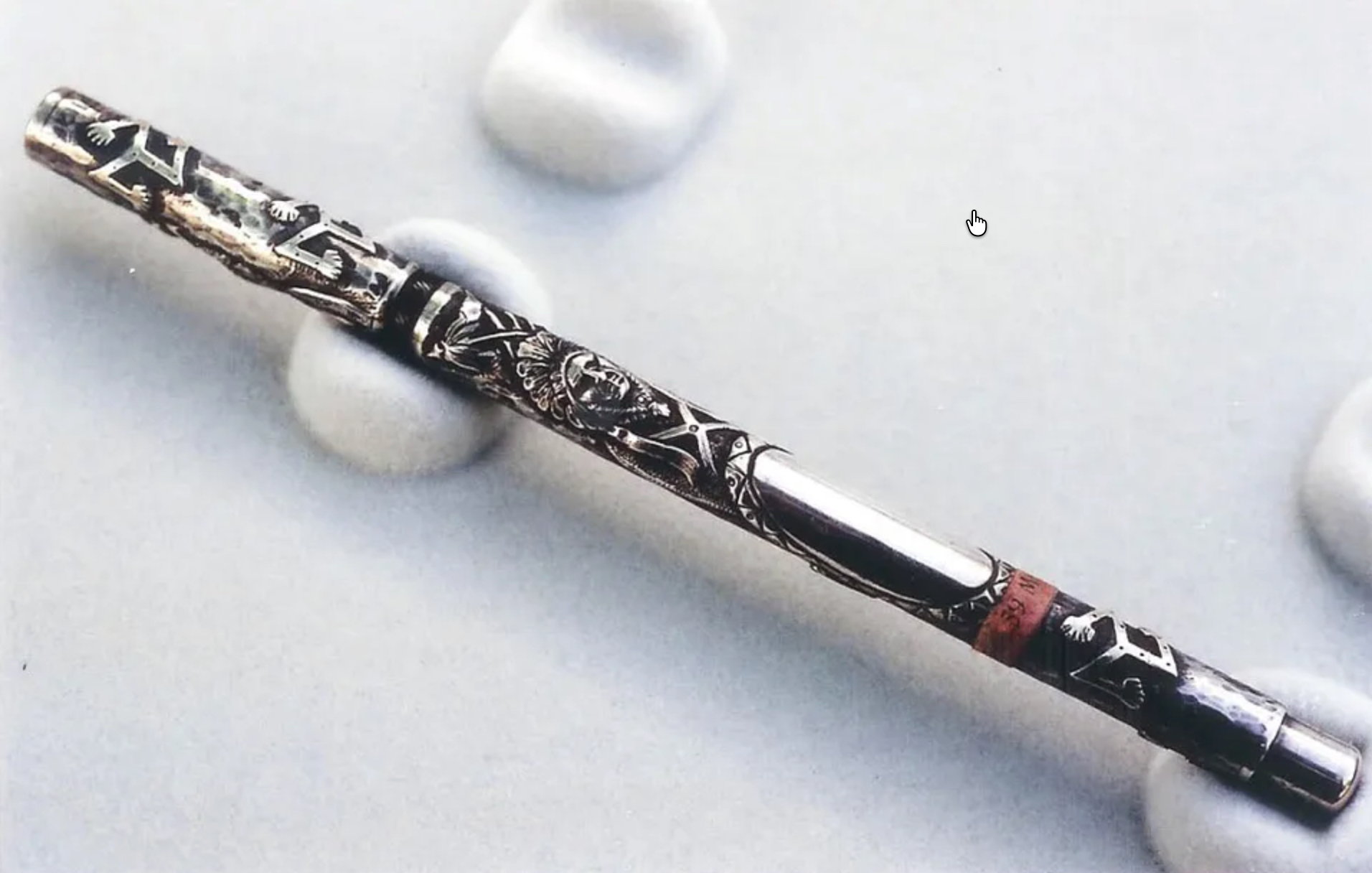
912 Parker No: 60 gold filled "Awanyu" Aztec Indian design pen. (Photo from Parker archives - PCA visit)
Here is the story of how George Parker was influenced by the mysterious story of the New Mexico Indians that lived in this area for three centuries as Indian farmers and hunters flourishing amid the canyons and forest mesas of the rugged Pajarito Plateau — and then they vanished. They were the Anasazi, the Ancient Ones, and from roughly 1250 to 1550 A.D., they fashioned a remarkable society in this spectacular region on the eastern slopes of the Jemez Mountains. They coaxed crops of corn, beans and squash from the volcanic soil of the canyon floors and along the mesa rims. In the deep forests, they hunted deer and wild turkeys. To supplement their food supply, they trapped squirrels and other small creatures and gathered a variety of berries and edible plants. Even with this arduous and never-ending struggle to maintain a daily existence, however, the Ancient Ones found time to develop a complex religion focused on the rhythms of nature and the Earth, the giver of all life. Their prayers and ceremonies sought the blessings of an array of protective gods — Sun Father, Moon Mother and Awanyu, the plumed serpent, lord of the water. However, the gods were fickle, and the time of the Ancient Ones grew short. By the mid-1500s, the people of the Pajarito were gone, and the great canyons and mesas stood deserted.