

The Corona Pen Company
A find at a Northern Illinois antique mall leads to the story of Samuel Corona, a Parker man who started his own Janesville pen company in 1922, and of the cam-filling pens it made until the company folded around 1930.
Some years ago I was at the same antique mall where I found the Waterman Patrician Turquoise set. I was again with my wife, scanning the hundreds of display cases and table tops. It was late Sunday afternoon, and I figured any pen-worthy collector had already been there and made some choice pickings, leaving me the Estys and third-tier 1940s wannabes. We are in Northern Illinois, less than 100 miles from Janesville, and I have had some good luck recently finding a variety of pens.
My wife was ahead of me by about half an aisle length, as she wants the thrill of finding something spectacular for me. She knows what to look for and has a sharp eye.
I hear her say… “Hmmm, Corona Pen Company… is that a good one?”
I believe Samuel Corona was an employee of the Parker Pen Co. in Janesville before 1922. With the phenomenal success of Parker, more than a few locals were inspired to start their own pen companies. Some actually started with the blessing of George Parker, and were eventually bought by Parker or had agreements to become sub-brand manufacturers for Parker. One such company was Hull Manufacturing, a few miles from Janesville in Milton Junction. They made and bottled ink and produced fountain pens as a sub-brand for Parker.
Some history of the Corona Pen Co.
The Corona Pen Company Inc. was incorporated in Janesville in 1922 by Samuel V. Corona, Herman G. Stubbendeck and Eldon H. Damrow, with James Pitt as vice president. The company was founded to produce pens using Samuel Corona’s design for a pen that filled by cam action, by twisting a knob at the back end of the barrel (U.S. Patent No. 1,540,763). The cam was attached to a lever bar inside the barrel, which pressed the ink sac to fill it with ink. With the desk pen, the taper is turned clockwise to make the cam move the pressure bar.
Corona applied for that patent on July 15, 1921, and it was granted on June 9, 1925. It describes a self-filling pen with a closure at the end of the barrel that turns. Turning it rotates a cam inside the closure against a second cam that slides lengthwise toward the ink sac, bowing a flat spring that squeezes the sac. As the turn goes on, the cams slip out of contact, the spring straightens, and the sac expands again, drawing ink in through the nib. The patent notes that the pen needs no lever or other part sticking out of the barrel to fill it.
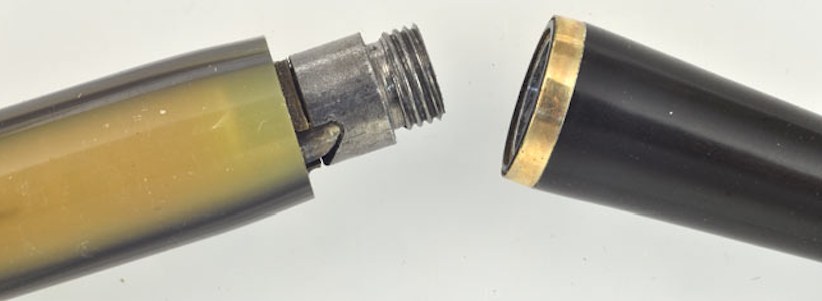
Corona’s cam filler, with the blind cap off: turning the knob works a cam that presses the bar against the ink sac. (Photo: David Nishimura, vintagepens.com)
This is the model of the desk set I found.
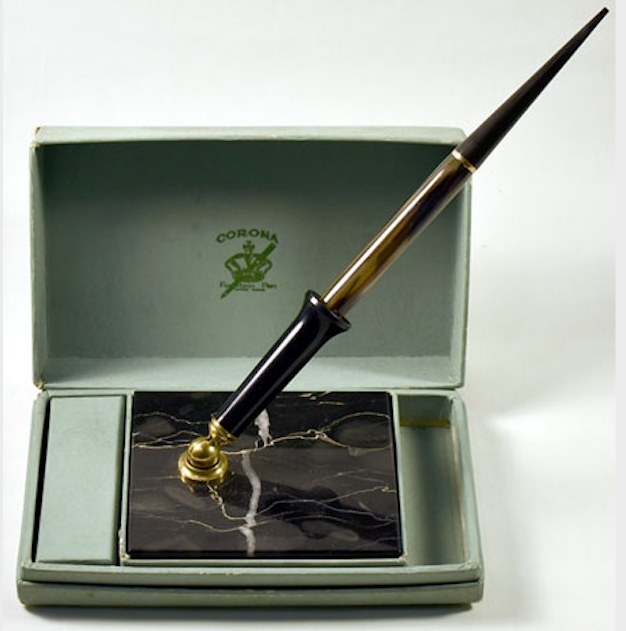
A Corona desk set in its box, the crown logo in the lid. (Photo: David Nishimura, vintagepens.com)
Samuel Corona had earlier received a design patent for a colored transparent cap crown with flecks of gold leaf embedded in the material (U.S. Patent No. D65,636). Corona moved to Antioch, Illinois, in the fall of 1927. On Feb. 20, 1928, a massive explosion occurred in the curing room, where the company was making its own celluloid. The explosion and the fire that followed virtually destroyed the building, but the employees had fled moments before, and no one was injured. The company rebuilt and resumed operations, but apparently folded in 1929 or 1930.
Legend says that after the death of her husband, Mrs. Corona was seen one day sitting on her front porch with a pile of Corona pens in front of her and a pair of pliers in her hand. To secure some means of living, she was pulling the 14K gold nibs from all the pens left in the company’s inventory, and dumping the rest of each pen in the garbage.
Sources
- Corona history: Richard Binder, richardspens.com
- Corona pen photos: David Nishimura, vintagepens.com
- Samuel V. Corona, Fountain Pen, U.S. Patent No. 1,540,763, June 9, 1925