The History of Casein Use In Writing Equipment. Part 1
| David Wells, vintage pen collector and dealer of primarily British writing instruments presents this discussion on a delicate material used by several pen companies in the past. Before the introduction of colourful resins and celluloid materials, fountain pens were made from vulcanised rubber with colour variations limited mostly to black , red or a variation of the two we call mottled, ripples or wood grains. Casein material was one of the first alternatives to provide a wide variation of colour and patterns. What is casein? Who discovered casein formaldehyde?
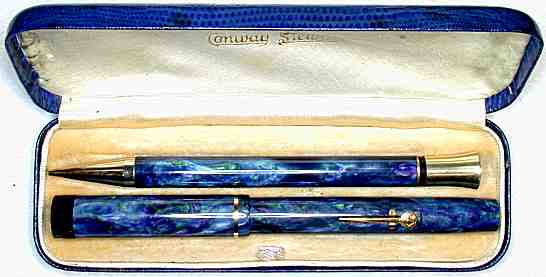
A vintage Conway Stewart 211 boxed set (Photo David Wells)
The Manufacturing History of casein. In Britain, a wet process starting with milk curds was patented in 1909 by Victor Schutze, a Russian student from Riga. This material was called Syrolit and a factory of the same name was set up in a disused cloth mill at Stroud in Gloucestershire. However, it was not successful and by 1913 the company was bankrupt. A new company was established at the same premises to manufacture casein using the dry process. The new product was called Erinoid and this was also adopted as the name of the company. Production commenced in 1914 and as supplies of Galalith were cut off at the commencement of World War I, the material found a ready market and button manufacturers from Birmingham were waiting on the doorstep for the first consignments. Lactoid, made by BX Plastics was introduced in 1922 at their Larkswood Factory in Higham Station Avenue, London. Young & Wolf Ltd. had a small production unit located at Bridgend Works, Stonehouse in Gloucestershire - they manufactured mainly rod, button blanks and knitting needles from about 1930.Young and Wolf pioneered the slicing of casein button blanks from rod in the UK. Charles Horner Ltd. of Halifax, England, like Young & Wolf, also produced casein plastics mainly in the form of knitting needles, button blanks and rod. Their brand name was Dorcasine. These four British manufacturers formed the Casein Plastics Association
(until 1938 it was called the Artificial Horn Manufacturers Association).
At the commencement of World War II supplies of raw casein granules were
no longer obtainable from Europe, the traditional source, and the CPA
were encouraged by the British Government to seek alternative supplies
in order to make buttons for military use. Argentina provided this need.
In 1944, the CPA co-operated with The Knitting Pin Association and the
Casein Button Manufacturers Association to form The Casein Plastics Joint
Development Association, to represent the interests of both manufacturers
and users of casein plastics. Perhaps the greatest contribution of the
CPA was in the 1950s to improve the process for manufacturing casein granules.
With the co-operation of the New Zealand and Norwegian dairies, this resulted
in casein of improved quality with a better base colour thus increasing
the colour range, especially of very pale colours. In the United States, casein plastics material was introduced by Christensen about 1919 and sold under the name Aladdinite. In 1924, Karolith was produced followed by Erinoid by a subsidiary of the British company. Casein did not achieve the same success in the US as it did in Europe - partly due to greater competition from cast phenolic resins, also some European applications were excluded because of the climatic conditions. Starting in about 1928 many casein manufacturing plants joined forces with button manufacturers to make casein directly into buttons. This included button manufacturer George Morrell who took over Kyloid, and Aladdinite who joined the Button Corporation of America. In 1931 Karolith Corporation, Erinoid Company of America, American Machine & Foundry Company and Pan plastics Corporation merged their casein interests to form the American Plastics Corporation to produce casein under the name Ameroid. References:
|