

How to Read a Parker Vacumatic Imprint
The faint lettering on a Vacumatic's barrel says who made the pen, what Parker called it, where it was made and, on most examples, the quarter of the year it left the factory. Here is how to find it, read it, and date the pen from it.
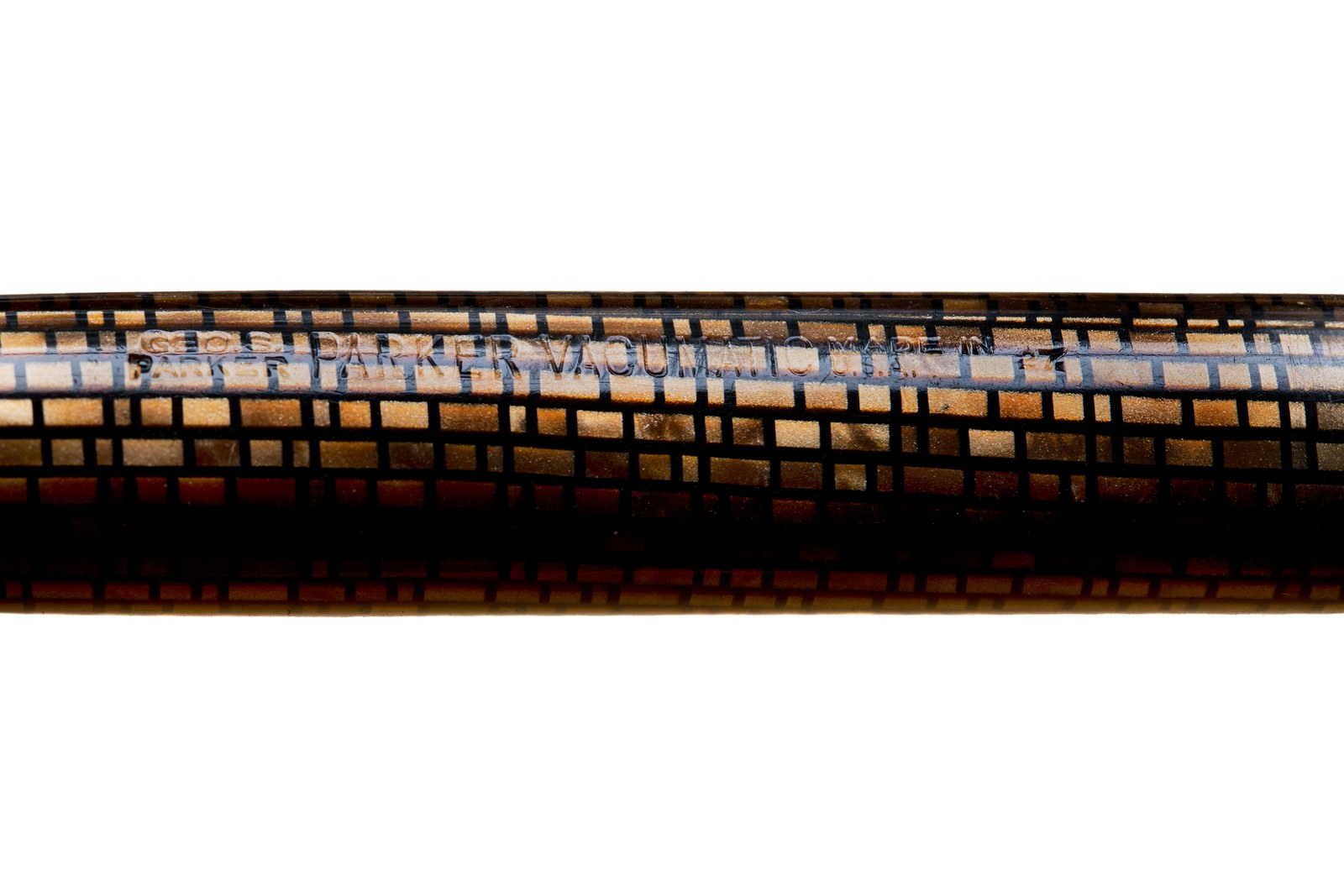
A 1937 Golden Web Vacumatic Junior. The imprint runs along the top of the barrel, almost lost in the pattern until the light catches it. (Donal Higgins)
Pick up a Parker Vacumatic that has spent eighty years in shirt pockets and desk drawers, and the barrel often looks blank. It isn't. Somewhere along its length Parker pressed in its own name, the pen's name, the country it was made in and, on most pens made after the middle of 1934, a small code that dates it to within three months. Pocket wear, polishing and old ink have softened the letters, but they are almost always still there, waiting for the right light.
The imprint matters more on a Vacumatic than on most pens. Parker made the line for some fifteen years in the United States and longer in Canada, in dozens of sizes, colours and trim levels, and changed the clip, the filler, the nib and the jewels as it went. The imprint is the one part of the pen that was stamped on the day it was made, so it is where any serious attempt to date a Vacumatic starts.
Where to look
The main imprint is on the barrel, running lengthways. Parker also stamped the nib, and on most nibs from 1934 on there is a second date code there. Matching Vacumatic pencils carry their own imprints and codes too, so a pen and pencil sold as a set can be dated separately.
The cap's clip, band and jewel are useful clues to when the pen was made (more on them below), but the words and numbers you are after are on the barrel and the nib.
Bringing a faded imprint back
An imprint is stamped into the celluloid, not printed on it, so even a worn one survives as shallow dents. The trick is to light them from the side rather than from the front.
- Use one small light, held low. A desk lamp with a narrow head, a phone's torch or an LED on a flexible arm all work. Bring it down until it is almost level with the barrel, so the light skims across the surface and every dent throws a shadow.
- Turn the pen slowly. As the light catches the edges of each letter, the imprint will appear and fade. Stop where it reads best, then try the light from the other end of the pen: some letters only show from one direction.
- Look through a loupe. A 10x jeweller's loupe makes the small date code much easier to read than the name. The dots of the later codes are tiny and are the first thing to wear away.
- Turn off the room lights. Light from the ceiling fills in the shadows that make the letters readable. One light in a dark room works best.
- Don't polish over it. Every pass with an abrasive takes a little more off the edges of the letters, and a buffing wheel can remove a weak imprint in seconds. Clean the barrel with a soft cloth and plain water, and keep any polishing compound well away from the imprint.
Some barrels really are bare. Richard Binder gives the two likeliest reasons a pen that should have a code has none: a replacement barrel fitted outside the factory, which would have no imprint at all, or an imprint buffed away by an over-keen restorer.
Others were simply stamped lightly. Late Canadian pens are known for weak imprints; the dealer David Isaacson of Vacumania calls them "notoriously weak," so a faint one there is no sign that anything is wrong.
The four parts of an imprint
A typical American imprint of the mid-1930s has four parts, read left to right along the barrel. The one on the Golden Web pen above reads like this:

The whole imprint, lit from one side. (Donal Higgins)
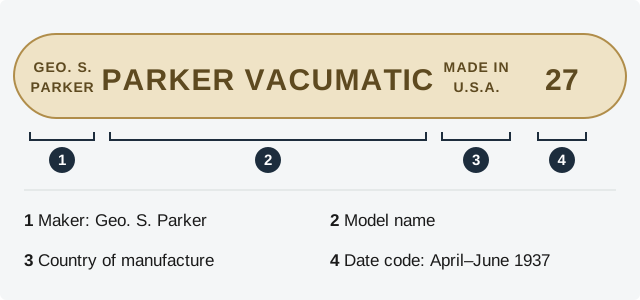
The same imprint, taken apart.
- The maker. "GEO. S. PARKER," stacked in two small lines, after the company's founder, George Safford Parker.
- The model name. "PARKER VACUMATIC" in the largest letters. On the first pens of 1932 and 1933 this says something else (see below).
- The country. "MADE IN U.S.A.," again stacked. Canadian pens say "MADE IN CANADA."
- The date code. Here "27": the second quarter of 1937.
Not every imprint has all four. Some special pens carry the model name alone, and the earliest have a patent mark where the date code would later go.
What the name tells you
The Vacumatic had three names in its first year, and the barrel shows which one a pen was sold under.
- Golden Arrow. Parker test-marketed its new pen in the second half of 1932 (its dealer newsletter, the Parkergram, covered it from August to November) as the Golden Arrow, with an imprint reading "Geo. S. Parker GOLDEN ARROW Made in U.S.A." It was dropped within months, perhaps because a British pen already used the name. Golden Arrows are rare: in ten years and more than sixty pen shows, David Isaacson saw only about ten.
- Vacuum Filler. The next name, advertised in a full-page Saturday Evening Post spread on March 18, 1933, with "VACUUM FILLER" in place of the model name.
- Vacumatic. The name that stuck, in 1933. Sources disagree on the exact month (the Parker Collector says the Vacuum Filler name went in February; Richard Binder dates the rename to July, with advertising from late September), and pens from the changeover are found with both imprints.
One of the strangest finds in the series is a barrel carrying a Vacumatic imprint on one side and the ghost of a Vacuum Filler imprint on the other. David Isaacson owns one. Nobody knows for certain why: it may be an early barrel that was stamped again when Parker used up old stock, or a factory replacement barrel for an older pen.
A caution about the first name: there was also an English "Golden Arrow" button-filler, which the Parker Collector says was not made by Parker. A Golden Arrow with a button at the end of the barrel is not the 1932 Parker.
The patent mark
The Vacumatic's filler, a plunger in the end of the barrel that flexes a rubber diaphragm, came from Arthur O. Dahlberg, who filed for a patent on it in September 1928. The patent was granted on April 18, 1933, by which time it belonged to Parker. Before date codes began, early Vacumatic barrels carried a patent mark in the imprint instead, and David Isaacson notes that a "Pat." marking with no date code points to a pen made before the third quarter of 1934. Some barrels from the changeover carry both the patent mark and one of the first codes, and there the code gives the date. Canadian imprints are different again: they often carry a patent number in every year, so on a Canadian pen it is no guide to the date.
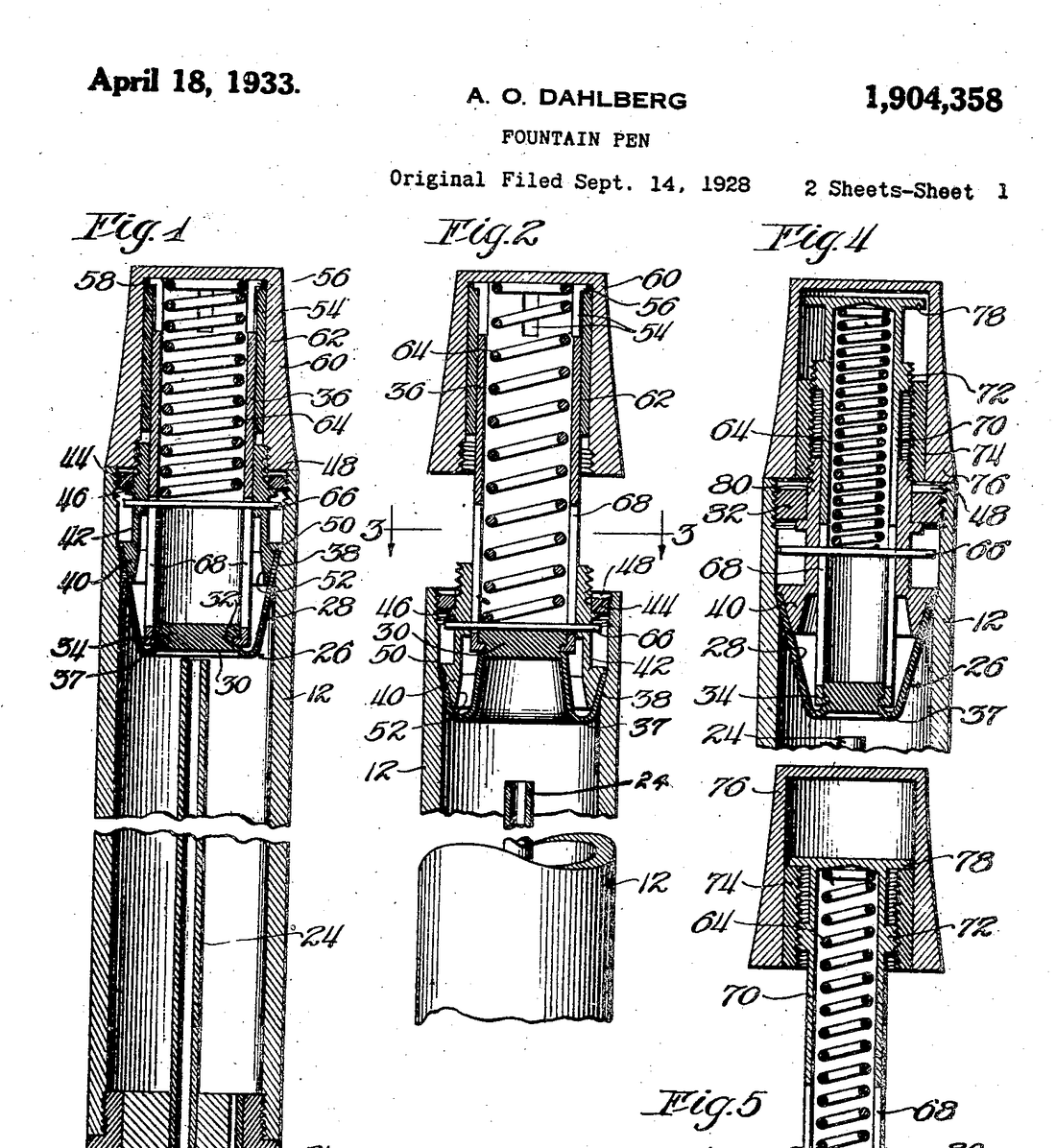
Arthur O. Dahlberg's patent for the Vacumatic filler, filed in 1928 and granted to him and Parker in 1933. (U.S. Patent 1,904,358)
Other words you may find
- "MARCA REGISTRADA." Spanish and Portuguese for "registered trademark." David Isaacson has seen it on some American pens of 1937 to 1940 and believes they were made for South America. He collected a near-complete set of Senior Maximas carrying it.
- "MADE IN CANADA" and "REG." Canadian imprints read along the lines of "MADE IN CANADA PARKER VACUMATIC REG.," often with a patent number, and the Canadian factory followed its own timetable: it kept making Vacumatics until about 1953, long after the American factory stopped in 1948, and made some sizes and colours (such as laminated Burgundy Pearl) that the American factory never did.
- "VACUMATIC" alone. A few pens skip the usual wording. The Candy Stripe Vacumatics, which the Parker Collector says were made in England from old Valentine pen company stock, carry only "Vacumatic." So does the "Vacufold," a pen that looks like a striped Duofold but fills like a Vacumatic: the barrel imprint, not the look, tells you which it is.
Reading the date code
In the middle of 1934 Parker began stamping a date code on most of its pens and pencils, on both the barrel and the nib. On a Vacumatic barrel it sits at the right-hand end of the imprint. There are two systems, and knowing which one you are looking at is most of the work.
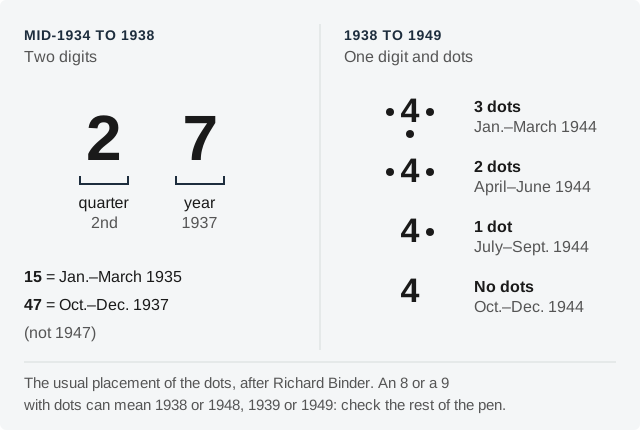
The two date-code systems of the Vacumatic years.
Two digits: quarter, then year (mid-1934 to 1938)
The first codes are two digits. The first gives the quarter of the year and the second the last digit of the year. A 27 was made in April, May or June 1937; a 15 in the first three months of 1935; a 36 in the summer of 1936. A 47 was made in the fourth quarter of 1937, not in 1947: it is the most common misreading of a Vacumatic code.
The Parker Collector gives the earliest date code yet found on a Vacumatic as the second quarter of 1933, a year before the system was in general use, so treat any code from before mid-1934 as rare and worth a second look.
One digit and dots (1938 to 1949)
In the second quarter of 1938 Parker changed to a single digit for the year, with up to three dots beside it for the quarter. The die started each year with three dots, and one was ground off each quarter:
- Three dots: first quarter (January to March)
- Two dots: second quarter (April to June)
- One dot: third quarter (July to September)
- No dots: fourth quarter (October to December)
So a 4 with three dots is early 1944, and a bare 1 is late 1941. Richard Binder gives the usual placement: three dots sit one on each side of the digit and one below it, two sit one on each side, and a single dot sits to the right. Because the change came in the second quarter of 1938, a code with three dots should be from 1939 or later. Both systems ran at once for a while: the second quarter of 1938 turns up as either 28 or .8.
Which decade?
Because the dot system started in 1938, a single digit from 0 to 7 can only mean 1940 to 1947. The doubt is over 8 and 9, which could be 1938 or 1948, 1939 or 1949. Here the rest of the pen decides it (see "Dating the pen without a code," below). A Blue Diamond clip, for example, rules out 1938, since Parker introduced it in 1939.
After 1949
From 1950 Parker went back to two digits, but now they simply gave the year: 50 means 1950. The American factory had stopped making Vacumatics in 1948, so these codes turn up mostly on Canadian pens, which ran until 1953 (a Canadian barrel stamped 53 is one of the last). The Vintage Pen Catalog's David Nishimura notes that a few late Vacumatics were date-coded into the early 1960s.
Parker's English and French factories didn't date-code their pens until 1980, according to the Parker Collector, so a Vacumatic made in England can't be dated from its barrel.
The oddities
Parker's stamping was not perfect, and collectors have catalogued its mistakes:
- Missing or misplaced dots. Some codes are missing a dot, and on some the quarter mark is on the wrong side of the year.
- Upside-down codes. A run of first-quarter 1941 pens has the date stamped upside down.
- Sideways codes. David Isaacson often found a "lateral" date code, turned on its side, on pens from the fourth quarter of 1935.
- Two digits with dots. A few pens made just before the change of 1938 combine a two-digit code with dots. David Nishimura suggested the dots mark the month within the quarter, and Richard Binder reads them that way: a 28 with three dots would be April 1938, the first month of the second quarter. David Nishimura’s own page counts one dot fewer (two dots for the first month). No Parker document has turned up to settle it.
The nib imprint
The nib has its own imprint, and it changed often enough in the 1930s to help date a pen whose barrel is worn. These are the main American and Canadian styles, as listed by the Parker Collector and David Isaacson. "Top line" means the expensive models; "bottom line" the cheaper ones.
| Nib imprint | Used on | Years |
|---|---|---|
| "Parker Vacuum Filler Made in USA" | Vacuum Fillers | 1933–1934 |
| "Parker Vacumatic De Luxe" | Top line; rare | 1933, perhaps 1934 |
| "Parker Vacumatic Made in USA," no arrow | Bottom line | 1933–1934 |
| Arrow over "USA Parker," two-tone gold and platinum | Top line | Until 1936 |
| Arrow over "USA Parker," plain gold | Bottom line | 1934–1935 |
| Arrow over "Parker USA," two-tone | Top line | 1936–1941 |
| Arrow over "Parker USA," plain gold | Bottom line from 1935; top line from 1942 | 1935–1948 |
| "Parker Vacumatic Reg TM Made in Canada" or "Parker Canada" | Canadian pens | Various |
Two-tone nibs, with a platinum-coloured mask around a gold arrow, mark the higher-priced pens until the United States entered the war; after that nearly all are plain gold, though David Isaacson has seen two-tone nibs dated as late as 1946. Many two-tone nibs have simply lost their mask to decades of wiping, so a plain nib on an early top-line pen isn't proof of a replacement. The nib's date code can be hidden under the front of the gripping section, so you may not be able to read it without taking the pen apart.
Dating the pen without a code
When the code is worn away, or reads 8 or 9, the rest of the pen narrows things down. Collectors usually group Vacumatics into generations by their filler; Vacumania's "4 Generations of the Parker Vacumatic" is a good guide to the details. The main changes in the American pens were these:
| Part | What changed | When |
|---|---|---|
| Name on barrel | Golden Arrow, then Vacuum Filler, then Vacumatic | 1932–1933 |
| Barrel code | Patent mark, no code | Until mid-1934 |
| Two digits, quarter and year | Mid-1934 to mid-1938 | |
| One digit with dots | Mid-1938 to 1949 | |
| Filler | “Lockdown”: metal plunger that locks down (aluminium; some early ones chrome-plated steel), short blind cap | 1933–1937 (a few as late as 1939) |
| “Speedline”: metal plunger that springs back, longer blind cap | 1937–1941 | |
| Plastic plunger with a mushroom-shaped button, rounded blind cap with no jewel | 1942–1948 | |
| Plastic collars holding the filler in place (wartime; metal again after the war) | About 1942–1945 | |
| Clip | Plain feathered arrow: no lettering, star or diamond | 1932 to early 1939 (Shadow Wave pens to about 1940) |
| Split arrow, “PARKER” between its halves | From about 1937 | |
| “PARKER” inside a long V, on the cheaper pens | From 1938 | |
| Star near the foot | Late 1938 to early 1940 | |
| Blue Diamond (lifetime guarantee), on pens priced at $8.75 and up | 1939–1948 | |
| Plain diamond, blue enamel removed | About 1947 | |
| Cap bands | Three narrow rings, all the same (better pens) | 1932–1937; lockdown Standard to 1939; “Streamlined” models to about 1941 |
| Three rings, the middle one wider (the Senior) | About 1935–1936 | |
| Two narrow rings (cheaper pens, such as the Junior) | Throughout | |
| Raised letters VACUMATIC, about 5 mm (4 mm on the Major and Debutante) | About ten weeks of 1937 | |
| Chevron band, about 5 mm: lines leaning left and right (Senior Maxima, Slender Maxima) | 1937–1941 | |
| Chevron band, about 4 mm (Major; the Maxima too from 1942) | 1937–1948 | |
| Chevrons and diamonds, about 3.5 mm (Junior Debutante, Debutante) | From 1938 | |
| Plain, about 2 mm (Sub-Deb) | From 1939 | |
| “Jeweler’s” band: much wider, finely lined, broad plain edges, large panel | 1939–1941 | |
| Very broad solid or gold-filled band, often Canadian | 1938 (later in Canada) | |
| “Stacked coin”: ridged, uncatalogued | Sources differ: 1937–1941 or about 1942–1945 | |
| Jewels | Striped jewel at each end on top-line pens | To about 1939 |
| Jewelled blind cap dropped to save metal | 1942 | |
| Section | Striped, matching the barrel (Slender, Standard, Oversize) | To early 1939 |
| Black (always on the Junior; on every model after the Speedline restyling) | Throughout |
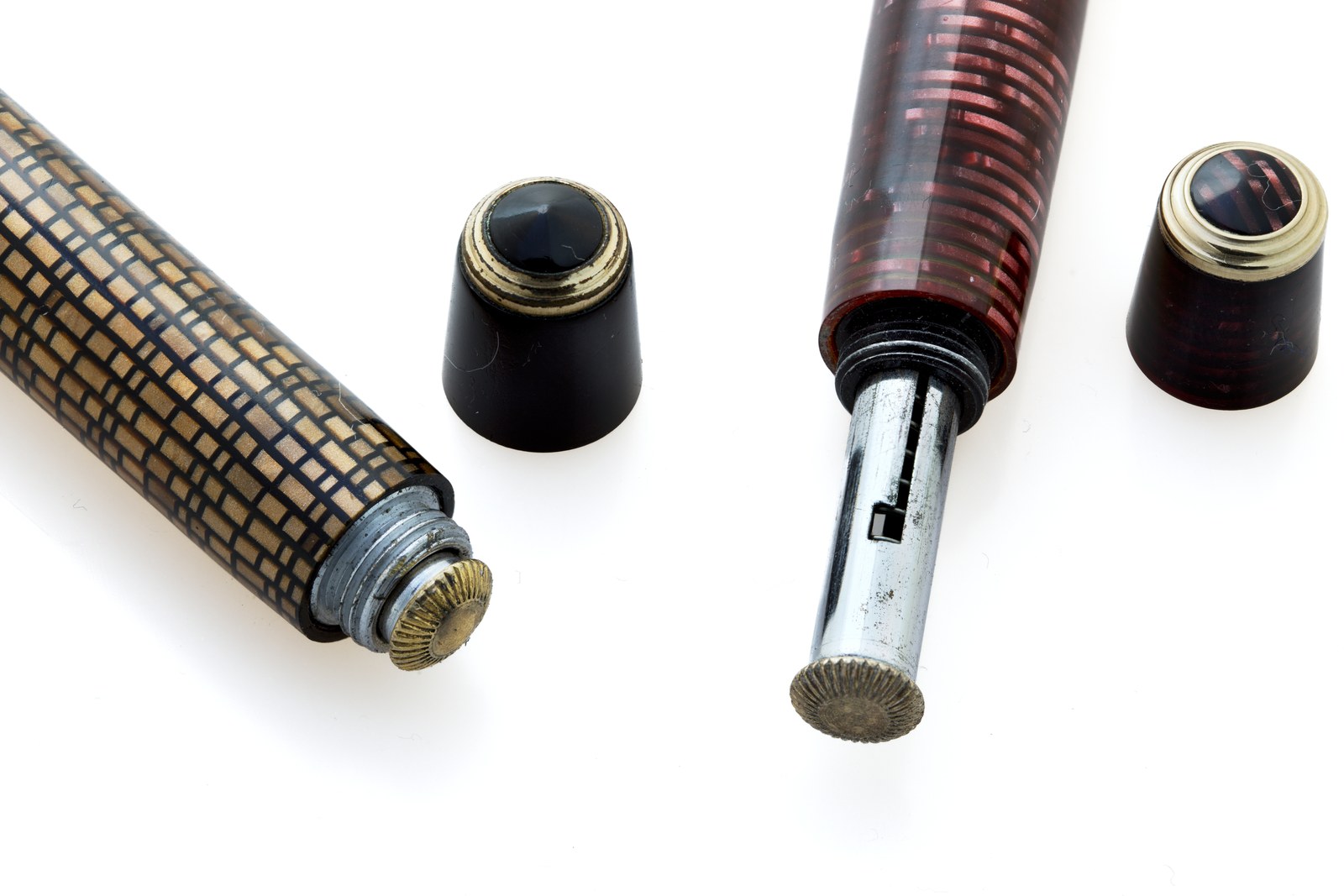
Two first-generation "lockdown" fillers, the Golden Web pen on the left. The metal plunger and short, jewelled blind cap belong to the years before 1937. (Donal Higgins)
The first quarter of 1939 is a good example of how quickly things changed: David Isaacson calls it "the one quarter when three different clips can be properly found," as the plain feathered arrow and the Star gave way to the Blue Diamond on the better pens. The cheaper pens had already taken “PARKER” lettering on the clip from about 1937, so after early 1939 a new pen’s clip carried lettering, a star or a diamond, almost never nothing at all. Every Vacumatic clip is a feathered arrow of some kind, so what dates one is what else is on it: lettering, a star or a diamond. The clip and the bands belong to the cap, and caps were easily swapped between pens, so a clip that doesn't match the barrel's code often means the cap came from another pen.
Size
Size helps too, once you know what to measure: the length with the cap on, and the width at the widest point. The model name is rarely on the pen, and sellers often get it wrong; a "Senior" in a listing may be a Senior Maxima, a Slender Maxima or a Major. The table brings together three sources: Tony Fischier's model tables at the Parker Collector, Parker Vacumatic (2008) by Geoff Parker, David Shepherd and Dan Zazove, written with the Parker Pen Company (135 mm for the Senior and the Maxima), and about 170 measured, dated pens in David Isaacson's Vacumania sales archive. Pens vary by a millimetre or two.
| Model | Length, cap on | Width | Usual band | Years |
|---|---|---|---|---|
| Oversize | 135–141 mm | 15 mm | 3 rings | 1933–1937 |
| Senior Maxima | 135–139 mm (most measured pens 135–136) | 16 mm | 5 mm chevron; 4 mm from 1942 | 1937 to the late 1940s |
| Senior | 135 mm | 14 mm | 3 rings, wider middle | About 1935–1936 |
| Slender Maxima | 135 mm | 14 mm | 5 mm chevron | 1937–1941 |
| Streamlined Standard | About 135 mm | 14 mm | 3 rings | 1938–1941 |
| Major, “long” | 135–136 mm | 14 mm | 4 mm chevron | Late 1938–1942 |
| Major | 128–131 mm | 14 mm | 4 mm chevron | 1937–1948 |
| Standard | 129–131 mm | 14 mm | 3 rings | 1933–1940 |
| Junior | 123–124 mm; 128–132 mm from 1939 | 14 mm | 2 rings | 1933–1948 |
| Slender | 125 mm | 12 mm | 3 rings | 1933–1941 |
| Juniorette (Junior Slender) | 121 mm | 12 mm | 2 rings | 1934–1938 |
| Junior Debutante, Debutante | 118–121 mm | 12 mm | Chevrons and diamonds | From 1938 |
| Sub-Deb | 110–115 mm | 11–12 mm | 2 mm plain | From 1939 |
| Sub Junior (“Stubby”) | 109–112 mm | 14 mm | 2 or 3 rings | 1932–1934 (and some 1937–1939) |
The sources agree closely except on the Senior Maxima, which the Parker Collector gives as 139 mm, and Richard Binder (5 11/32 in., 136 mm), the measured pens and Parker Vacumatic as about 135–136 mm. Richard Binder also gives each model’s barrel diameter, a useful check with calipers: Debutante 10.7 mm, Junior and Standard 11.9 mm, Major and later Junior 12.2 mm, Senior Maxima 13.2 mm, Oversize 13.5 mm. His typical Speedline Major of 1937–1941 is the 135 mm “long” one, and his wartime Major 129 mm. Lengths alone won't separate the 135 mm pens: the Slender Maxima, the long Major and the Streamlined Standard are nearly identical, and are told apart by the cap band (a 5 mm chevron band, a 4 mm chevron band, three rings) and by the Slender Maxima's larger nib. In the same way, a 130 mm pen is a Major, a Standard or a later Junior, and the bands tell you which: a 4 mm chevron band, three rings, or two rings.
When the clues disagree
Parker built pens from the parts it had on hand, and it was not above using up old stock, so a Vacumatic's parts don't always agree.
- Nib older than the barrel. A pen with a barrel from the first quarter of 1940 can turn up with a nib from the second quarter of 1939, straight from the factory. A nib can also simply have been replaced some time in the last eighty years. Date the pen by its barrel, and treat the nib's code as a footnote.
- Old plastic, new code. Between about 1937 and 1939 Parker seems to have used up leftover opaque celluloid from 1932 and 1933, so early-looking pens turn up with late-1930s codes. The short, fat "Stubby" is known with Golden Arrow and Vacuum Filler imprints, and also with Vacumatic imprints and 1937 to 1939 codes.
- Old shapes, new parts. David Isaacson has seen about six first-generation Oversize pens with a Senior Maxima cap band and a 1940 barrel code, always in red.
- Leftover clips. The Star clip was meant for the top-line pens of early 1939, but leftovers turn up on cheaper pens such as the Shadow Wave as late as early 1940. Most Shadow Wave pens went further and kept the plain 1930s arrow to about 1940, after the other cheap pens had taken the lettered clip.
- Pen and pencil a year or two apart. Sets were often put together from stock, so a 1939 pen with a 1940 pencil is quite normal.
David Nishimura offers a useful rule: codes that seem too late for the pen turn up quite often, for the reasons above, but codes that seem too early don't. So if a barrel's code is older than its clip or filler allows, such as a 1937 barrel with a Blue Diamond clip, suspect that a part has been swapped since.
Putting it together: the Golden Web pen
The pen in the photographs shows how the clues fit. Its imprint reads "GEO. S. PARKER / PARKER VACUMATIC / MADE IN U.S.A." with the code 27, so the barrel was finished in the second quarter of 1937. Golden Web, a gold-and-black pattern used on the cheaper Junior pens, was only made in 1936 and 1937, and the pen has the black blind cap those pens were given and the first-generation lockdown filler, which the Speedline began to replace that year. Every clue agrees: a Vacumatic Junior from the spring of 1937, near the end of the lockdown era.
Photographing an imprint
The same low light that helps you read an imprint makes it show up in a photograph. Put the pen on a plain background, light it from one side only, as low as you can, and focus on the date code rather than the name, since it is the smallest thing you need to show. A macro lens or a phone's close-up mode, a tripod and a slow turn of the pen will catch the moment the letters come up out of the stripes. For pens with transparent stripes, a second, weaker light behind the barrel lifts the pattern without washing out the letters.

Date your Vacumatic
Put it all together with the Pentrace Vacumatic Dater. Pick what you can see on your pen (its imprint, filler, clip, cap bands, size, nib and colour), or on your pencil (its imprint, clip, cap bands and colour), and it works out when and where it was made, which model it most likely is, and which of its parts fit that date. You can link straight to it at pentrace.ink/vacumatic-dater, and every result has a link of its own to share.
Further reading
- Anatomy of a Fountain Pen II: The Parker Vacumatic, Richard Binder's guide to how the pen is put together.
- Colors: The Parker Vacumatic, Richard Binder’s 2001 colour chart for Pentrace, with the years each colour was made (his profile, below, has the revised dates).
- Pen Doctor: The Other Vacumatic Tool, for when your dated pen needs a new diaphragm.
- Parker date codes, David Nishimura's reference at the Vintage Pen Catalog.
- Golden Arrow, Vacuum Filler, Vacumatic, the Vacumatic model guide (by filler and cap band) and Date codes, Tony Fischier’s pages at the Parker Collector.
- The Parker Vacumatic, Richard Binder's profile, with sizes, clip dates and colours, and his Parker’s Date Coding Systems.
- 4 Generations of the Parker Vacumatic, David Isaacson's essay at Vacumania, whose archive of sold Vacumatics describes hundreds of real imprints.
- Parker Vacumatic, by Geoff Parker, David Shepherd and Dan Zazove, in collaboration with the Parker Pen Company (Brighton: Surrenden Pens, 2008; ISBN 0-9546875-3-1).
- U.S. Patent 1,904,358, Arthur O. Dahlberg's patent for the filler.