



Montblanc 149 Feed Question
A question from Robert Arief on the Pentrace Message Board led me to investigate whether my own 1990's Mont Blanc 149 has an ebonite or plastic feed.
Robert asked - "This is photograph of my Montblanc 149 feed. The nib is two tone 14C. Is the feed a modern plastic feed or is the feed an ebonite? Hope someone here can help"
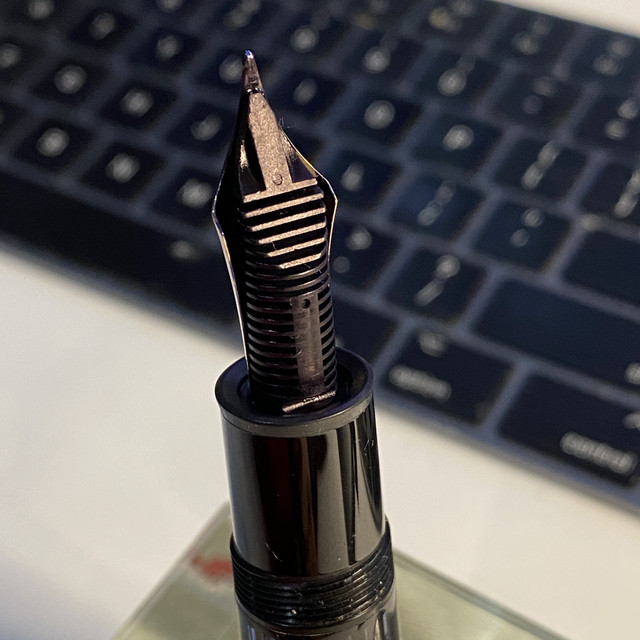
Robert's MB 149 Feed (Photo by Robert Arief)
I have a 1990s 149 myself, so your question got me curious about which side of the ebonite/plastic line mine falls on. I did a bit of digging and thought I'd share what I found in case it helps.
Short answer: a two-tone 14C nib points strongly to an ebonite feed, most likely the split-ebonite type – provided the nib and feed are original to the pen.
The nib is the best clue to the feed. Roughly, the pairings go like this:
- Tri-tone 18C / 14C nibs (1950s – early 1970s): ebonite feeds – the early flat "ski-slope" feed, then round grooved ebonite feeds.
- Two-tone 14C nibs (1970s – mid 1980s): solid ebonite, then split-ebonite feeds. This looks like your pen.
- Two-tone 14K / 18K nibs (mid 1980s – early 1990s): a transitional era. Late split-ebonite feeds carried on for a while, then Montblanc moved to plastic around 1990–92, with a short overlap when both were fitted.
- Tri-tone 18K nibs (from 1994): plastic feeds. The first-generation plastic feed (roughly 1992–95) looks very like ebonite at first glance, which can cause confusion.
Since your nib is marked 14C rather than 14K or 18K, it sits in the ebonite era by a comfortable margin.
A caveat: nibs and feeds get swapped during repairs and nib exchanges, so the nib alone isn't proof. A few things to check:
- Colour and finish: ebonite often fades to a dull brownish or greenish black with age, while plastic stays a uniform glossy black. Your photo does show a slightly brownish tone, although lighting can play tricks.
- Smell: ebonite is hard rubber, and some owners notice a faint sulphur smell when the pen is uncapped or the feed is warm.
- The split: a split-ebonite feed is made in two parts, which you can usually see as a seam or division along the underside under magnification.
I'd avoid pulling the feed to check – ebonite feeds in these pens are usually a tight fit and are best removed with the proper tool, so that's a job for a pen repairer like the one Len suggested.
Sources I found useful:
- Ink Delta – What to look for when pursuing a Montblanc 149 (good photos of the plastic, split-ebonite and early feeds side by side)
- FPN – Montblanc 149 feed
- FPN – Differences of solid ebonite, split and plastic feeds for the 149
- Hepworth Dixon – Montblanc Meisterstück 149 timeline
- r/fountainpens – Ebonite vs plastic feeds: do you notice that big a difference?
Also this article from Pentrace.ink
My Montblanc 149s - 1952 to 1990
There's also a video on the topic:
Ebonite Feeds. How to distinguish them?
Here are two close-ups of my own 149.
The nib
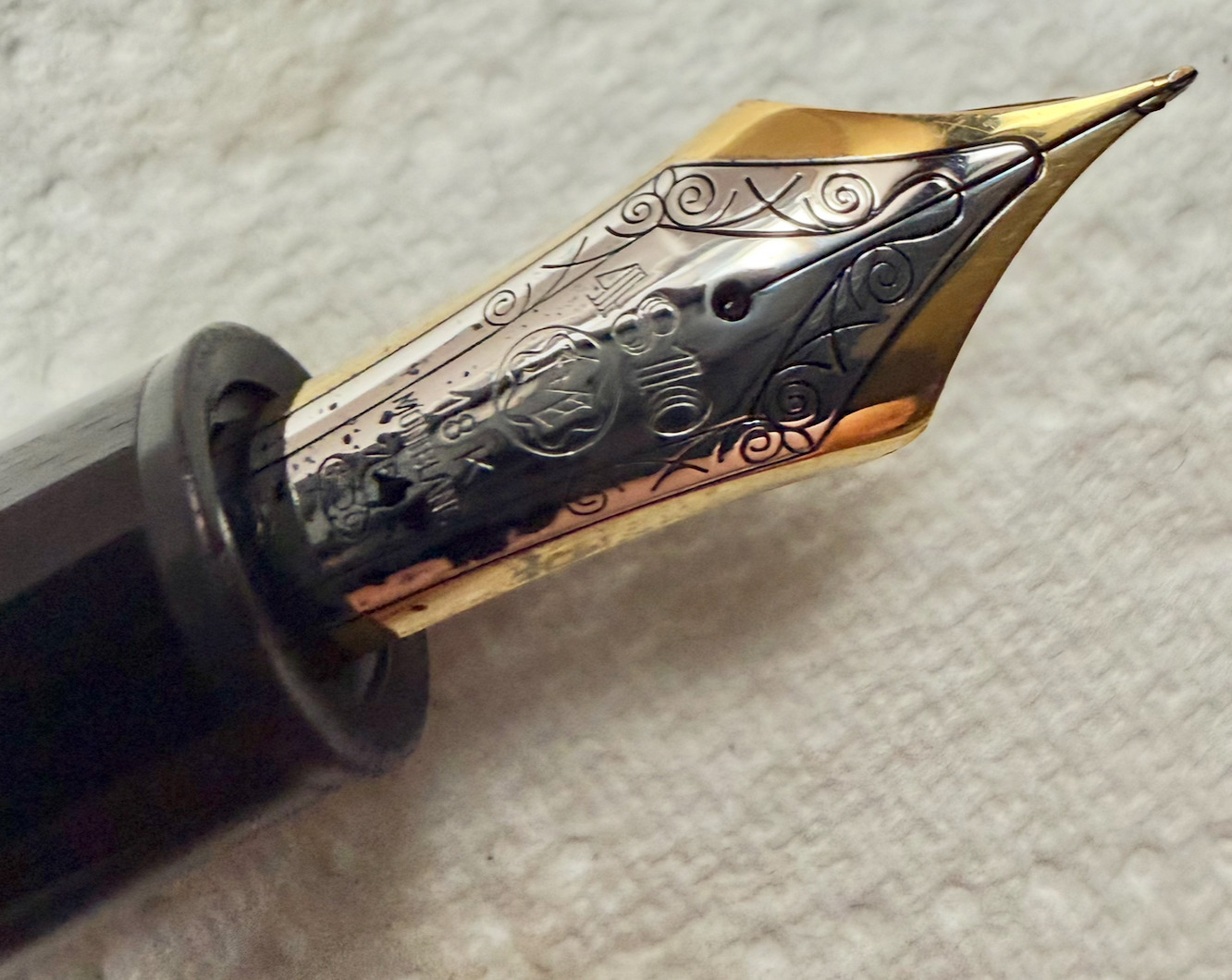
The two-tone 18K gold nib, with the 4810 and Montblanc imprints on the rhodium-plated centre and the usual scrollwork around it. (full-size photo)
The feed
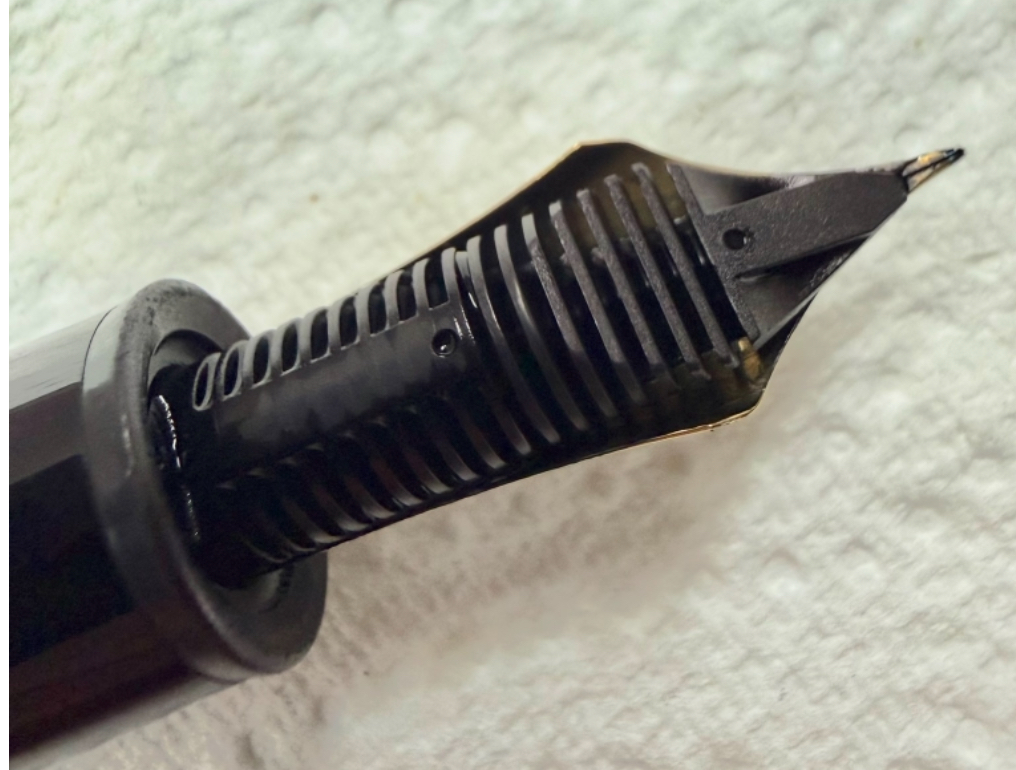
The underside, showing the finned feed. I believe mine is plastic rather than the ebonite of earlier 149s: it has the crisp, even fins and flat matte black of a moulded feed. If anyone can confirm from the photo, I'd be glad to hear it. (full-size photo)