

Pentrace East: Japanese Yatate Information Page
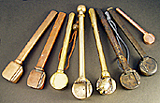

If someone were to bring up the topic of Japanese antiques, what images would come to your mind? Kimono? Swords? Armor? Possibly netsuke? A few might even know what an inro is. How about the yatate?
I have conducted informal surveys among my Japanese acquaintances here in Tokyo, and was surprised that the average Japanese does not even know what a yatate is!
A yatate (pronounced yah-tah-teh) is a Japanese portable writing set. The yatate has been around since the Kamakura period (1185-1333). It contains a traditional Japanese bamboo brush and an ink pot filled with cotton which holds liquid sumi ink.
Yatate literally means "arrow stand."
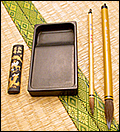 Ink stick, grinding stone and bamboo brushes |
The Japanese traditional way of writing is with a brush (fude) and ink (sumi). Before the invention of the yatate, whenever anyone wanted to write or draw in ink, he had to make his own ink by grinding the ink stick in water on the grinding stone (suzuri). This method has been used for many centuries, and is still being used today.
Warriors (samurai) often had to write letters and reports from the field, and so carried a small grinding stone in a small drawer at the bottom of their quiver along with the arrows.
 This grinding stone became known as the "yatate no suzuri" (arrow stand's grinding stone). Eventually it was simply called "yatate."
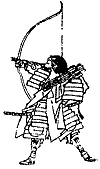 It was burdensome to have to pull out the grinding stone, ink stick, and water container every time one needed to write, but in those days before spill-proof containers, carrying liquid sumi ink could lead to disasters, especially on the battle field.
Then sometime during the Kamakura era (1185-1333 ) someone came up with the clever idea of saturating a piece of cotton in liquid ink. This could be carried about in a simple container without any worry of spills.
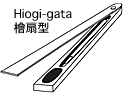 A truly portable writing set was finally born. Now one could quickly dash off a letter by just sliding open the lid and pressing the brush into the cotton.
These new writing sets were made in the shape of a folded fan (hiogi-gata) which contained both the ink soaked cotton and brush.
Warriors continued to carry these in the quiver with the arrows, so they were also called yatate just like the grinding stones they replaced.
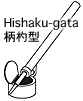 These new writing sets were very convenient, but the ink capacity was rather small in this slim, compact design. As the yatate grew in popularity, the demand for larger ink containers brought about a change in its shape.
By the time the Edo era had arrived (1603-1867) almost all were shaped like a dipper (hishaku-gata) with a tube-like container for the brush, and a hinged ink pot (sumi tsubo).
Originally used exclusively by the Samurai, the yatate became very popular with merchants, scholars, and the common folk.
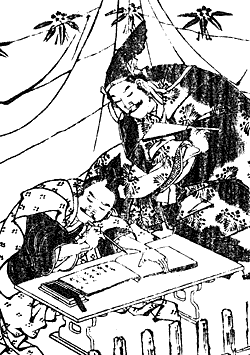
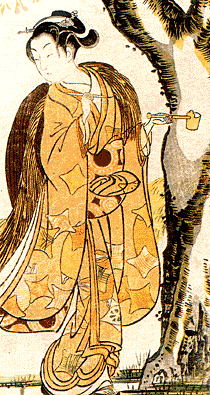 From a wood block print by Suzuki Harunobu National Library in Paris. |
Although most people hung the yatate from their waist sash (obi) by a cord with an ornamental button (netsuke) which kept the cord from slipping, some people simply tucked the yatate in their obi for quick use.
The yatate was a part of daily life. Not only was the yatate an extremely useful invention, it was also a fashionable accessory, and could be seen proudly hanging from waists all over Japan.
Since only the samurai were allowed to carry swords, it is said that many men preferred a big heavy yatate in case they needed a handy weapon.
Other items often seen hanging from obi included pipe (kiseru) and tobacco holders and small cases (inro) for carrying seals, medicine and small objects.
For those who went on journeys, the yatate was an indispensible piece of equipment for sending word to their families that they were safe, and for writing in their travel journals. Many masterpieces of literature from the Edo era owe their existence to the yatate. Traveling artists were able to fill their sketchbooks with on-the-spot drawings thanks to the yatate.
Although the dipper shape was practically the only yatate style for centuries, there were as many variations in design and decoration as there were craftsmen producing them.
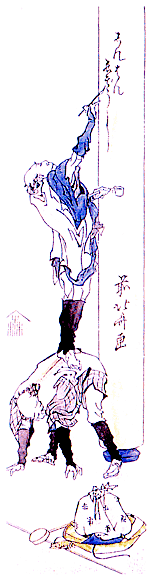 The yatate was perfect for writing quick graffiti without getting caught! A variety of materials were used to create the yatate such as copper, brass, gold, silver, iron, shibuichi, sentoku, shakudo, ivory, bamboo, rattan, and chinaware. Decorations included mother of pearl or ivory inlays and maki-e (gold sprinkled into urushi lacquer). During the middle of the Edo era, there was a ban on luxurious homes and clothing in Japan, so those who had the money to afford luxury would enjoy it in the form of a fancy yatate which was not covered by the ban. Craftsmen continued to experiment with new designs, and it was not uncommon to find a yatate that resembled a short sword or an arrow.
Even after new styles came along, the older styles remained popular, so it is not possible to determine the date of a yatate based on the shape alone. By this time many craftsmen stopped using brass for yatate production and began using an alloy of copper and gold called "shakudo". Shakudo is a Japanese invention, and has no English equivalent term. New shakudo looks just like copper, but over time the surface turns a beautiful dark purple color, almost black. This is due to the addition of gold. Regular copper would turn green. The coloration, or patina, will come off if you rub it enough, but since shakudo was created with this beautiful patina in mind, it's best left as it is, in its patinated state. In the early 20th century, an new invention, the fountain pen was imported from the west, causing many Japanese to abandon the yatate. However some people continued to prefer them over their western counterparts.
Although some of the early fountain pens had very flexible gold nibs, none could compare with the expressiveness and line variation of a brush, especially for drawing, as well as writing Japanese characters.
The fountain pen as we know it has been around for a little over a hundred years, but before that the yatate was widely used as the only portable writing system in Japan for some seven hundred years.
I have done sketches with my yatate of people on the subway. The slim bamboo brush allows for much better line control than a brush pen, and it also can produce much finer consistent hair lines. Although the yatate is still being put to good practical use, it has also become popular with collectors all around the world. And as the photo on the left indicates, it also qualifies as a genuine museum piece. They are becoming increasingly difficult to find in antique stores throughout Japan, and are very rare in the west. Occasionally one can find a yatate on eBay. Samurai dramas known as "jidai geki" or "chambara" have always been popular on Japanese television, and may be compared to cowboy TV westerns in America. Although not usually historically very accurate, they are entertaining. Here the bad guys tie up the wealthy widow and thrust a yatate in her face, demanding she sign over the Japanese version of the "deed to the ranch." 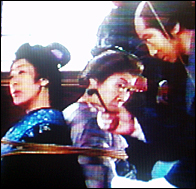
Scene from The long running television series Mito Komon. |
 Near the end of the Edo era, a new style of yatate appeared with separate brush and ink containers connected by a cord or chain (inro-gata). One could insert the tube shaped brush holder in the obi and let the ink pot hang loose like an inro. This style became fashionable for a short time, but eventually the one-piece dipper shape returned as the prevalent style.
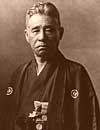
 Even today the yatate is popular with artists as well as brush calligraphers. American watercolorist
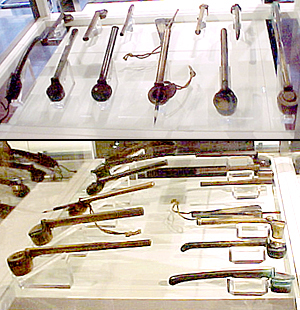
Some yatate photos:
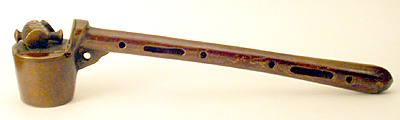
Brass yatate with "kozuchi" and "koban" design on the lid.
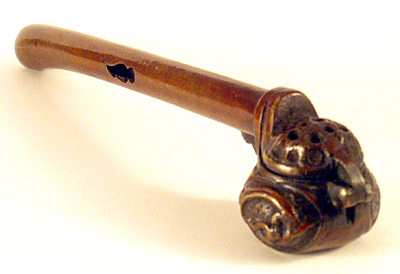
Brass yatate with unusual design that defies description.
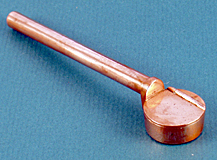
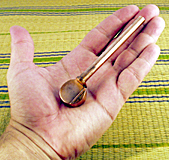
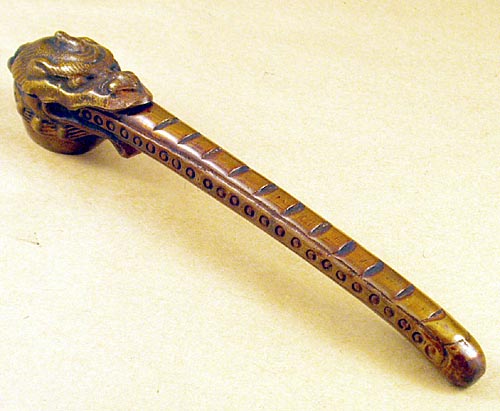
Frightening dragon yatate with long tongue.
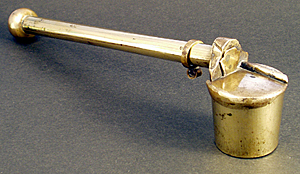
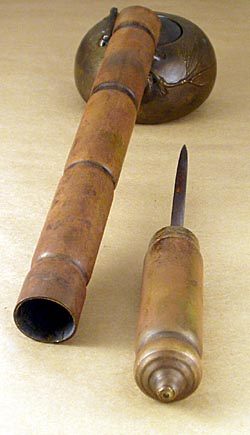 Huge yatate (my thumb will fit in the handle) with hidden knife which made up part of the handle. This was reportedly used by Ninjas, and the knife was for more than just opening letters! |
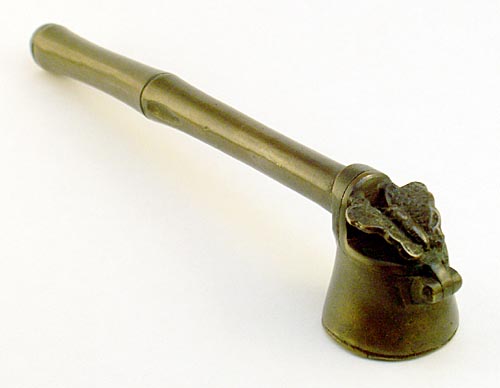
Yatate with butterfly decoration
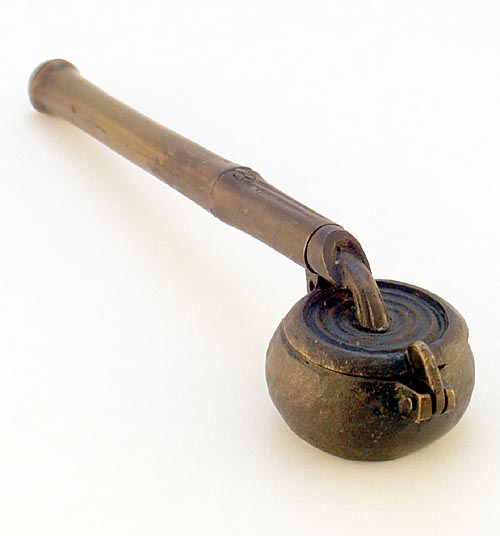
This yatate resembles a pool of water.
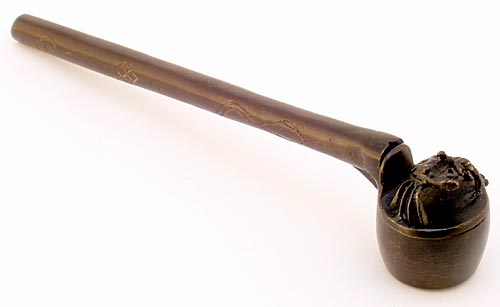
Yatate with crab decoration
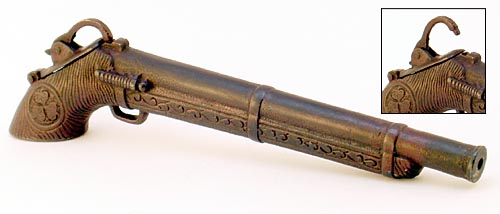
Yatate made in the shape of an Edo-era pistol.
Quite intimidating when tucked in the waist sash!
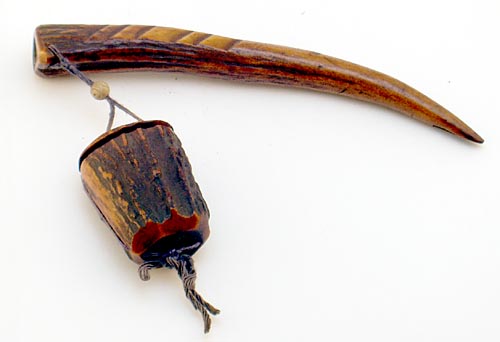
Unusual yatate made of a deer antler
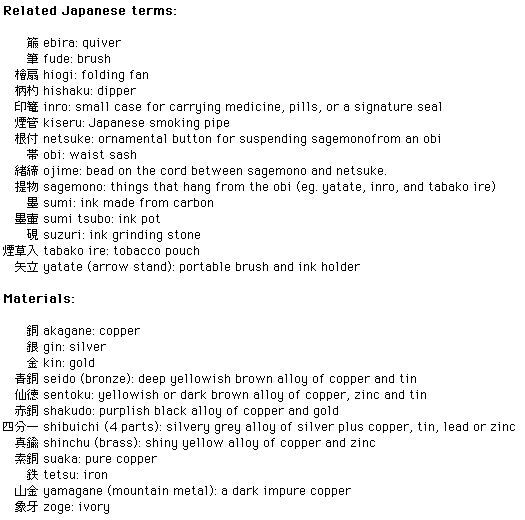
The old black and white drawings on this page were taken from woodblock prints done by Hokusai
Regarding the dating (what era) of the yatate examples on this page, I have relied on what the previous owners have told me.