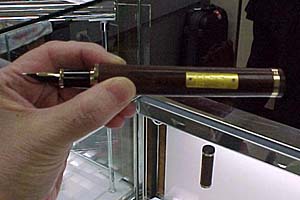
Pentrace East: The 4th Annual Mitsukoshi World Pen Fair
Springtime in Tokyo. The entire city awakened from a mild winter by the flowering of the Sakura. Warm, sunny days complimented by faint, but fragrant breezes. Cool nights; sleeping weather where one can find comfort under a warm blanket with a good book. Pen Fairs and new friends. Life is good.
I woke up early that Thursday morning to meet my fellow Tokyo Pentracers at the Mitsukoshi Department Store. My heart willing, but my body cursing me after entertaining clients until 3 a.m. Perhaps too much Sashimi, Sake, and Singing (Karaoke) I think as I leave my apartment, hoping that the local Starbucks will be open on this Government holiday.
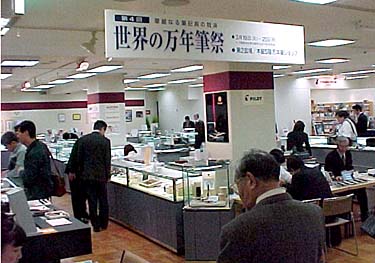
Entrance to the Mitsukoshi Pen Fair
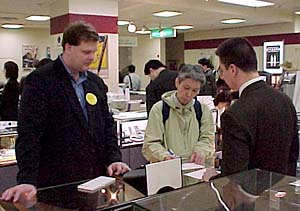
Ron (with yellow snailee badge) and Mikiko with an Aurora representative Upon reflection, the Pen Fair that day suggested that the Japanese fountain pen industry is very representative of Japanese culture as I have experienced it. That is, a blending of tradition and respect for the past together with a desire, for some, to be as modern as possible.
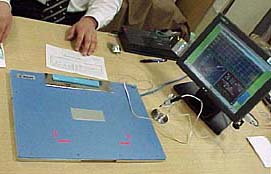
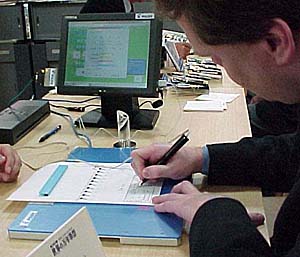
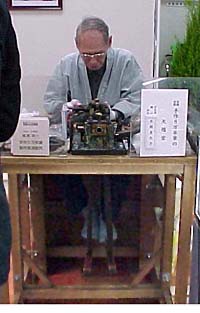
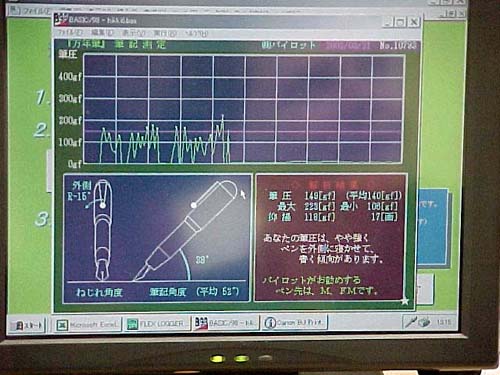 The results on the monitor. We also received a free printout. However, Pilot also brought their more traditional handwriting analyzer to the Pen Fair, as well as Sailor and Nakaya. For example, the handwriting analyzer that Nakaya brought to the Fair is over 60 years old and unlikely respondent to any machine language. Nakaya uses a device named the "Sadao Watanabe." At this Pen Fair, as well as an earlier one that I had attended with Mikiko, the Watanabe device was in constant use and seemed very efficient and reliable. I understand that the Watanabe device was used by the Platinum Pen Company for over 40 years before being acquired by Nakaya, a record of longevity likely not to be matched by most modern machinery or computers.
Also unique to the Watanabe device is its ability to ask verbal questions should any of the input information from the scan be unclear, or should the user desire a nib/feed set-up that is non-standard. What really distinguishes the Watanabe device from the computer handwriting analyzer is that the Watanabe device is operable to perform maintenance on the pen based on the results of the scan and the user input, a feature not present on the newer, computer handwriting analyzer.
Also on display at the Fair were Japanese Maki-e pens. Maki-e is a Japanese lacquer technique ornamented with use of gold powder. As explained to Mikiko and I at an earlier Pen Fair in March by a Namiki Maki-e artist, Japan was once referred to as "a land of gold" on voyage notes by Marco Polo. It is suggested that these entries were made partly because of the many Maki-e daily goods, such as wooden boxes, in use at that time.
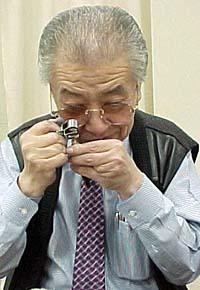
Finally, besides the opportunity to have your pens worked-on and adjusted by the pen representatives at no cost, the Pen Fair allows one to try out most of the pens on display with the pen representatives happily assisting you. This is very helpful in being able to compare several pens and nib sizes during the same day. Also greatly admired is the cultural aspect of Japanese society where many representatives openly display their pens for one to try, with no expectation (or chance for that matter) that they would be taken. It was a long, but rewarding day. I am thankful to my new friends Mikiko Yamamoto and Russ Stutler for their help in preparing this report, and especially for the fun day! |