The Prince Protean Pen
|
Ever since I learned that Mark Twain once used a Prince Protean pen, I have been trying to find one. I’d be willing to pay several thousand dollars for one, but even if you had a million to spend it would be doubtful you could find one of these very early pens. And by early, I mean one of the first fountain pens manufactured in the United States. When Mark twain wrote letters praising his new MacKinnon Stylographic pen, he told how much better it was than the Prince and how he had flung it out his window. Francis Cashel Brown, of Caw’s Pen and Ink, who incidentally, had earlier been the treasurer of the Mackinnon Pen Company, explained that in 1851, Newall A. Prince’s Protean Fountain pen had been released and for a short time was widely popular. However, the first Proteans’ had steel parts and quickly corroded in the acidic ink of the day. They soon stopped writing - not that they wrote well to begin with. Nevertheless, we are talking of the 1850’s, a fountain pen manufactured before the Civil War, and roughly 35 years before Lewis Waterman would patent his famous three channel feed. I recently found an article from the 1908 Boston Herald that gives a detailed
history of Newall Prince and his pen. It is rather well written so I will include
it here in its entireity: MINISTER INVENTED THE FOUNTAIN PEN
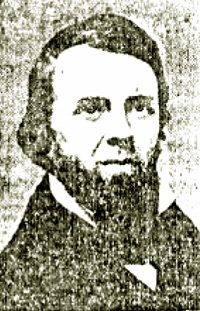
Newall Prince After the war he was principal of the high school in Portland, Maine, and later studied law and practiced in Washington for many years. When Rev. Mr. Prince graduated from Bowdoin, he took a four years’ course in the Bangor theological seminary, graduating in 1844. Before actively taking up his ministerial duties, Mr. Prince taught school in Freeport, Falmouth and Bath, Maine, Paris, Kentucky, and Milltown, New Brunswick. In 1847, he became pastor of the Congregational church in New Gloucester, Maine but later went to Milltown, New Brunswick. He was during his life the pastor of churches in Boston, Brooklyn, Paterson, NJ, Bethel, Conn, Orange Mass., Union Springs, NY, Binghampton, NY, Simsbury, Conn., New Haven, Cornwall, Conn., Enfield, Conn., Auburn, Mass, and West Suffield, Conn. It was when Mr. Prince was a student at Bowdoin that the idea of the Fountain pen came to him. Shorthand writing was at that time in its infancy, and Mr. Prince, with his brothers and Daniel Temple, who afterward became a clergyman and missionary, took up the study of shorthand together. After a time Mr. Prince discovered, however, when he had reached the stage in this study of taking from dictation, that the constant dipping of the pen was not only a loss in speed, but it left him at times with a stenographic character half formed. Wishing to excel in this new method of condensing the English language, it occurred to him then, that, if a self-feeding pen could be devised, where there would be a constant flow of ink, regulated to suit the needs of the writer, writing of shorthand characters would be greatly simplified, with the result of greater speed and accuracy. He studied over it for several months without telling any of his student friends of his hopes. He tried many experiments, all of which were failures, but he was a persistent youth, and his ingenuity won. His first successful pen was very crude, but it worked. He went to a local tinsmith and had made for him a barrel of tin about half an inch in diameter at the top and tapering to three-eighths of an inch at the bottom. It was 12 inches in length and very clumsy to handle. At the smaller end he made an indentation in such a way that a pen could be inserted. The pens in those days were flat, and it was a flat steel pen that he used in his first tin penholder. He filled the barrel with ink and in the top he placed a cork with a vent hole in it to allow for the admission of air. The indentation at the bottom was made in such a way that the flow of ink was regulated by the tightness with which the pen was inserted. He first tried it in his room secretly and found that it worked well, and the next day, to the amusement of every one in the study room, he produced his tin-barreled fountain pen and proceeded to do his work.. It is said that this was in 1839, the year before Mr. Prince graduated. At any rate, it caused a mild sensation, and several of the students were soon provided with this tin fountain pen, and used them in their work in the class rooms. This was the first fountain pen of which there is any record and to Bowdoin college falls the honor of its birthplace. For several months the possibility of a fountain pen of commercial value did not
occur to this inventive genius, but it soon found lodgment just before his
graduation and he began the task of perfecting it with the idea of securing
a patent on it at Washington. All through his four years in the Bangor theological
seminary, while he was a teacher and pastor in several places, he kept this idea in mind and worked to perfect his invention, but it was not until 1830
that he had overcome all the obstacles and was ready to ask for his patent
papers.
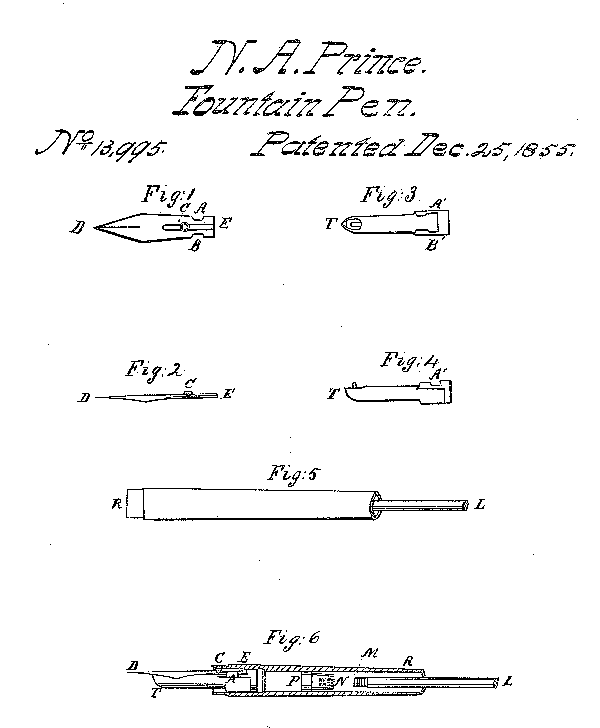
The Prince Protean Fountain Pen Patent On September 30, 1851, Mr. Prince took out his first patent. He called it
the “Prince Protean Fountain Pen,” or changeable pen. As an inventor
Mr. Prince was a success, but of business he knew little. Immersed in his books,
his studies, his writings and his inventions, he had no idea of business, and,
like many of good clergymen and inventors, he was all at sea when he began
his search for the means to manufacture and to place his invention on the market.
Stay Well,
|