

A Conklin Crescent-Filler No. 25
A black chased hard rubber Conklin from my collection, read from its clip, barrel and nib: what each marking says, which patents are behind them, and when the pen was probably made.
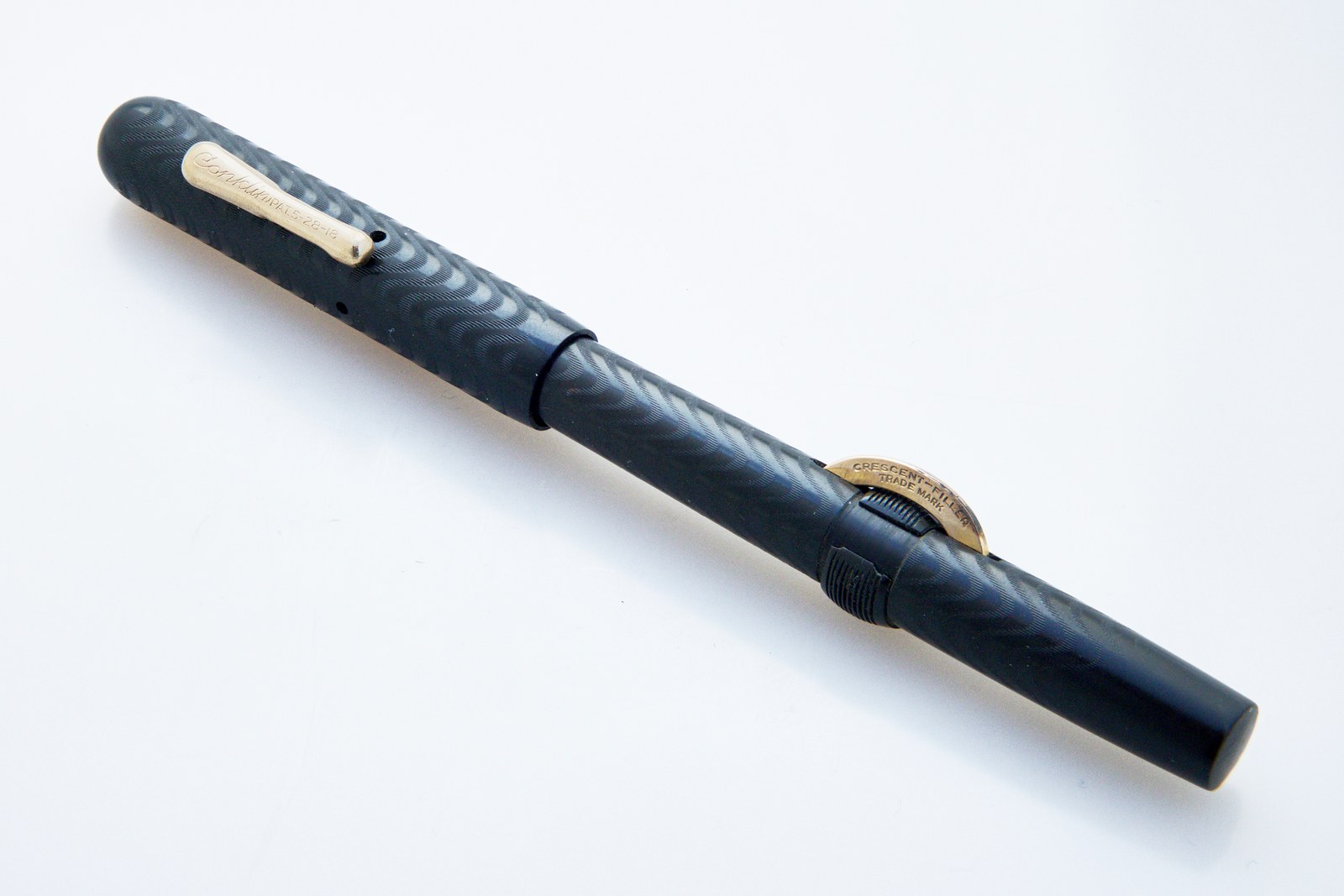
My Conklin Crescent-Filler No. 25, in black chased hard rubber. (Photo: Donal Higgins, private collection)
The gold half-moon on the barrel gives this pen away at a glance. It is a Conklin Crescent-Filler, a pen that fills by pressing a crescent that stands out of the barrel, and no other maker used the idea. Everything else about it can be read from three places: the clip, the imprint on the barrel and the nib. I bought it at the Chicago Pen Show in 2002; my report from that year's show is in the archive.
How the Crescent-Filler works
Inside the barrel a metal pressure bar is joined to the crescent, which comes out through a narrow slot. Press the crescent and the bar flattens the rubber sac; release it and the sac springs back, drawing in ink. The ribbed ring around the crescent is a lock. Turn it until its gap lines up with the crescent and you can fill the pen; turn it back and the crescent cannot be pressed by accident in a pocket. Silviu describes the mechanism, and Roy Conklin's first sac filler of 1898, in Vintage Filling Mechanisms – Sac Fillers Part 1.
The clip
The clip is signed with Conklin's script name and "PAT. 5-28-18", May 28, 1918. That is the grant date of US Patent 1,267,575, "Fountain-pen clip", invented by Frank H. Mooney of Toledo, Ohio, filed May 7, 1917 and assigned to The Conklin Pen Manufacturing Company.
The patent describes a clip that needs no rivets or retaining bands. A lever is clamped to a spring strip, which passes sideways through an inclined opening in the cap, runs along the inside of the cap and ends in a spur that presses on the opposite wall. That is why the clip has no visible fixing, and why a small hole sits beside it on the cap.
The barrel
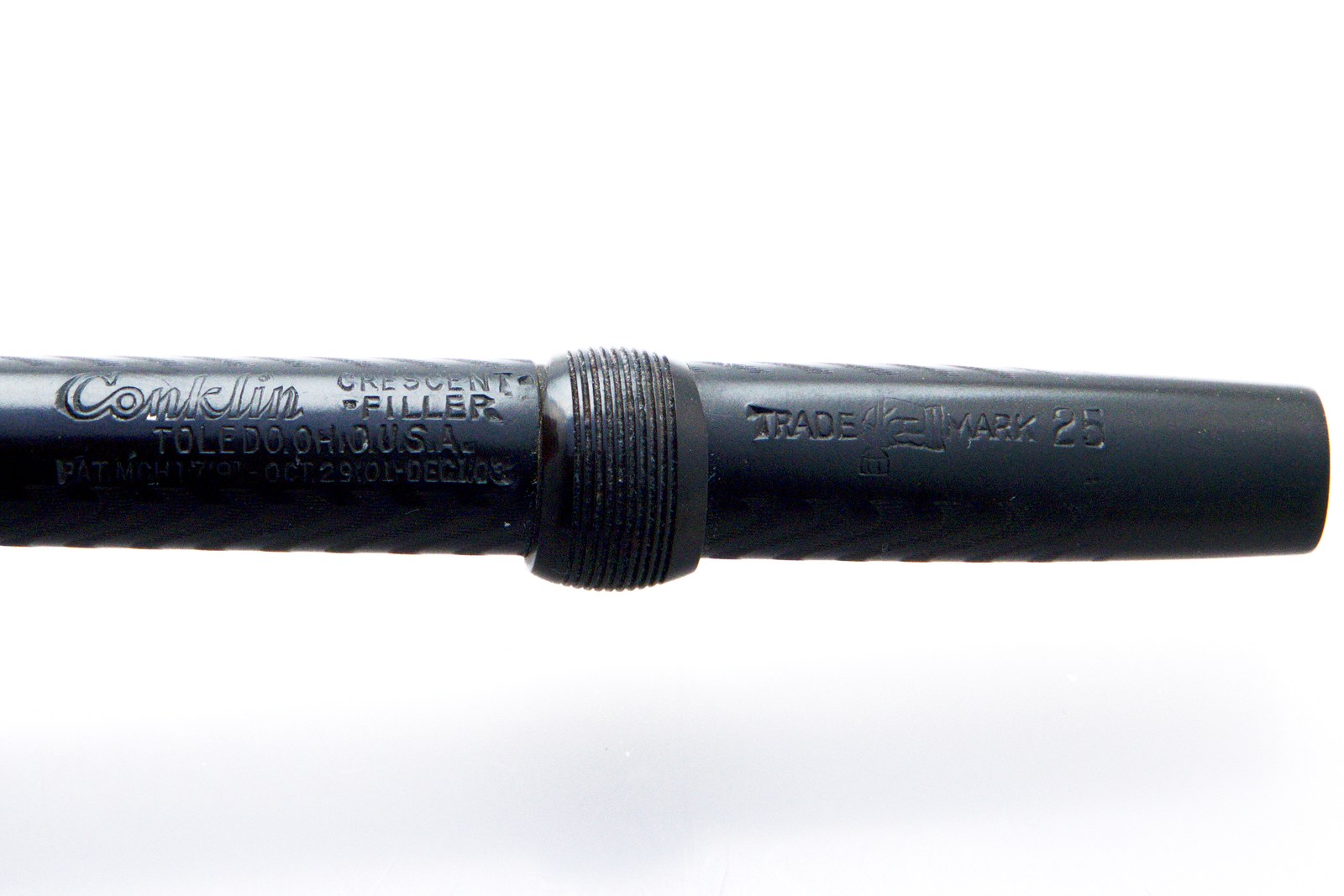
The barrel imprint and, beyond the locking ring, the trade mark with the model number. (Photo: Donal Higgins, private collection)
The imprint reads "Conklin CRESCENT-FILLER, TOLEDO, OHIO, U.S.A." over three patent dates: "PAT. MCH 17 '91 – OCT 29 '01 – DEC 1 '03". These are the dates of Conklin's patents, not the date the pen was made. Collectors tie the last of them to the domed locking ring that replaced the earliest square one, which is the shape on this pen.
On the far side of the ring, the Conklin trade mark is followed by 25, the model number. Collectors working from the old Conklin catalogs read the first digit as the nib size and the last as the cap trim (0 for none, 1 for a quarter-inch band, 2 for a half-inch band, 3 for a ring top). On that reading a 25 is a pen for a No. 2 nib, with a plain cap, and one collector describes the 5 as a slimmer version of the 20.
The nib
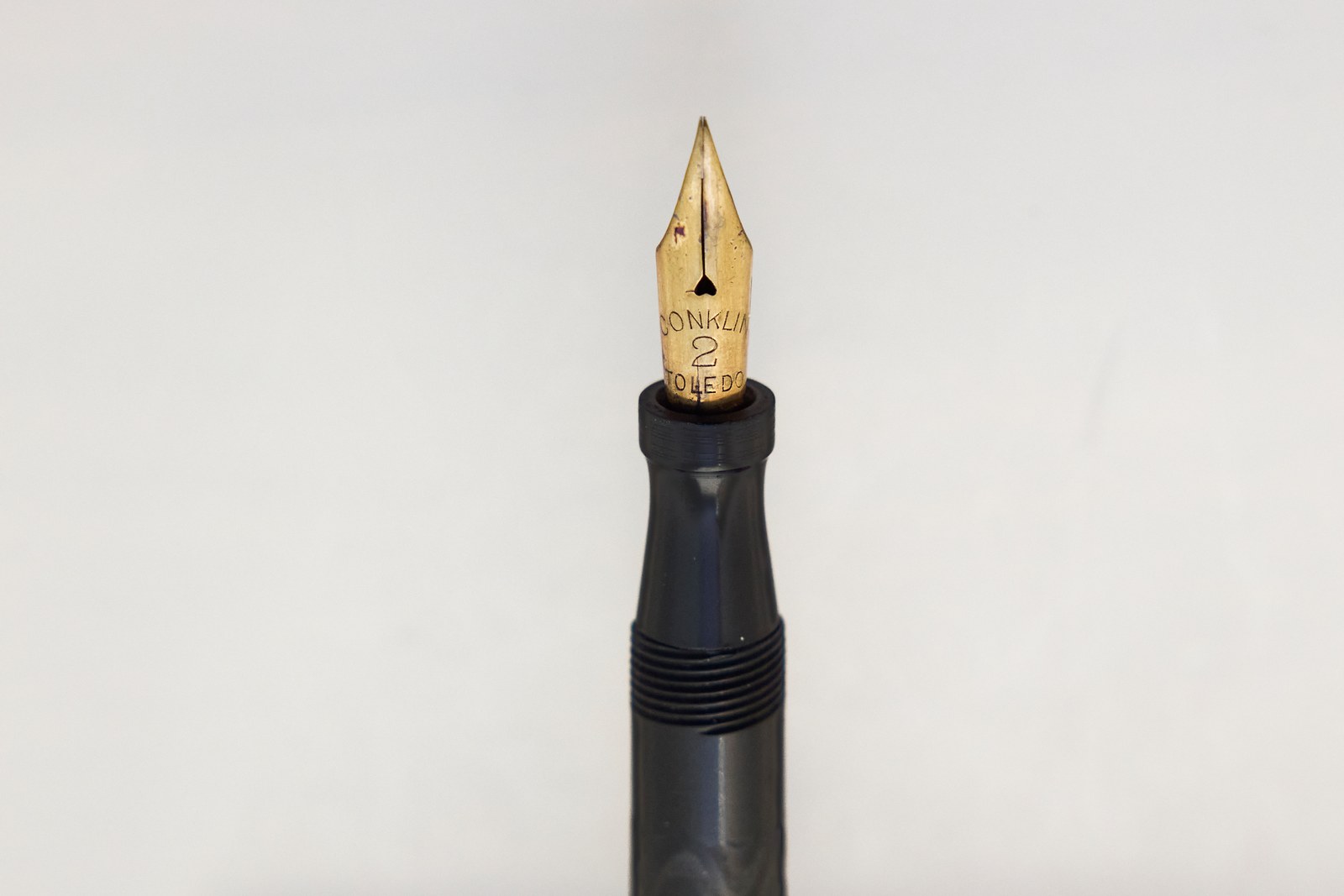
The nib is stamped "CONKLIN 2 TOLEDO". (Photo: Donal Higgins, private collection)
The nib is stamped "CONKLIN 2 TOLEDO" in block capitals, and the breather hole is a heart. Collectors on the Fountain Pen Network place block-capital Conklin nibs up to about 1923. The 2 matches the first digit of the model number, which is what a No. 25 should carry. I can see no karat stamp on the face or the sides, and I am reluctant to pull a nib this old to look beneath it, so I cannot say whether it is 14-karat gold. Nibs were often swapped over the years, so even a matching nib is a clue and not proof.
Size
These are my own measurements, to the nearest half millimetre or so:
- Length capped: 130 mm
- Length uncapped: 115 mm
- Cap: 60 mm long and 11.5 mm across
- Barrel: 9.5 mm across
It is a small, slim pen, which fits the catalog reading of a 25 as a slimmer relative of the 20.
When was it made?
The clip sets the earliest date: the pen cannot be older than about 1918. Collectors sort Conklin barrel imprints into types, and the one that reads "Conklin CRESCENT-FILLER", without the possessive of the older "Conklin's Self-Filling Pen", is placed at roughly 1920 to 1925. The nib fits that range. My best estimate is therefore the early to middle 1920s. That comes from collectors' notes and dealers' listings, not from a published reference, and they disagree on some of the details, so I hold it loosely.