Pompeian Brown
| Some of you may be aware of the story
of the early advertising strategy, merchandising campaign, and sales drive used
by the Parker Pen Co. to introduce the Duofold in 1922. The official story is
that Parker decided to first test the pen in the Chicago area in the spring of
1922 using a combination of saturation marketing techniques. If successful, they
would then repeat the technique in other cities. Salesmen armed with supplies
of the pens and advertising ephemera visited those stores which did not have the
pen in stock yet. They postered the area with Duofold ads and placed advertisements
in the Chicago Tribune in a certain sequence. In those days, a newspaper page
was much larger than it is today, and the first promotion was a large 800-line
ad that took up two-thirds of the newspaper page. This ad featured some Duofold
copy, beneath which was a long list of all the stores in the area that stocked
the pen. This advertisement ran once in the first week of the campaign, thereafter
followed by two 360-line ads each week for 3 weeks, and one 360-line ad each week
for 8 weeks. By the fifth ad in the third week, there was such a surge in sales
that Parker didn't wait to complete the Chicago trial before he went ahead with
similar campaigns in New York and fourteen other major US cities. So the story
goes.
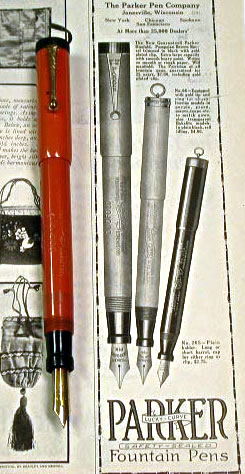
If you look at the actual ads that appeared in the Tribune,another version of the story emerges. After Lewis Tebbel made his proposal to the company for the design of this new pen in early 1921, a batch of prototypes was made up for him to sell in his sales area, Spokane and Seattle, Washington. More batches were made up for him, and when he and other salesmen sold well over 12,500 Duofolds, Parker decided to test the pen in a larger market area. The test area chosen was Chicago, but it happened in November and December of 1921. And the first Duofold ad to appear was not in the Tribune, but actually a modest ad in The Saturday Evening Post, November 5, 1921, p.79. The magazine page at that time consisted of four columns of text or advertising space, and the first Duofold ad consisted of one column only. The pen in this ad was described as having a "red brown barrel". In "Proxy", a newsletter for salesmen, in the August 4, 1921 issue, George Parker referred to the color of the pen as "maroon". Now, I would not describe an early red hard rubber Duofold as "red brown", or "maroon", so something curious is going on here. Then a series of more-traditionally-shaped rectangular ads appeared in the Chicago Tribune between November 19 and December 22 that year, and all of them use the phrases "rich Pompeian brown", or "red brown", in the ad copy. These are the ads familiar from the Glen Bowen book, which reproduces two of them, but I found five different versions of these ads. There was another ad in The Saturday Evening Post on December 10, this one also using the phrase "Pompeian Brown", and then no more ads appeared for a while. Within a few years of the introduction of the Duofold, the Moore Pen Co. also had pens in a red-brown color that were also referred to as "Tuscan Red" and "Maroon". An interesting point in all these ads is that the Duofold was also advertised as "the patrician of all fountain pens", thus preceding the Waterman's pen of the same name by almost a decade.
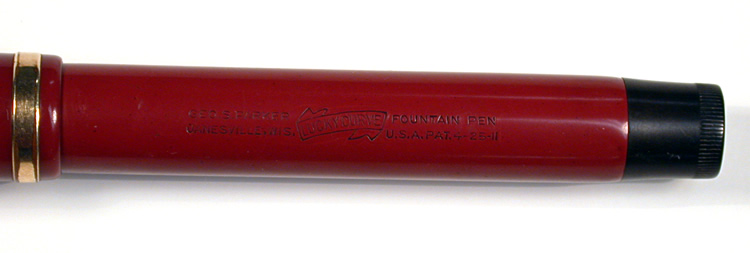
The mysterious 1927 Permanite (plastic)
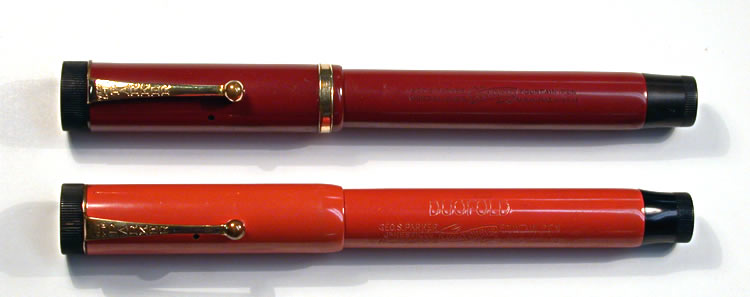
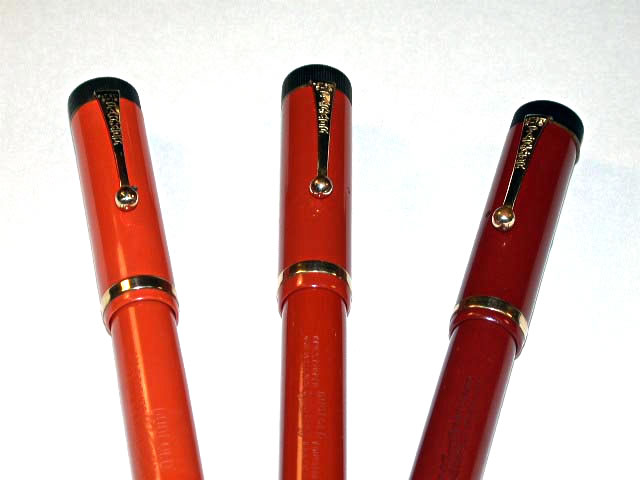
pen in maroon. One thing that's conspicuous by its absence in all these ads is the phrase "resembles Chinese red lacquer". Another missing element in the ads is the image of the familiar Scarlet Tanager with outstretched wings, and the line "Rivals the beauty of the Scarlet Tanager", or "the black-tipped redbird". All of these design elements and lines of ad copy appear only in the ads from spring 1922. The next Duofold ad to appear was the 800-line ad in the Tribune, March 27, 1922, p.13. It lists over 150 stores where the pen is available, but the "Pompeian Brown" color is nowhere to be found in the ad. Instead, the "Chinese Lacquer Red" color replaces it. It even goes so far as to say, "Note how soft [is] this shade of Chinese-red". Now, that's the orange-red color that we are all familiar with! Parker had two earlier large red hard rubber pens that preceded the Duofold, the #28 and the "Red Giant", but they experienced a lot of cap breakage with these pens. Could they have been apprehensive about using the same bright red hard rubber when they first test-marketed the Duofold, and so released it first in that darker red-brown shade? Visconti chose a darker shade of red hard rubber for their Alhambra for the same reason. They thought it might be a stronger hard rubber because of the inclusion of some black pigment in the mix. Could it be that somewhere between December 1921 and March 1922 Parker switched to a brighter orange rod stock? And could it be that all the Pompeian pens date to that early marketing period in mid-to-late 1921? Or did they continue making the two colors concurrently well into 1922 and 1923? I have seen a Duofold Jr. pencil in that Pompeian brown color, so that means that that color of rod stock was around at least long enough for that type of pencil to come into production.
(L to R) 1922 RHR with cap band., 1927 Permanite red plastic, c1927 Permanite mysterious maroon After this large ad, there was a series of smaller ads that appeared in the Tribune, one every few days from March 30 to June 13. As a punctuation mark to end this series, a small postage-stamp-sized Duofold ad appeared in the Tribune on June 30. It was not an official Parker Pen Co. ad, but was part of the jumble of mixed-product ads included in the large half-page ad for Walgreen's Drug Stores in Chicago. That's how quickly the pen had passed to the area of commonly advertised products. At the same time, there were one-column ads in The Saturday Evening Post on April 22, May 6, and June 3, but then no ad in the July issue. Something big was being prepared, the first full, one-page ad for the Duofold! This was an ad for the large-format magazines such as The Saturday Evening Post and Collier's in the US, and MacLean's in Canada. Downsized versions of these ads were also prepared for such small-format magazines as National Geographic. It made its debut in the August 26 issue of the Post, and a one-page Duofold ad was to appear every month for the next eleven years, until the appearance of the Vacumatic in March 1933.
c1927 Permanite maroon barrel Before 1921, Parker had a very low market share, around 15 to 20 percent of
all pen sales, mostly because their product line consisted of over 400 different
models in many sizes, and their production facilities were too diversified. After
the success of the Duofold, however, their market share soared to around 50 to
60 percent, and their product lines shrank to about 100 different models. The
Duofold was so successful that any company that wanted to survive had to have
a Duofold look-alike, a red pen with black tips. Waterman's already had an all-red
pen, but it was only in this era that the color was marketed as "Cardinal",
and in 1923, it came out with its red and black "Ripple" line of pens
to compete with the Duofold. Morrison had its "Tourist", and Conklin
its "Duragraph", and Eclipse and every other no-name brand had to have
a red-and-black pen in order to compete.
|