

The History of the Parker Pen Company Part I
In
the autumn of 1633 William Parker left Dover, England
with his wife Margery, aged 17, and eventually set sail
from London on the ship “Matthew” departing
May 21, 1635. Their ambitious journey no doubt may have
been inspired by tales of the great migration in the
prior few years by the Wellington Fleet, and several
other convoys of ships carrying over thousands of settlers
to the New World and The Massachusetts Bay Colony.
One can only imagine the anxiety and even fear of making
such a journey. There must have been profound reason
to undertake such a risk, to travel for months on open
seas subjected to storms, disease and perhaps “ocean
monsters” believed to be able to swallow entire
ships. The reason was primarily the same as thousands
of other Pilgrims and Puritans taking this great migration,
in protest of the religious intolerance of the High
Church establishment of the day.
Other countries such as France, Spain, Holland and Sweden also send convoys of settlers to establish communities in the New World. Land charters were given to wealthy merchants for the purpose of reaping the riches of this new trade market. The success of these settlers gaining foothold in the new land would eventually determine the future nationalities of America.
The
Parker’s ship sailed to St. Christophers, a small
English Colony island in the West Indies. In the autumn
of 1635 a Dutch trade ship deposited salt, tobacco,
trade goods and the young Parker family to the docks
in or near Boston.
Geoffrey S. Parker today relates that “soon after
in 1636 they moved to Hartford, Connecticut where William
Parker is listed as one of the original founders of
this community.”
The Parker’s first child, Sarah was born “a
little before Michaelmas” Oct 29, 1637, followed
by Joseph, John, Ruth, William, Joseph, Margaret, Jonathan,
David and Debora. Of these children several survived
to adulthood, many having achieved notable accomplishments
in their communities.
About
the year 1649 William Parker moved to a property owned
by the English Lords Saye and Brooke (Saybrook, Connecticut).
This area was recently an Indian village called Pash-ebe-shauke
“the place by the river’s mouth” occupied
by Algonquin and Nehantic Indians. The Indian name for
this area was
Quon-ito-cutt. Say this quickly and you will now hear…Connecticut.
William Parker became a large land holder by 1673, likely
receiving land grants for serving in the Pequot Indian
War. He filled several town offices, and was a member
of important town committees such as Deputy to the General
Court for many sessions. To this day his original home,
one of the oldest surviving structures in the county
still stands and can be visited in Saybrook.
The Parker families remained in and around Saybrook until about the time of the American Revolution. There is record of several Parkers who had served in the Continental Army who fought for American Independence. At about this time the Parker family began to move inland. They first settled in western Connecticut and then to Vermont.
Over one hundred years later George Safford Parker’s father and family traveled by covered wagon out of New England, in the same spirit as pioneer frontiersmen, eventually seeking a new homestead in the Midwest. The attraction was the incredible farming soil where a man could sink his arm into the prairie soil and work the land fruitful without too much difficulty.
George’s father Norman S. Parker was born in Vermont in the early 1800’s. Norman, his siblings and parents moved from Vermont first to Buffalo, New York and then traveled by lake boat to Byron, Illinois, just south of Rockford where they settled in about 1835. This homestead was located on the Rock River, which ran down from Janesville, Wisconsin located only about 40 miles north.
This was still a dangerous time of Indian Wars. In May of 1832 Sac and Fox Indians under the leadership of Black Hawk left the Iowa territory and returned to their homes across the Mississippi River in northern Illinois. These Native Americans had lost their Illinois lands in a disputed treaty signed in St. Louis in 1805. Their return to northern Illinois sparked widespread panic among white settlers, and Illinois Governor Reynolds quickly called up the militia, which included a young Abraham Lincoln. This Black Hawk Indian War raged in the same areas of Illinois and southwest Wisconsin in which the young Parkers settled a few years later.
This
northern Illinois land was recently Indian Territory,
opened by the Government for pioneer settlement. It
was here that Norman Parker met and married Jane Folsom
in 1847 in Galena, Illinois. They settled on property
he had purchased in nearby Shullsburg, Wisconsin, about
50 miles west of Janesville.
In 1846, the village of Shullsburg was platted. The
commercial development of downtown Shullsburg occurred
in two stages. The first stage was in the 1840s and
1850s when the lead and zinc mining was booming. The
second period began with the coming of the railroad
in 1881. Norman Parker’s arrival was timely and
evidently he prospered in this growing community. Jane
Parker helped to found the Congregational Church located
there, and Norman sometimes taught Sunday school.
Norman Parker was a nurseryman, growing trees and plants which he likely provided to the growing communities in the surrounding areas. Located near the Mississippi River at the far northwest corner of Illinois, Galena and Shullsburg had long been a lead and mineral mining area and was experiencing a solid prosperity.
Land
was offered by the railroads at bargain prices. Priced
from 70 cents to $1.25 per acre in order to attract
communities as travel and freight customers. Land agents
and speculators were doing a brisk business, the nation’s
population was quickly spreading, and Norman keep looking
further west.
It was the tradition of devout families to raise their
children for meaningful service to the community and
their church. This is a tradition engrained in the Parker
family from these very earliest years and was now being
carried forth to the small farm communities of Fayette,
Iowa and Janesville, Wisconsin.
George
Safford Parker was born November 1, 1863 in Shullsburg,
Wisconsin.
He was the seventh of eight children and at about age
seven in 1871, the family once again packed all their
belongings to travel by covered wagon to a new farm
69 miles further west near Fayette, Iowa. Located about
35 miles west of the Mississippi River, this was the
lush farming area of the Volga River Valley. Norman
Parker continued his trade as a nurseryman, growing
trees for the local community.
Norman may have had relatives here as county records
indicate several other Parker families, six of which
served in the Civil War, and a Dr. Charles C. Parker
who was one of the founders of the County Medical Society
in 1868.
Here young George followed the typical life of a farm
boy, working long hours in the fields from planting
to harvest seasons. It was only in the winter months
that he was able to attend school. This was a typical
family practice at the time to spare children from chores
on the farm after the harvest season.
George S. Parker related many years later…”Life
in Iowa at this time was the sort you read about in
books of the early days. Wide expanses, few settlers,
vast prairies, ride as you wish –hither and thither
– and it was very wild, very wild. The house where
we lived had been built by a previous settler. Part
of it was made of logs, part of it was upright boards.
Well do I remember sleeping upstairs in the not-too-well
constructed log part of the house and being able to
look through the cracks. Many a time I would awaken
in the wintertime to find a little snowdrift on my bed.
This was not considered a hardship but merely a nuisance.
There was no such thing as a steam-heated or water heated
bathroom. In fact, I am not sure whether they had them
in those days or not, but certainly not in north western
Iowa.”
George Parker finally attended Upper Iowa University, located in nearby Fayette.
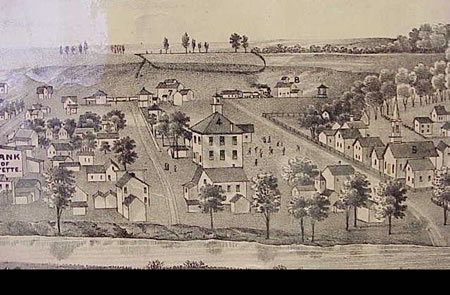
Image of Fayette, Iowa mid 1870’s
Fayette in the mid 1870's looking south down King and Mechanics Streets. Note the fords across the Volga were will in use. Main Street and the Bank of Fayette are on the left. The Grade School is in the center, the railroad area at the back, and Grandview Cemetery on top of the hill. No quarry is depicted behind the railroad area. The tree line at the top right is Westfield road.
Here he started to think about a career. He had his fill of unmechanized farming and his own mother stated young George was not suited for the agrarian farm life and he had other ambitions to pursue. One of his interests at this time was to pursue a career as a doctor. The reason may be due to one of the tasks that usually fell to the younger family members on a farm. It was typical of the younger to provide lunch, refreshments and medical aid to older family members working in the fields.
Mostly
young George yearned to travel, and in those days one
of the best ways to do so was to learn telegraphy. These
“talking wires” as called by the Indians,
was the most modern of long distance technology and
must have been a fascination to young Mr. Parker. Railroads
were reaching to every part of the country, and they
needed telegraphers at stations along their routes.
This was the means for George to travel as he dreamed.
It is easy to understand his attraction to the railroad. This was the wonder of modern mechanism, and the transcontinental railway was recently completed May 10, 1869 at Promontory Point, Utah. Travel across the entire continent was now possible, the westward expansion of new settlers was at it’s greatest level.
Just
imagine what a young farm boy with a vivid imagination
and full of wonder with the newest gadgets and inventions
that were exploding in the latter part of the 19th century.
This was the time of the Industrial Revolution with
a major shift from an agrarian society to an industrialized
city population. It was this window of opportunity to
find employment in the big city, which would allow him
to travel the country, very likely his primary ambition.
You can imagine the adventure and travel he envisioned,
to parts of a new nation still occupied by cowboys and
Indians, unexplored frontiers and far away adventures.
Remember what this time in American history was like,
the last Indian Wars and Custer’s Last Stand recently
occurred June 25, 1876, and George Parker was twelve
years old.
This event also created panic in the nation at the thought
of new dangers on the frontier prairies of nearby South
Dakota and their home state of Iowa.
As
an avid reader of “Youth’s Companion”
young George one day read an advertisement for the Valentine
School of Telegraphy in Janesville, Wisconsin.
The temptation was overpowering.
He soon saved his $55. tuition and departed for Janesville.
www.pentrace.com