

They Didn’t Run Out of Customers
Pen Shops We’ve Lost Over the Years
In the past decade some of the best-loved pen shops in the world have closed their doors, Dublin’s Pen Corner among them. Rents, leases, the death of an owner and the move online closed them, far more than any shortage of people wanting pens.
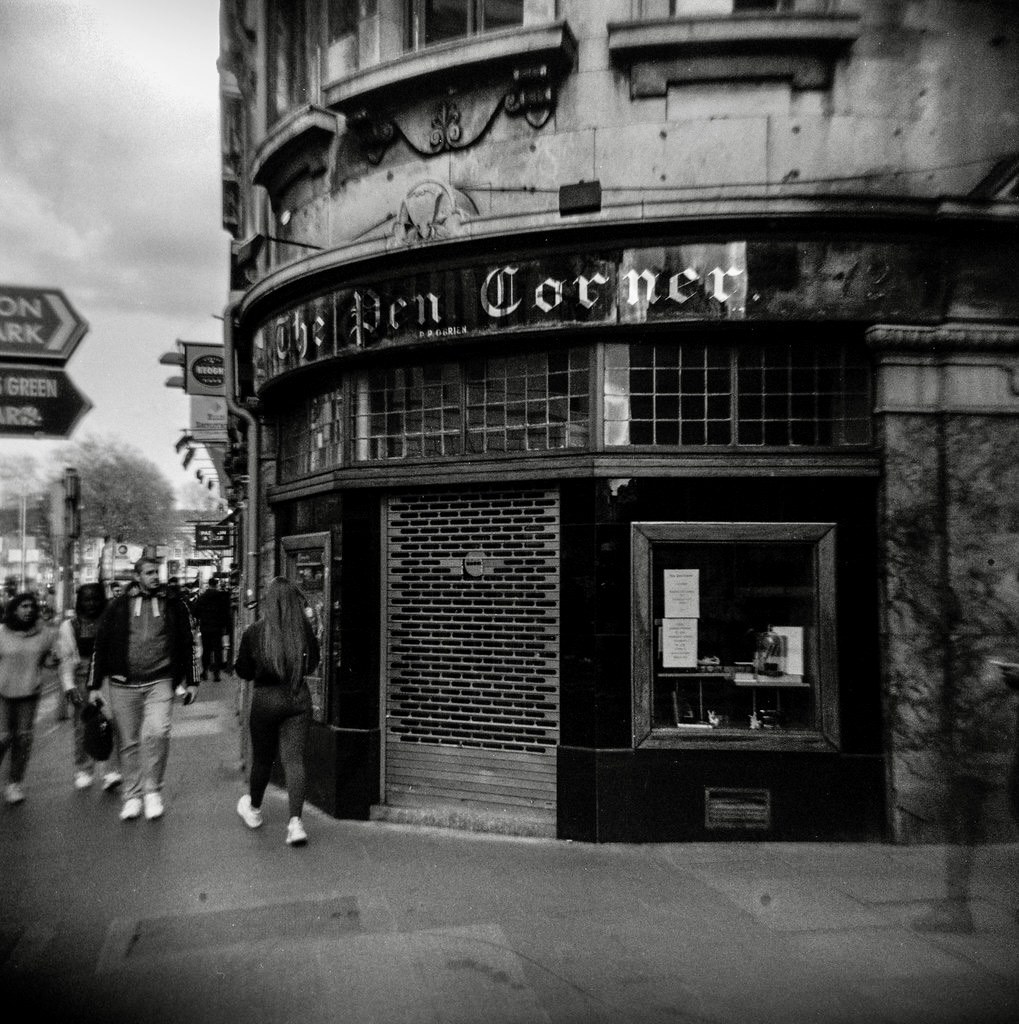
The Pen Corner on the corner of College Green and Trinity Street, its shutter down and notices in the window. The small letters under the name on the fascia read “P. P. O’Brien,” for the shop’s co-founder, Paddy O’Brien. (Photo: Eddie Mallin)
At the end of May 2022 the Pen Corner, on the corner of College Green and Trinity Street in Dublin, closed after 95 years. It was Ireland’s longest-running pen shop, and for three generations of Dubliners it was where you went for a first proper pen, a pen for the Leaving Cert, a pen for a new job or a retirement. When the closure was announced, the tributes were less about pens than about people: a parent buying a fountain pen and a bottle of ink for a child who had just got a college place, a shop assistant who remembered your nib, an hour spent at the counter trying one pen after another.
The Pen Corner wasn’t alone. Between 2018 and 2022, pen shops with nearly a century behind them closed in Melbourne, Sheffield, Los Angeles and Milwaukee, and the two biggest pen chains in Britain and the United States shrank or vanished. Read the closure notices and one thing stands out: hardly any of these shops ran out of customers. Several owners said demand for fountain pens was as healthy as ever. What closed them was the rent, the end of a lease, the death of the one person who knew the trade, or the arithmetic of selling online. This is an attempt to record some of them while the people who remember them are still around, starting at home.
The Pen Corner, Dublin, 1927–2022
The Pen Corner was started in 1927 by Florence “Florrie” FitzGerald and her husband, Paddy O’Brien, who had met working at Hely’s, the stationers on Dame Street. It was Mr. Hely, by the family’s account, who encouraged them to try fountain pens. They took the corner unit of a tall Victorian building owned by an insurance company, where the Automobile Association had been the first tenant, and in the early years they sold nothing but pens and ink.
Paddy O’Brien died in 1933. Florrie carried on, with her brother George advising on the business side and a Ms. Dunlop managing the shop, and she ran it until her death in 1982. Her nephew Maurice FitzGerald joined in 1946. He imported pens and sold them to shops around the country through the 1940s and 1950s, and brought Montblanc and Cross to the counter. Maurice’s son John took over in the late 1980s and ran the shop for more than 30 years, with Pat Martin repairing pens at the back and Aileen Morin, who stayed more than 20 years, as manager.
Gold under her skirts
The best story the shop told about itself goes back to the war. Gold nibs need gold, and during the Second World War, the Emergency here, there was an embargo on it. For a while the Pen Corner sold pens with glass nibs, and John FitzGerald still kept a piece of the glass to show visitors. Just after the war, with Parker and the other makers in Britain still unable to supply gold nibs, Florrie went looking for them in the one place that had them. She sailed to America on the Queen Mary and came home with Sheaffer pens, “only 20 or 30 of them,” as John told the Irish Times in 2003, smuggled back under her skirts. The trip did more than restock the counter: Florrie went on to set up the distribution of Sheaffer pens in Ireland.
The shop’s customers made their own stories. Prince Rainier and Princess Grace called in during the 1950s. In the late 1980s John FitzGerald served a young man in a hurry and didn’t recognise him until later: it was Kurt Cobain. Seamus Heaney and Brian Friel bought there, and John Banville called it his favourite shop in the city. When Dublin buried its Millennium Time Capsule, a Montblanc from the Pen Corner went in with it.
The end
What closed it was not one thing. The business never recovered the trade it lost during Covid. The rent had reached €75,000 a year: the building had been bought for €1.45 million in 1996 and was on the market for €6.5 million in 2018. And fewer people write by hand. Aileen Morin’s argument for the shop was always that buying a pen is like buying shoes: you have to hold it and try it before you know. That argument didn’t pay the rent. The family said they would keep selling online. A vintage clothes shop took the unit and kept the old Pen Corner lettering over the door.
The Pen Shop, Nassau Street
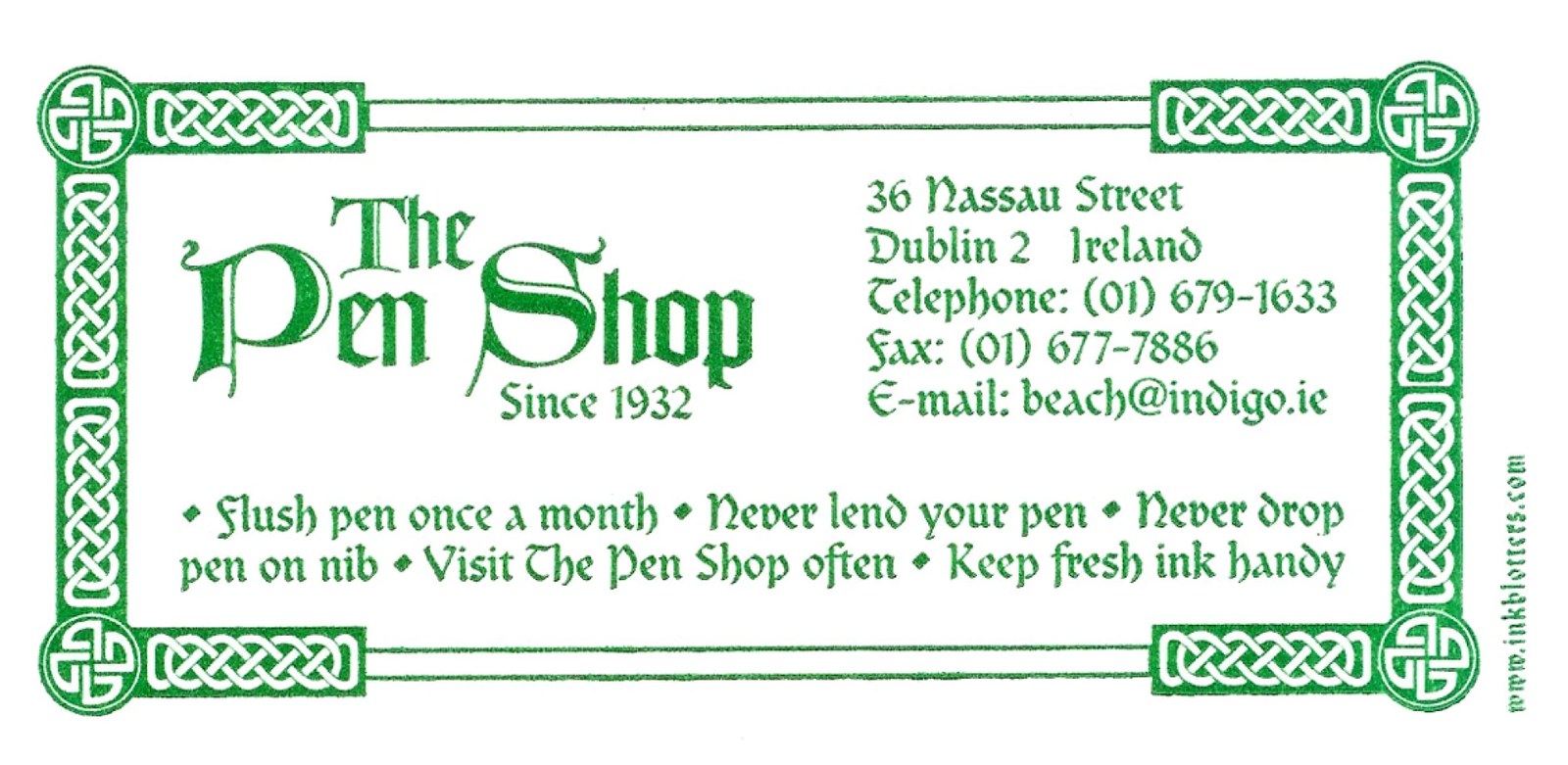
A blotter from the Pen Shop at 36 Nassau Street, printed by Len Provisor’s inkblotters.com (the address runs up the right edge). The e-mail address at Indigo, one of the early Irish internet providers, dates it to the late 1990s. (Donal Higgins collection)
The Pen Corner wasn’t Dublin’s only pen shop. A few minutes’ walk away, on Nassau Street along the south wall of Trinity College, was the Pen Shop, “Since 1932.” Its blotter, above, is one of the ink blotters Len Provisor printed for pen shops and dealers through his inkblotters.com, a gift for customers in the old tradition, and it carries five rules that any pen shop could have given you: flush your pen once a month, never lend it, never drop it on its nib, keep fresh ink handy, and visit the Pen Shop often.
Plenty of people did. At Christmas 1998, with the Celtic Tiger in full roar, the shop’s manager, Philip McGuire, told the Irish Times that his average sale had gone from £20 or £30 to £100 in a year, and that his buyers were getting younger. A man in his early 20s had been in that morning looking at Montblancs at up to £1,800. The shop had sold five £495 limited editions since the start of December, and a transparent blue Pelikan for £5,000.
I haven’t found when the Pen Shop closed. I believe it was gone by the early 2000s, a few years after that boom Christmas. If you know, or if you bought a pen there, please tell us.
When every town had one
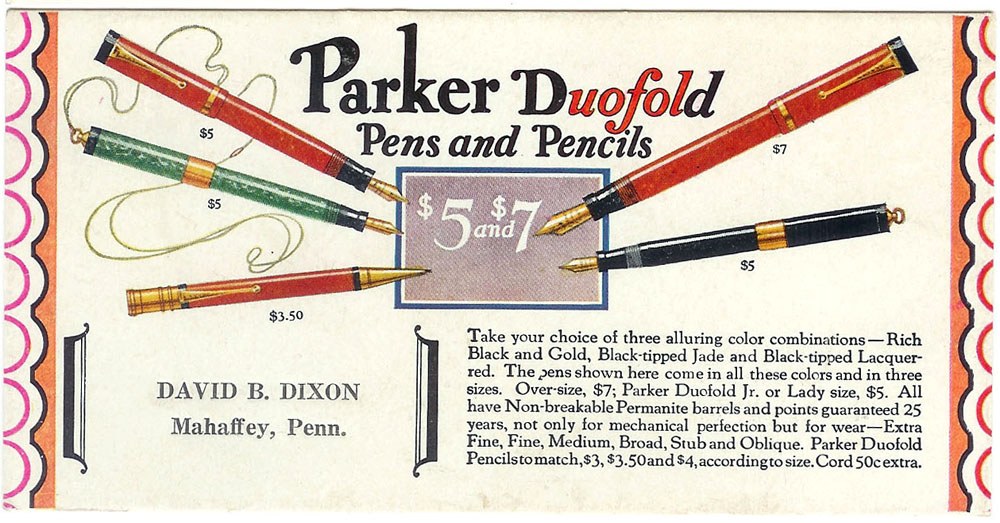
For most of the last century a pen shop was nothing special. Fountain pens were everyday tools that wore out, leaked and broke, and every town had somewhere to buy one and somewhere to have it mended, often the same counter. Len Provisor’s collection of ink blotters, the free advertising that pen makers and shops handed out by the thousand, shows how ordinary it was. Chemists, jewellers and camera shops sold pens and fixed them. Combe’s in Kansas City, “the handiest Kodak shop in town,” ran a fountain pen repair department that mended all makes “while you wait.”
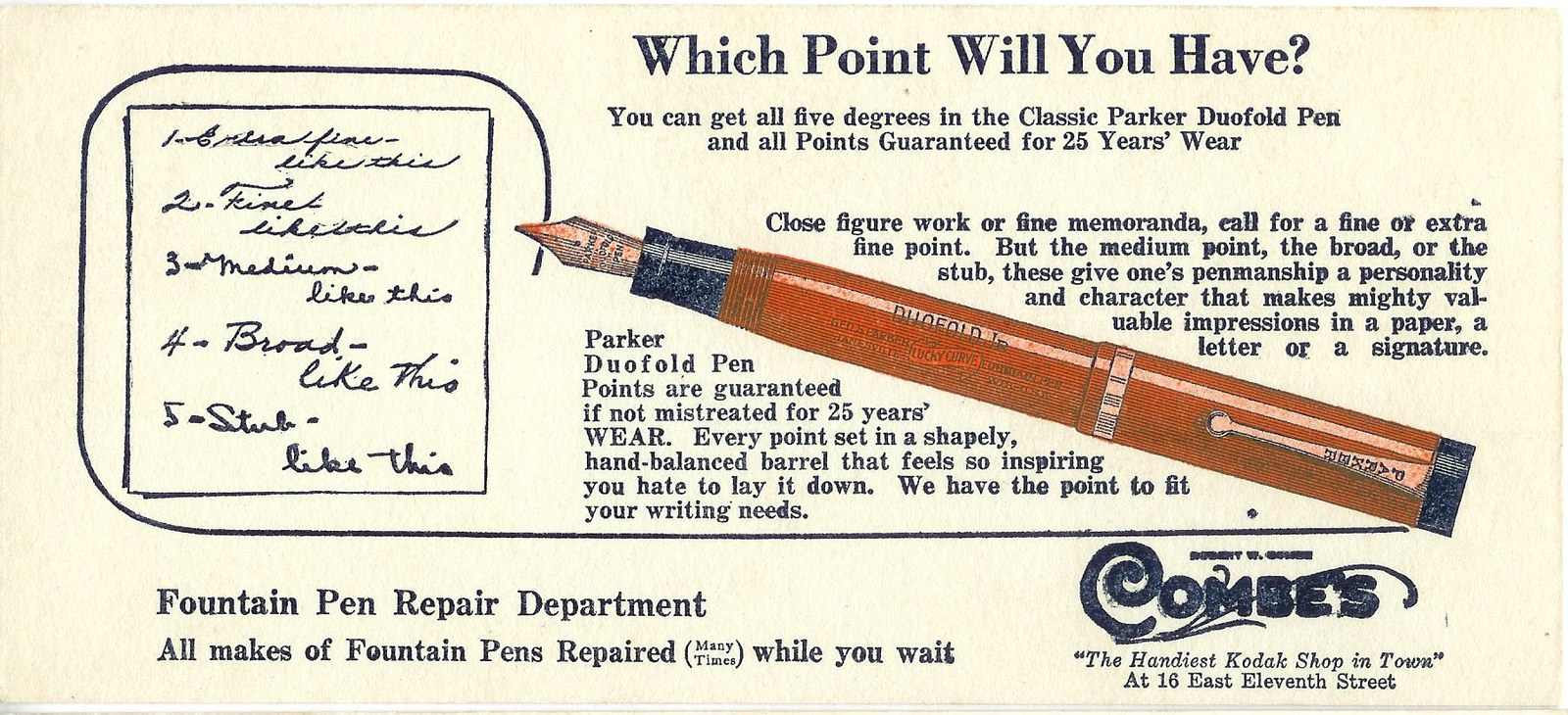
A 1920s blotter from Combe’s, a camera shop on East Eleventh Street in Kansas City, offering the Parker Duofold in five points and a repair department for all makes. (Len Provisor collection)
Big cities had specialists. In Chicago there was McLennan’s, “Chicago’s finest exclusive pen shop,” and up in Room 416 at 179 West Washington Street the Loop Pen Hospital, whose repairman advertised seven years at the Parker Pen Company and a complete overhaul, with a new sac, for 35 cents.
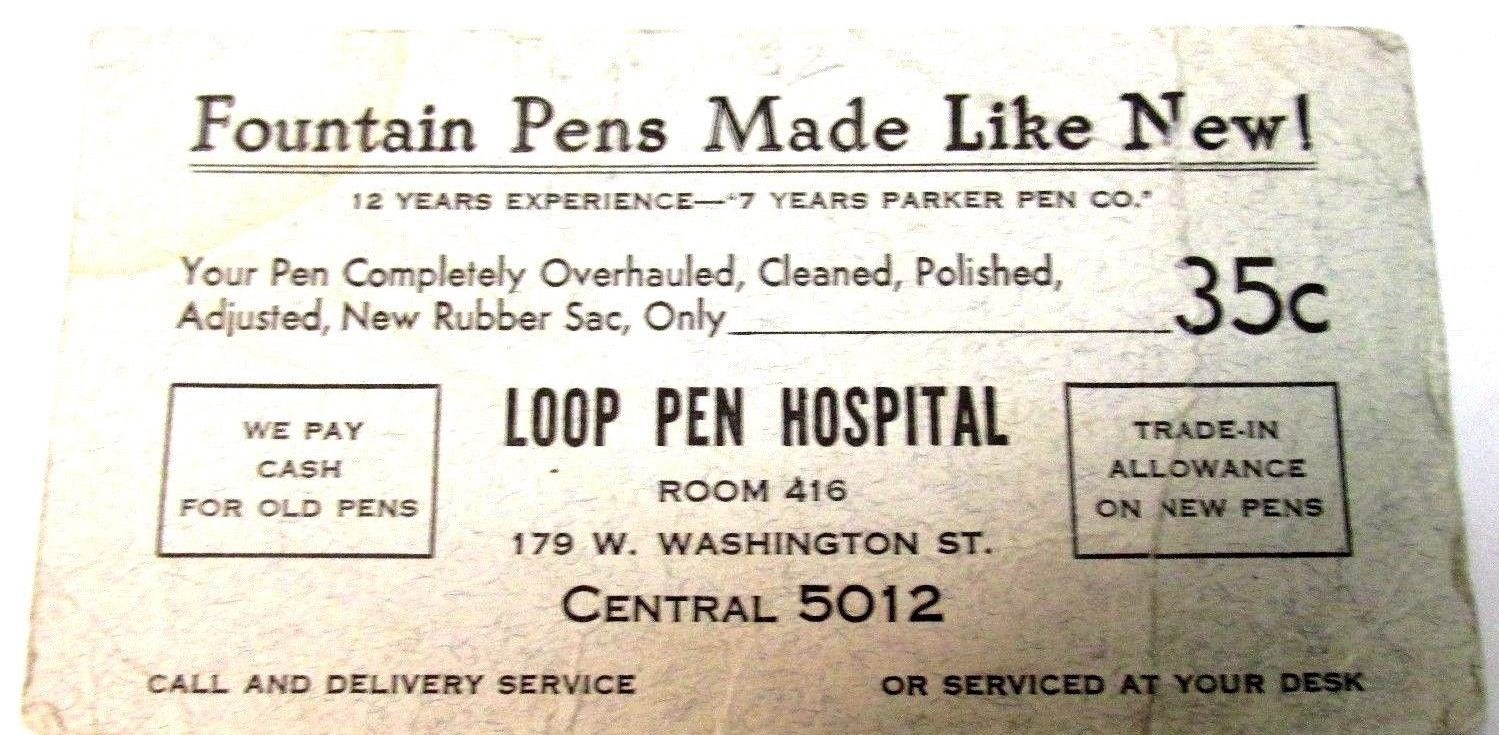
The Loop Pen Hospital in Chicago, about 1940: a full overhaul for 35 cents, cash for old pens and a call-and-delivery service. (Len Provisor collection)
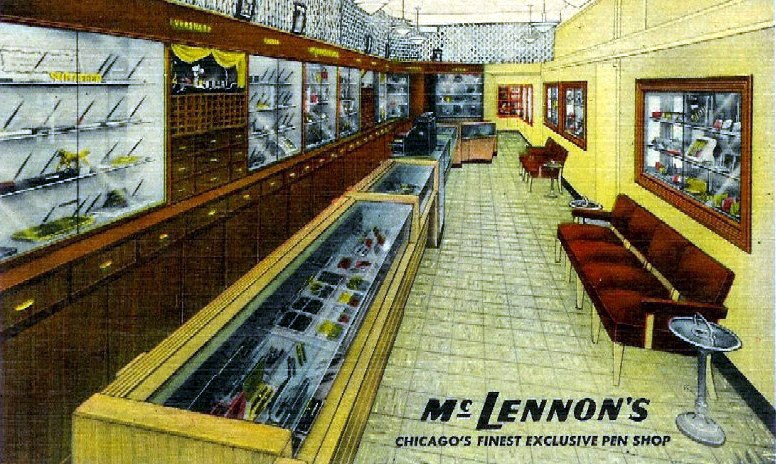
McLennan’s in Chicago, on a postcard of the 1940s or 1950s: a long room of glass cases, and chairs at the counter so you could sit and try a pen. (Len Provisor collection)
The grandest of them all may have been in Los Angeles. Henry Fenenbock, an orphan from New York’s Lower East Side, opened Swanee’s Pen Hospital on West 8th Street in 1936, repairing pawnshop pens in the window while passers-by watched. Within a few years he was a Parker dealer, and by 1946 his orders were so large they broke the counter on Parker’s tabulating machine. Parker’s own man called it the world’s largest pen outlet. Len Provisor and Henry’s son tell the whole story in Henry “Swanee” Fenenbock: The Ultimate Pen Man, including the pen shop he opened on Main Street at Disneyland. Swanee’s closed in 1960.
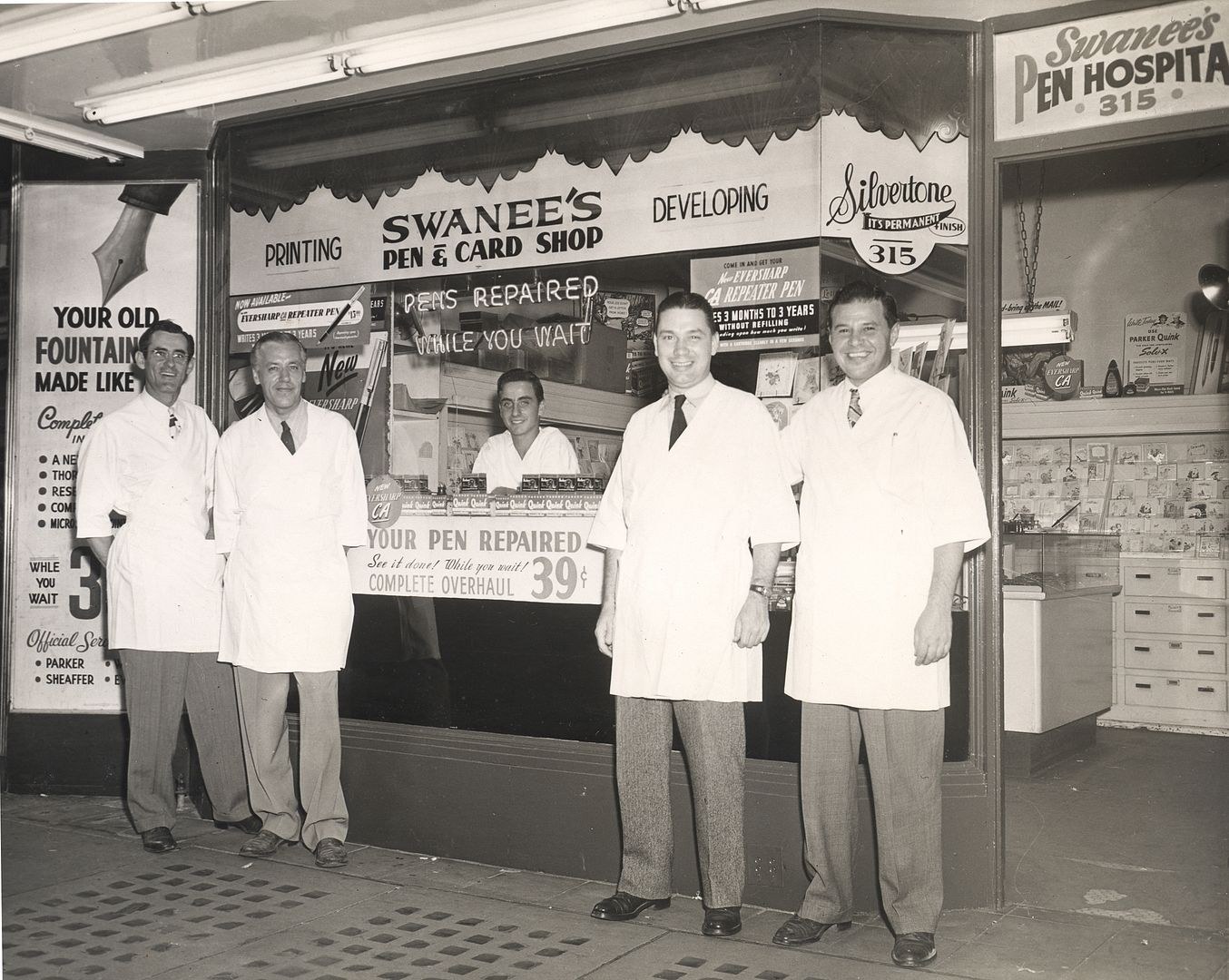
Swanee’s Pen and Card Shop at 315 West 8th Street, Los Angeles: “Your pen repaired, 39¢.” (Fenenbock family, from the Pentrace archive)
The Pen Shop on Paper
Blotters and cards from Len Provisor’s collection, from the 1910s to this century. The pen shops come first, then the jewellers, chemists and stationers who sold pens and mended them.
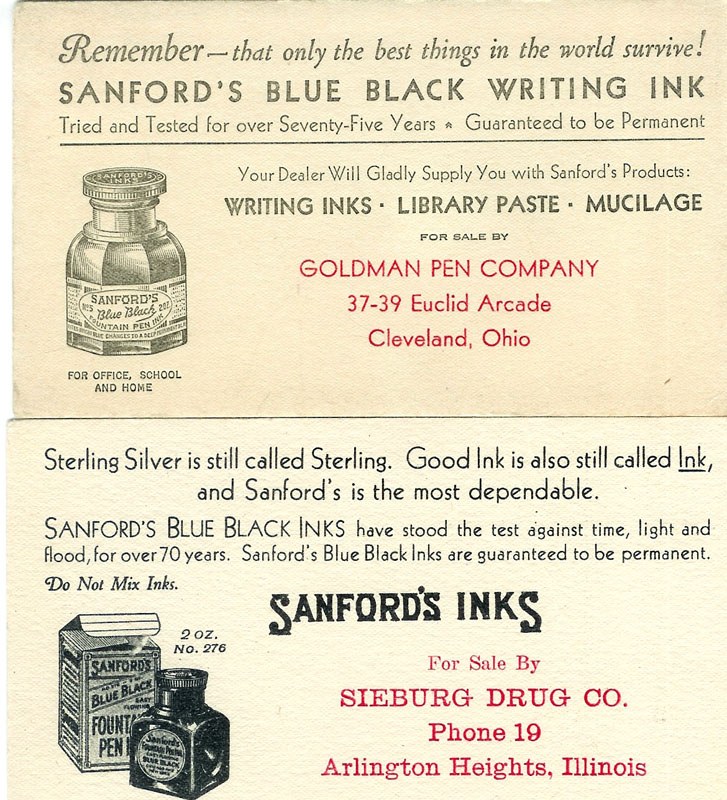
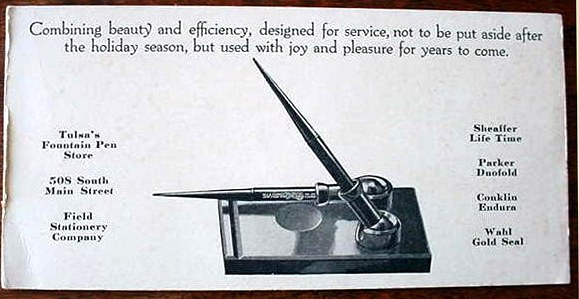
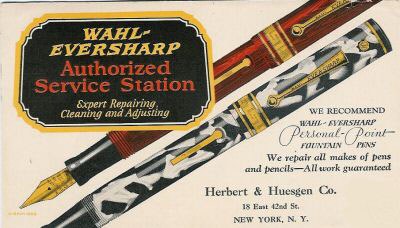
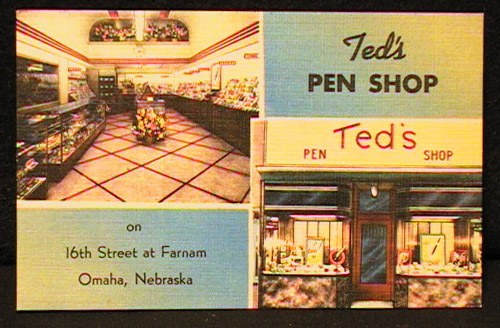
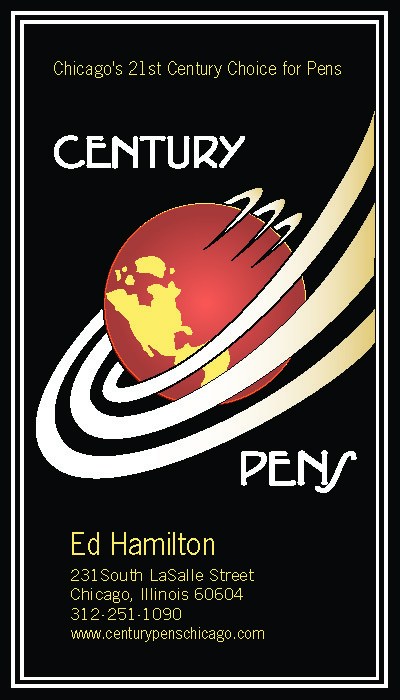

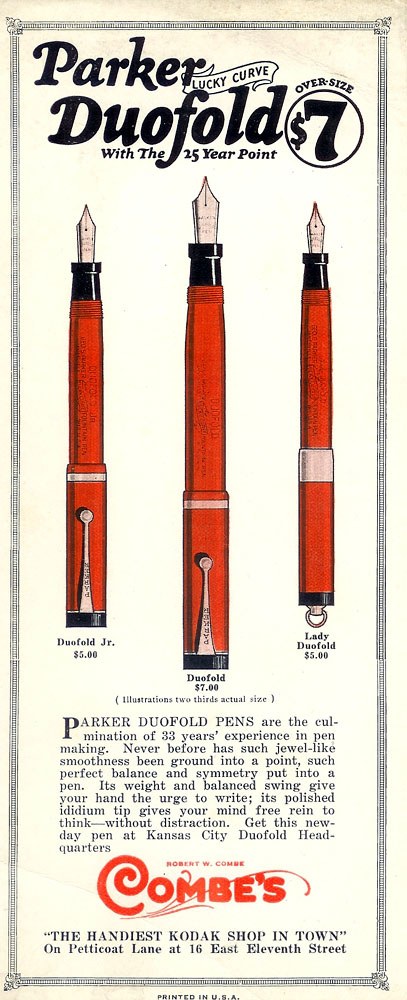
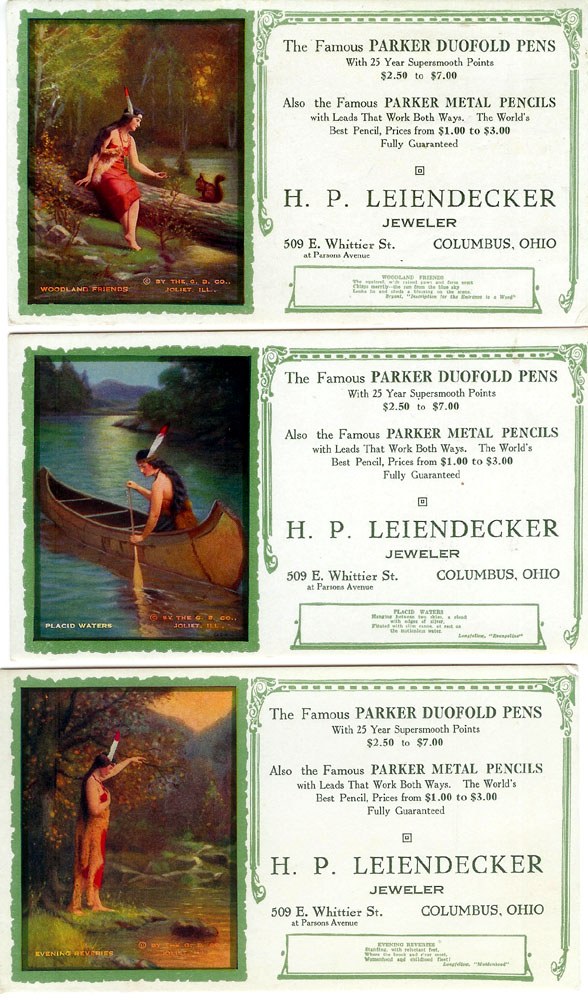
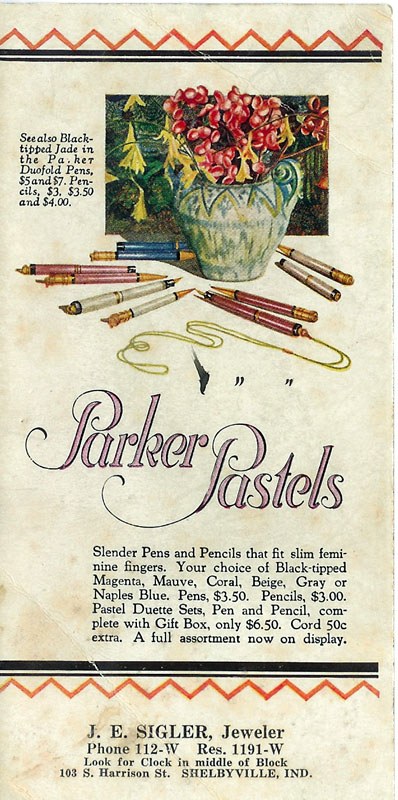
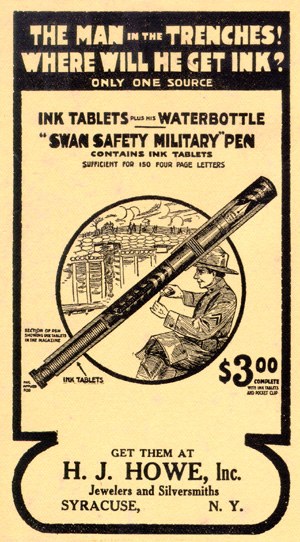
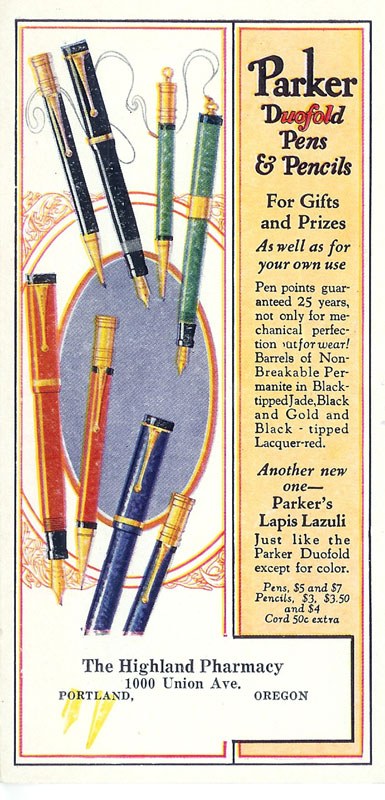
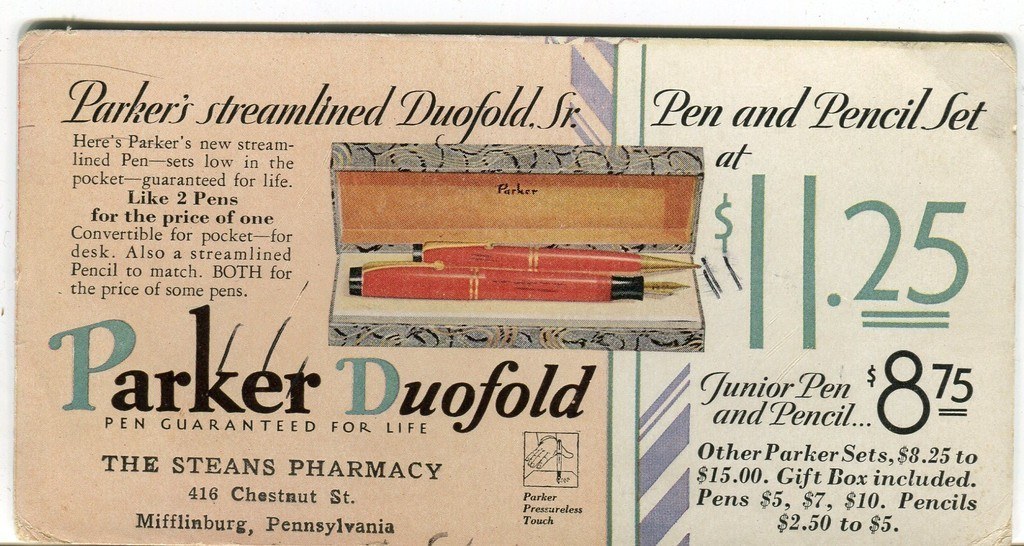
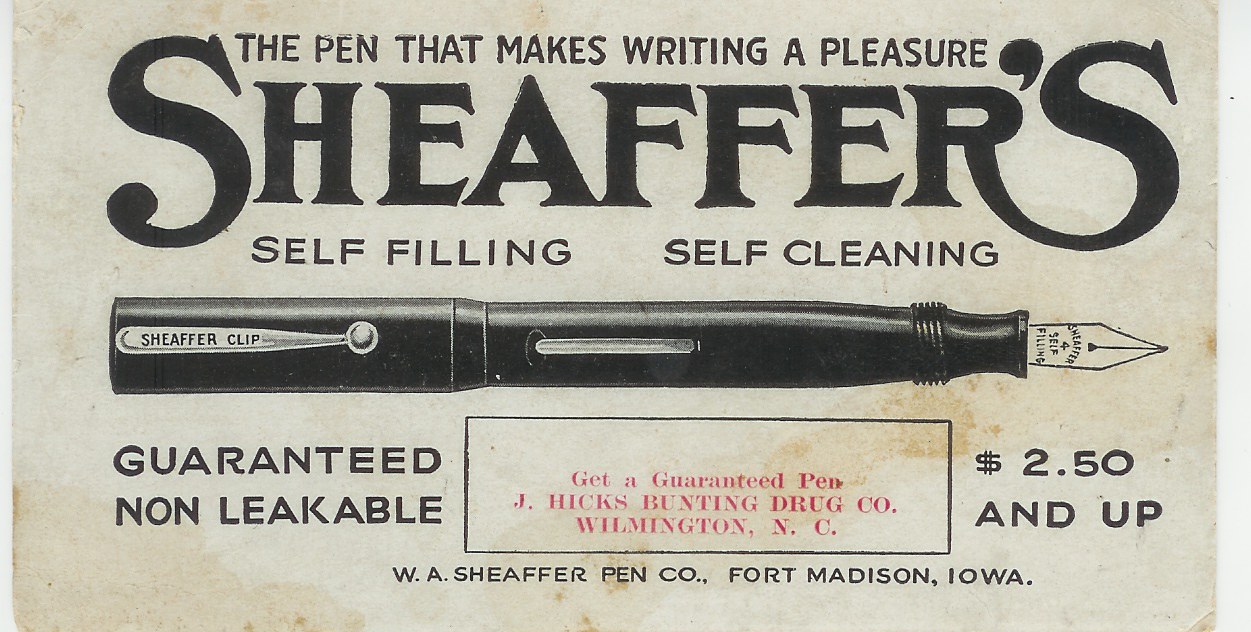
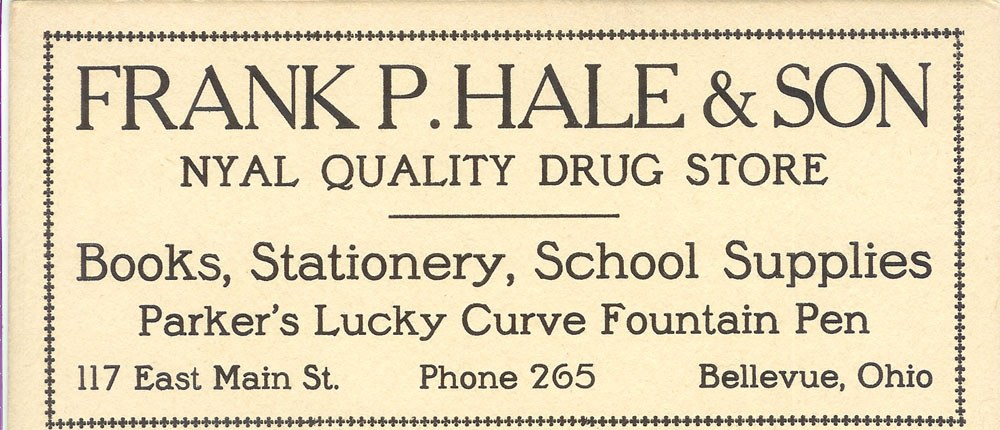
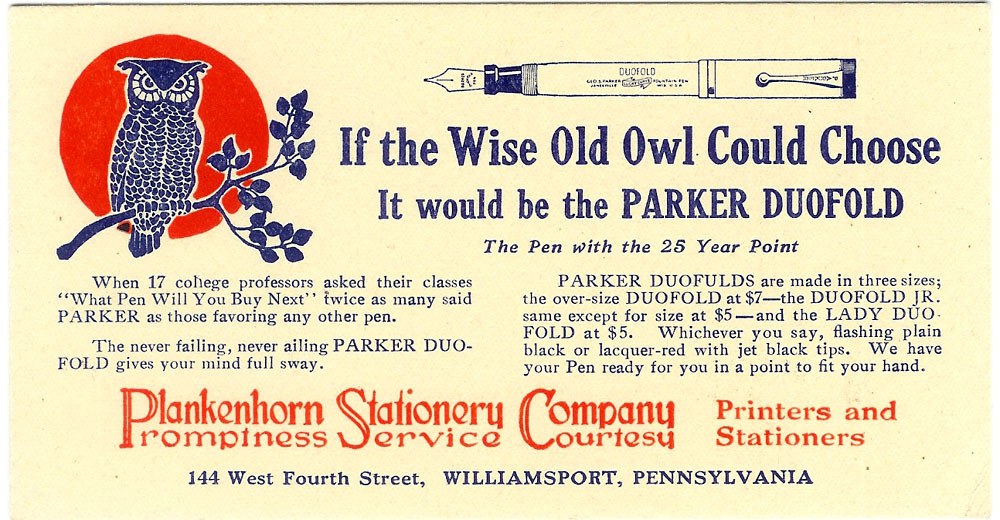
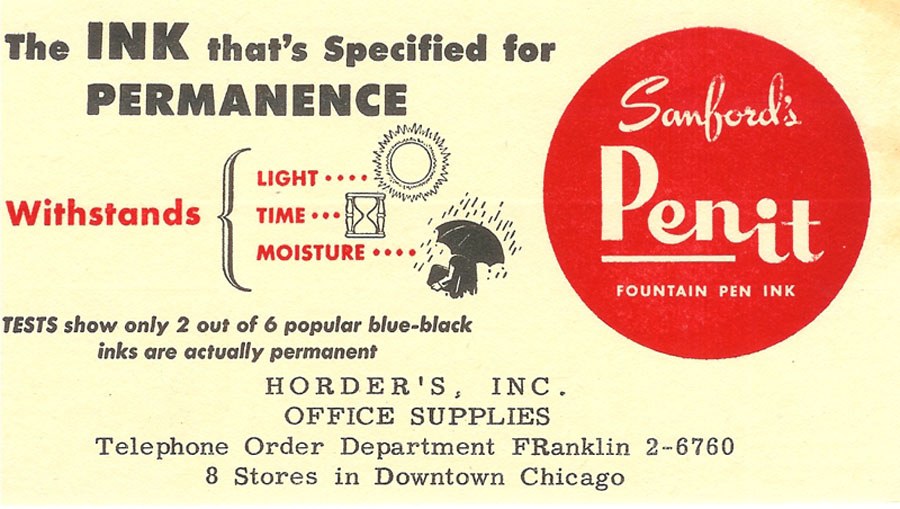
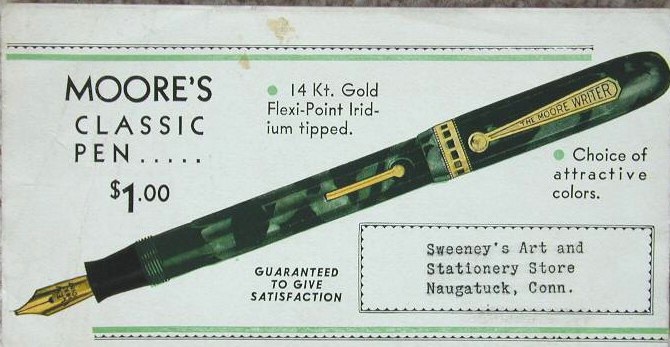
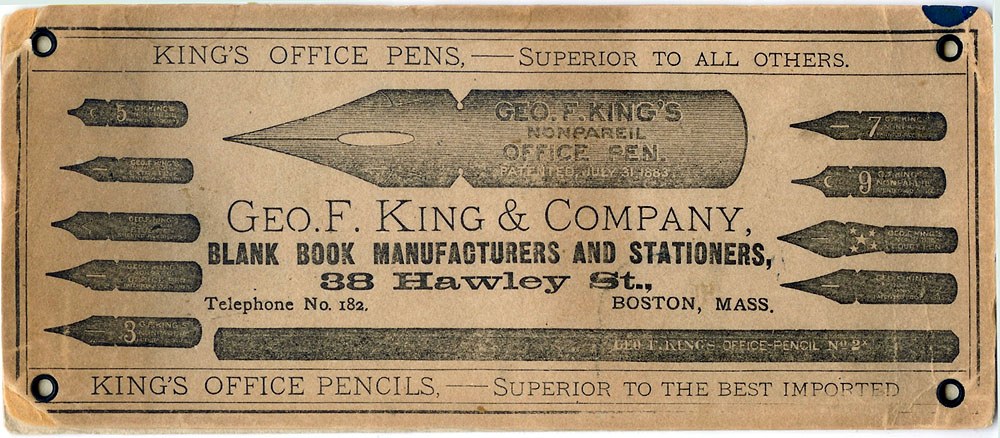
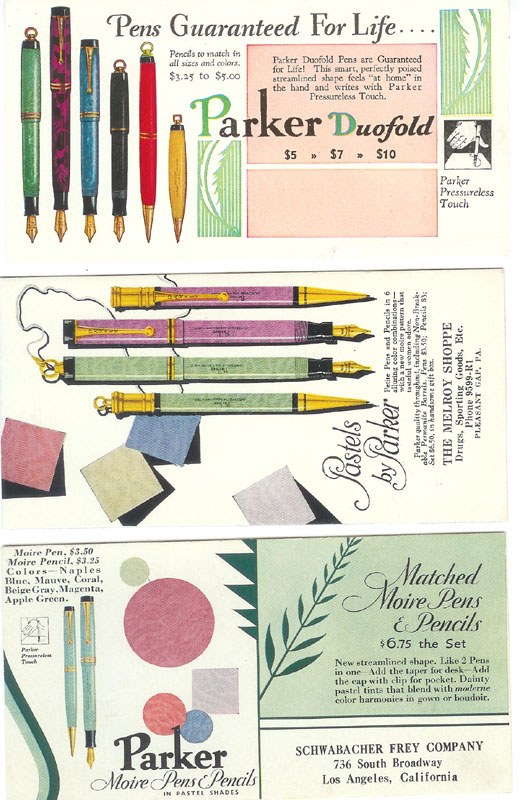
The ballpoint took most of those shops in the 1950s and 1960s. The ones that lasted into this century did so because they had become something more than a place to buy a pen: the shop where a collector’s parts came from, where the repairs were done properly, where the staff knew the difference between a Vacumatic and a 51. They were the shops we lost next.
Around the world
| Shop | Where | Opened | What happened |
|---|---|---|---|
| The Pen Corner | Dublin | 1927 | Closed May 2022 |
| Tafts – The Pen People | Melbourne | 1906 | Closed August 2019 |
| F.G. Thomas | Sheffield | 1920s | Shop closed October 2019; online only |
| The Fountain Pen Shop | Los Angeles, later Monrovia | 1922 | Closed after Fred Krinke’s death, late 2019 |
| Daly’s Pen Shop | Milwaukee | 1924 | Left downtown 2013; later online only |
| Paradise Pen Co. | U.S. chain | 1988 | Last stores closed around 2018 |
| The Pen Shop | U.K. chain | 1946 | Cut from about 20 stores to five; mainly online |
| Penfriend | London | 1950 | Shops closed; online and by appointment |
Tafts – The Pen People, Melbourne. Tafts opened in 1906 and in 1912 became the first tenant of the Centreway Arcade on Collins Street, where it stayed until August 2019. Rising rents were blamed. One Melbourne writer remembered Tafts keeping his discontinued Parker 45 going for years after the parts had all but disappeared.
F.G. Thomas, Sheffield. For more than 90 years it sold pens on Surrey Street, and it survived bomb damage in the Blitz. In October 2019, with the lease up for renewal, the owner, Gary Ellison, closed the shop and moved the business online. He said demand for fountain pens, especially as gifts, was as healthy as ever.
The Fountain Pen Shop, Los Angeles. Founded in 1922, it was thought to be the oldest pen shop in America run by one family. It moved from downtown Los Angeles to Monrovia after the Northridge earthquake of 1994. Collectors knew it for vintage repairs done with original parts from an enormous stock, and for its owner, Fred Krinke, who also founded the Southern California Pen Collectors Club. When Fred died in November 2019, at 91, the family sold the stock and closed the shop.
Daly’s Pen Shop, Milwaukee. Daly’s, founded in 1924, called itself America’s oldest pen shop. It left its downtown home in 2013 and later closed its store altogether. The owner, Brad Bodart, said his online sales were about 40 times what the counter took, and called the shop the business’s “dead weight.”
Paradise Pen and The Pen Shop. The chains went the same way on a larger scale. Paradise Pen, based in Denver, once called itself the largest Montblanc retailer in the United States; after years of closures, its last dozen or so stores shut at once. The Pen Shop opened in Newcastle in 1946 as Britain’s first shop selling only pens, and grew to call itself Europe’s largest pen retailer, with branches in stations and shopping centres. After administration and a buy-out it went from about 20 stores to five, and today it is best known for its website.
Penfriend, London. Penfriend was started in 1950 by Ivan Mason, a former Parker mechanic, as a repair shop, and later had counters in the Burlington Arcade and on Fleet Street. Both have closed, and it now sells online and lets customers try pens by appointment. Its owner has said that once the shop closed, Montblanc and Lamy stopped supplying her. Without a counter, some makers won’t deal with you at all.
What closed them
It’s tempting to blame the internet, and it played its part: a website reaches the world for the price of one quiet street, and Daly’s, F.G. Thomas, Penfriend and the Pen Corner all kept selling online after the shutters came down. But read the closure notices closely and the same three causes come up again and again, and a shortage of customers isn’t one of them. Even at the Pen Corner, where Covid cost the shop trade it never won back and fewer people write by hand, it was the rent that made the numbers impossible. The first is the rent. Tafts fell to Collins Street rents, F.G. Thomas closed when its lease came up, and the Pen Corner was paying €75,000 a year. The second is succession: a great pen shop often lives in one person’s hands and head, and when Fred Krinke died, decades of repair knowledge went with him. The third is overreach. The chains spread into malls and airports, then contracted hard when the footfall couldn’t carry the rent. Most of these shops didn’t run out of customers. They ran out of reasons to keep a counter.
One that stayed: Fountain Pen Hospital
Some survived, and how they did it is telling. The best known is the one Pentrace readers know best. Fountain Pen Hospital, on Warren Street in Lower Manhattan, was one of Pentrace’s sponsors through the site’s first decade, and it runs all through the archive. In December 2004 Ed Fingerman offered 30 per cent off for Pentrace readers. Len Provisor was there in October 2003 when the first OMAS Boutique in the United States opened in the shop, which by then was the largest OMAS dealer in the world, and he wrote up the Stipula limited edition made for it. Maryann and Steve Zucker braved the first snowstorm of the winter for the shop’s annual Pen Fair in 2002, hosted by Terry and Steve Wiederlight. Show reports from Chicago to Washington mention its tables, and Burt Janz’s primer on buying a pen holds it up as the model of a “real” pen shop.
Its owners have said that New York once had 14 shops like theirs. Today it is one of the few left. One of the others was Arthur Brown & Bro., which closed around 2013 after nearly 90 years because the rent had become impossible, and in a quietly moving detail, Marilyn Brown of Arthur Brown ended up working behind the counter at Fountain Pen Hospital. In 2023, after more than six decades, the Wiederlight brothers sold the business. The new owners kept the name and the shop on Warren Street.
Washington’s Fahrney’s Pens, founded in 1929, came through the same way. In December 2024 it was bought by the parent company of Retro 51, and in 2025 it moved back into the Willard Hotel, its home from the 1950s to the 1970s. The lesson isn’t that the old shops were doomed. It’s that the ones that survived found someone new to carry them.
What we lose with the counter
You can buy almost any pen online now, often for less, and the hobby is arguably healthier than it has ever been. Several of the shopkeepers who closed said so themselves. What you can’t buy online is the moment of uncapping a pen you’ve never held, writing your name on a scrap pad, and having someone across the counter say, “Try the fine instead.” Pen shows give us some of that back for a weekend at a time; see the Pen Show Calendar for the next one near you. But a show isn’t a shop on the way home from work.
That is what closed in Dublin, Melbourne, Sheffield and Los Angeles: not the hobby, but the shared room where it happened. If you still have a pen shop near you, visit it often, as the blotter says.
Over to you. Which shop did you lose? Tell us on the Message Board: where it was, what you bought there and who served you. I’d especially like to hear from anyone who remembers the Pen Shop on Nassau Street, and when it closed.
Sources
- Rose Doyle, “Cornering the quality pen business,” Irish Times, Oct. 1, 2003.
- Deirdre McQuillan, “Much-loved Dublin city shop Pen Corner to close its doors,” Irish Times, April 14, 2022.
- “‘I once served Kurt Cobain – but had no idea who he was’,” Irish Independent, April 27, 2022.
- “Ireland’s oldest pen shop to close its doors in May,” Lovin Dublin, 2022.
- “The Pen Corner has written its final chapter,” The Liberty, March 9, 2023.
- “Santa’s list includes furs and diamonds for the girls and football trips for the boys,” Irish Times, Dec. 18, 1998.
- 3AW and Only Melbourne on the closing of Tafts.
- “Popular Sheffield shop closing after nearly 100 years,” Sheffield Star, 2019.
- “The Fountain Pen Shop,” Wikipedia.
- “Storied pen shop closing doors as owner switches focus to online sales,” Tribune News Service, on Daly’s.
- “Looks like Paradise Pen is done,” Fountain Pen Network.
- “Five Pen Shop stores to close after Morpeth firm is bought out of administration,” Chronicle Live.
- Jenks & Co. interview with Penfriend, and Time Out London.
- “Fountain Pen Hospital and the End of an Era,” Pen World, and CBS New York.
- Fahrney’s Pens, “Writeside Holdings acquires iconic Fahrney’s Pens” and “Our story.”