Starting a Vintage Pen Collection: A User
Or, How the Scrivener Acquired Some Tools of the Trade and Saved a Gaggle of Geese Their Feathers
|
Introitus: In Which the Scrivener Explains What Is Afoot I’ve had no success with modern fountain pens. My gift Sheaffer Targa lays down too much ink to properly form letters. My Waterman Hemisphere, purchased at a swank mall pen shop, skipped right out of the box, and a one-month vacation at the Waterman repair facility in Wisconsin did not solve the problem. Both pens languish in a jar on my desk. Yet there is one fountain pen in the house that functions properly and is a pleasure to Using Nancy’s well-tuned vintage Parker with its smooth, responsive nib was a transforming experience. So about four months ago (April 2003), I set myself the pleasurable task of acquiring a few vintage fountain pens. These would not be collector-grade, never-to-be-inked pens but a representative group of clean, restored vintage pens for use in regular rotation. Chapter the First: In Which the Scrivener, Recognizing His Tendency to Go Overboard in New Endeavors, Sets Down Some Much Needed Ground Rules I applied some lessons learned in prior collecting and accumulating adventures to this new interest in vintage pens and set down the following ground rules:
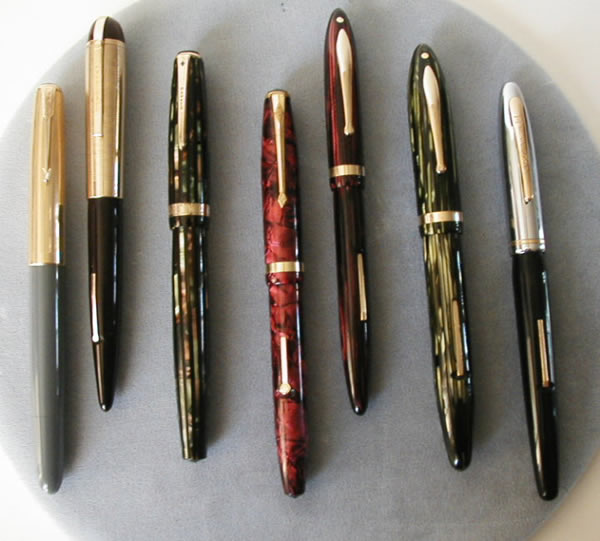
The first step was research, an easy and enjoyable process using any Internet search engine. Vintage pen dealers, collectors, and users are extremely generous with information. In a dozen websites I found what I wanted to know about pen manufacturers, product lines, nibs, filling systems, repair and refurbishment, ink, and paper. Most of those sites have numerous links to other sites. The best fountain pen link site is maintained by Jim Mamoulides, at PenHero.com, where you will find enough links to keep you busy for weeks. Other indispensable sites to bookmark include Richard Binder’s richardspens.com; David Nishimura’s vintagepens.com; writetime.co.uk and Jonathan’s Vintage Pens for Conway Stewart; marcuslink.com/pens/ for information about ink; and the Pen Bulletin Boards, including pentrace.com, zoss.com/pens.htm, and penlovers.com. Before long, I began to focus on specific brands and then on specific product lines. I printed out company histories, information about specific pens that looked promising, and advice articles about the best user pens to buy based on nib quality, hardiness, ease of repair, aesthetics, and, to some extent, where the pens fit into a historical context. I studied my stacks of printouts, took notes, and looked at more websites. Before I purchased a single pen, I studied completed eBay auctions to get a sense of values and the level of competition for specific models. Finally, my well researched want list of vintage pens included a Parker “51” Vacumatic, a Parker Striped Duofold, a couple of Sheaffer Balances, an Eversharp Skyline, and at least one Conway Stewart. Having recently sold some expensive books on eBay, I set my budget at $500. For that, I calculated, I could get at least six high quality user pens. If my interest was kindled these pens would form the core of a modest collection. If not, I would still have a serviceable group of vintage user pens. Chapter the Second: In Which the Scrivener Discovers that an Occasional Inky Finger Is Far More Entertaining than Having No Pens at All Here, in order, are the first seven vintage fountain pens I purchased. They are all lever or vacumatic fillers. All of them were fully reconditioned when purchased, are in very good to excellent condition, and are now part of my regular rotation.
All of these pens met my criteria for nib quality, ease of repair (if necessary), and aesthetics, and, as a group, they represent some of the best pens made from the late 1930s to the late 1950s. Each pen, of course, has a distinct personality, but all are great writers. Most have firm fine nibs with good ink flow and respond easily to my fairly light touch. The Sheaffer Balances and Parker Duofold have the smoothest nibs. The semiflexible Eversharp nibs have more tooth against the paper and lay down a wetter line of ink. The Parker “51” nib has a heavier feel on the paper but never skips and is always ready to write. The Conway Stewart nib is smooth with just enough tooth to make it interesting. I like them all and use them all, but favorites always emerge. The OS Balance, despite its, massive size, is light weight and genuinely well balanced with the weight of the pen near the nib. The Parker Blue Diamond Striped Duofold is surprisingly heavy and extremely well made. (Parker obviously had high production values for their top line pens.) The nib responds with very light pressure on the paper. Conway gets a nod for sheer beauty. Chapter the Third: In Which the Scrivener Orders Another Pint, Fills His Pipe Anew, and Muses upon Where He Has Been and What Might Lie Ahead In four months I acquired seven fully restored vintage pens for
$475.00. Only three cost I allowed myself one $9.99 deviation from the Will more vintage pens find their way to inky usefulness in my hand? Most certainly. I learned much in four months and assembled a good core collection of vintage user pens. My ground rules still But that is a tale in the making, a longer tale indeed. For now, the pens are inked and paper is at hand. “Innkeeper, a fresh candle, please.” |